

Purging with inert gas is not necessary for this product. The recommended storage 2-30°C. The lot-specific Certificate of Analysis provides shelf life information, as product quality integrity is reflected by those dates.
8.03282

1,8-Diazabicyclo[5.4.0]undec-7-ene
for synthesis
Sustainability features
Synonym(s):
1,8-Diazabicyclo[5.4.0]undec-7-ene
Sign In to View Organizational & Contract Pricing.
Select a Size
Change View
| Size/SKU | Availability | Price |
|---|---|---|
25 mL | Check Cart for Availability | $41.90 |
100 mL | Check Cart for Availability | $119.00 |
2.5 L | Check Cart for Availability | $343.00 |
About This Item
Empirical Formula (Hill Notation):
C9H16N2
Molecular Weight:
152.24
UNSPSC Code:
12352005
EC Index Number:
229-713-7
NACRES:
NA.22
MDL number:
Form:
liquid
Grade:
synthesis grade
grade
synthesis grade
Quality Segment
vapor pressure
0.02 hPa ( 25 °C)
form
liquid
autoignition temp.
260 °C
potency
215-681 mg/kg LD50, oral (Rat)
expl. lim.
1.1-6.5 % (v/v)
sustainability
Sustainability features
pH
12.8 (20 °C, 10 g/L in H2O)
kinematic viscosity
5.48 cSt(40 °C)
mp
<-70 °C
transition temp
flash point 116 °C
solubility
soluble 1000 g/L
density
1.02 g/cm3 at 20 °C
storage temp.
2-30°C
InChI
1S/C9H16N2/c1-2-5-9-10-6-4-8-11(9)7-3-1/h1-8H2
InChI key
GQHTUMJGOHRCHB-UHFFFAOYSA-N
General description
We are committed to bringing you Greener Alternative Products, which adhere to one or more of The 12 Principles of Greener Chemistry. This product has been enhanced for catalytic efficiency. Click here for more information.
Application
- Depolymerization of poly (bisphenol A carbonate) under mild conditions by solvent-free alcoholysis catalyzed by 1, 8-diazabicyclo undec-7-ene as a recyclable: DBU catalyzes the depolymerization of polycarbonates under mild, solvent-free conditions, demonstrating its effectiveness and recyclability as a catalyst (E Quaranta, D Sgherza, G Tartaro, 2017).
- Activating cellulose via its reversible reaction with CO2 in the presence of 1, 8-diazabicyclo undec-7-ene for the efficient synthesis of cellulose acetate: This research shows how DBU can activate cellulose for a reversible reaction with CO2, facilitating the synthesis of cellulose acetate (Y Yang, L Song, C Peng, E Liu, H Xie, 2015).
- Bifunctional 1, 8-Diazabicyclo undec-7-ene for Visible Light-Induced Heck-Type Perfluoroalkylation of Alkenes: DBU acts as a bifunctional organocatalyst for visible light-induced Heck-type perfluoroalkylation of alkenes, showcasing its potential in photoredox catalysis (L Tang, G Lv, Y Fu, XP Chang, R Cheng, 2022).
- Cooperative calcium-based catalysis with 1, 8-diazabicyclo undec-7-ene for the cycloaddition of epoxides with CO2 at atmospheric pressure: This study demonstrates the cooperative catalysis of CaBr2 and DBU in the cycloaddition of epoxides with CO2, highlighting a sustainable approach to carbonate synthesis (X Liu, S Zhang, QW Song, XF Liu, R Ma, LN He, 2016).
Still not finding the right product?
Explore all of our products under 1,8-Diazabicyclo[5.4.0]undec-7-ene
Signal Word
Danger
WGK
WGK 2
Flash Point (°F)
240.8 °F
Flash Point (°C)
116 °C
Hazard Codes
Precautionary Statements
Hazard Classifications
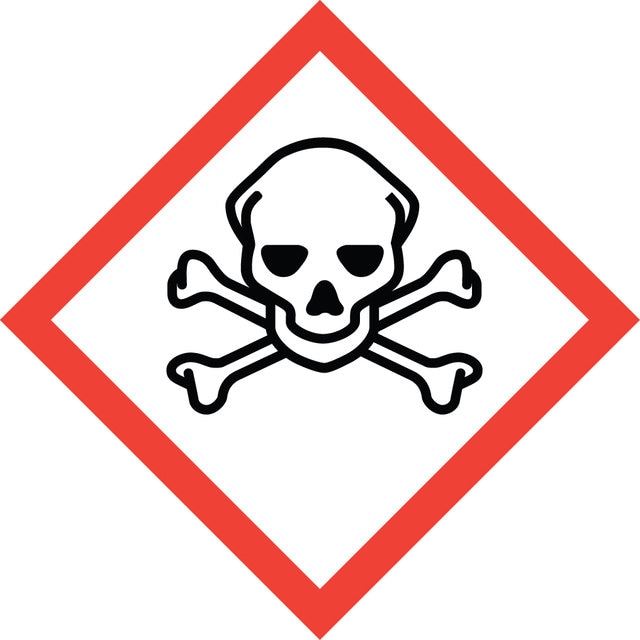
Acute Tox. 3 Oral - Eye Dam. 1 - Skin Corr. 1B
Storage Class
6.1A - Combustible acute toxic Cat. 1 and 2 / very toxic hazardous materials
Choose from one of the most recent versions:
Already Own This Product?
Find documentation for the products that you have recently purchased in the Document Library.
-
After opening, is it necessary to preserve it with argon or other noble gases, or can it be stored directly in a 4°C refrigerator? How long will its performance remain unchanged after opening?
1 answer-
Helpful?
-