Skip to Content
Merck

Skip To

D0540

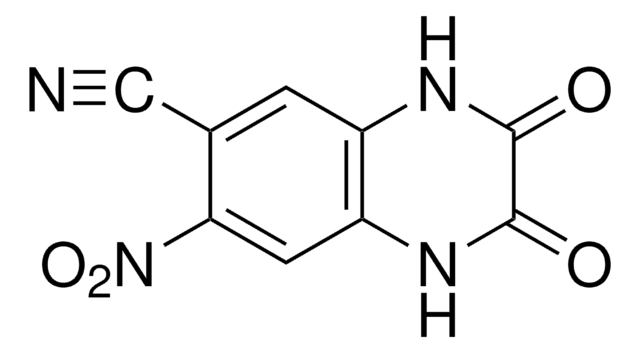
DNQX

≥98% (TLC), kainate, quisqualate (non-NMDA) glutamate receptor antagonist, powder

Synonym(s):

6,7-Dinitroquinoxaline-2,3(1H,4H)-dione

Sign In to View Organizational & Contract Pricing.

Select a Size

Change View
Pack SizeSKUAvailabilityPrice
25 mg
Please contact Customer Service for Availability
₪531.00
50 mg
Please contact Customer Service for Availability
₪1,073.00

About This Item

Empirical Formula (Hill Notation):
C8H4N4O6
CAS Number:
Molecular Weight:
252.14
UNSPSC Code:
51111800
PubChem Substance ID:
NACRES:
NA.77
MDL number:
Assay:
≥98% (TLC)
Form:
powder
Quality level:

₪531.00


Please contact Customer Service for Availability

Request a Bulk Order
Technical Service
Need help? Our team of experienced scientists is here for you.
Let Us Assist


Product Name

DNQX, ≥98% (TLC)

Quality Level

assay

≥98% (TLC)

form

powder

SMILES string

[O-][N+](=O)c1cc2NC(=O)C(=O)Nc2cc1[N+]([O-])=O

InChI

1S/C8H4N4O6/c13-7-8(14)10-4-2-6(12(17)18)5(11(15)16)1-3(4)9-7/h1-2H,(H,9,13)(H,10,14)

InChI key

RWVIMCIPOAXUDG-UHFFFAOYSA-N

Application

DNQX has been used to block N-Methyl-D-aspartic acid (NMDA) and α-amino-3-hydroxy-5-methyl-4-isoxazolepropionic acid (AMPA) receptors in various experiments.

Biochem/physiol Actions

A competitive kainate, quisqualate (non-NMDA) glutamate receptor antagonist.
DNQX is a quinoxaline derivative.

Features and Benefits

This compound is a featured product for Neuroscience research. Click here to discover more featured Neuroscience products. Learn more about bioactive small molecules for other areas of research at sigma.com/discover-bsm.
This compound is featured on the Glutamate Receptors (Ion Channel Family) page of the Handbook of Receptor Classification and Signal Transduction. To browse other handbook pages, click here.

Compare Similar Items

View Full Comparison

Show Differences

1 of 1

This Item
C127C239B3188
assay

≥98% (TLC)

assay

≥98% (HPLC)

assay

≥98% (HPLC)

assay

≥98% (HPLC)

form

powder

form

solid

form

solid

form

powder

Quality Level

200

Quality Level

100

Quality Level

100

Quality Level

100

Gene Information

human ... GRIA1(2890), GRIA2(2891), GRIK1(2897), GRIK2(2898), GRIK3(2899), GRIK4(2900), GRIK5(2901)
mouse ... Gria1(14799)
rat ... Gria1(50592), Grik1(29559), Grik4(24406), Grin2a(24409)

Gene Information

rat ... Gria1(50592), Grik1(29559), Grik2(54257), Grik4(24406), Grin2a(24409)

Gene Information

human ... ADORA1(134), ADORA2A(135), ADORA2B(136), ADORA3(140), GRIA1(2890), GRIA2(2891), GRIA3(2892), GRIA4(2893)

Gene Information

human ... PARP1(142)
mouse ... PARP1(11545)
rat ... PARP1(25591)


Choose from one of the most recent versions:

Certificates of Analysis (COA)

Lot/Batch Number

Don't see the Right Version?

If you require a particular version, you can look up a specific certificate by the Lot or Batch number.

Already Own This Product?

Find documentation for the products that you have recently purchased in the Document Library.

Visit the Document Library


Articles

DISCOVER Bioactive Small Molecules for Neuroscience


The mouse pulvinar nucleus links the lateral extrastriate cortex, striatum, and amygdala
Zhou N, et al.
The Journal of Neuroscience, 38(2), 347-362 (2018)
Differential Desensitization Observed at Multiple Effectors of Somatic mu-Opioid Receptors Underlies Sustained Agonist-Mediated Inhibition of Proopiomelanocortin Neuron Activity
Fox PD and Hentges ST
The Journal of Neuroscience, 37(36), 8667-8677 (2017)
Rei Yamada et al.
The Journal of neuroscience : the official journal of the Society for Neuroscience, 33(9), 3927-3938 (2013-03-01)
Neurons in the nucleus laminaris (NL) of birds detect the coincidence of binaural excitatory inputs from the nucleus magnocellularis (NM) on both sides and process the interaural time differences (ITDs) for sound localization. Sustained inhibition from the superior olivary nucleus


Global Trade Item Number

SKUGTIN
D0540-25MG04061832090146
D0540-50MG04061833557839

Questions

Reviews

No rating value

Active Filters