


These tips have not been tested for autoclave suitability. The items may be sanitized using Ethanol. After sanitizing, flush each tip with distilled or sterile water repeatedly, for at least 1 minute, to remove any residual Ethanol trapped in the pores of the silica.
D1947

Diffinity RapidTip®
for PCR Purification
Synonym(s):
PCR clean up tip, PCR purification tip, PCR reaction clean-up tip
Sign In to View Organizational & Contract Pricing.
Select a Size
Change View
| Size/SKU | Availability | Price |
|---|---|---|
96 reactions | Check Cart for Availability | $261.00 |
About This Item
UNSPSC Code:
41106300
EC Number:
293-303-4
NACRES:
NA.52
Manufacturer/tradename:
(Diffinity Genomics, Inc.)
Quality Segment
form
solid
manufacturer/tradename
(Diffinity Genomics, Inc.)
capacity
50(µL)
storage temp.
room temp
General description
Diffinity RapidTip effectively removes dNTPs, primers and primer dimers while providing greater than 90% recovery of pure DNA fragments from 100 bp to 10 kb. The functional pipette tip contains everything you need for PCR purification. The tip is filled with a proprietary adsorption technology that has a differential affinity for PCR components. The dispensed solution yields purified, high quality DNA ready for downstream applications such as DNA sequencing, SNP analysis and microarray printing.
Features and Benefits
- Single step
- Recovers 90% of high quality dsDNA
- Optimized for 25 μL RXN
Legal Information
RapidTip is a registered trademark of Diffinity Genomics, Inc.
1 of 1
This Item | |||
|---|---|---|---|
| description for PCR Purification | description C18 resin, bed volume 0.6 μL, tip volume 10 μL | description strong cation exchange (SCX) resin, bed volume 0.6 μL, tip volume 10 μL | description C18 resin, micro, bed volume 0.2 μL, tip volume 10 μL |
| manufacturer/tradename (Diffinity Genomics, Inc.) | manufacturer/tradename ZipTip® | manufacturer/tradename ZipTip® | manufacturer/tradename ZipTip® |
| Quality Level 100 | Quality Level 400 | Quality Level 400 | Quality Level 400 |
| form solid | form - | form - | form - |
| capacity 50(µL) | capacity 5 μg binding capacity(typically; when used with saturating amounts of analyte) | capacity 5 μg binding capacity(typically; when used with saturating amounts of analyte) | capacity 2.0 μg binding capacity(typically; when used with saturating amounts of analyte) |
| storage temp. room temp | storage temp. - | storage temp. - | storage temp. - |
Storage Class
11 - Combustible Solids
WGK
WGK 3
Flash Point (°F)
Not applicable
Flash Point (°C)
Not applicable
Precautionary Statements
Target Organs
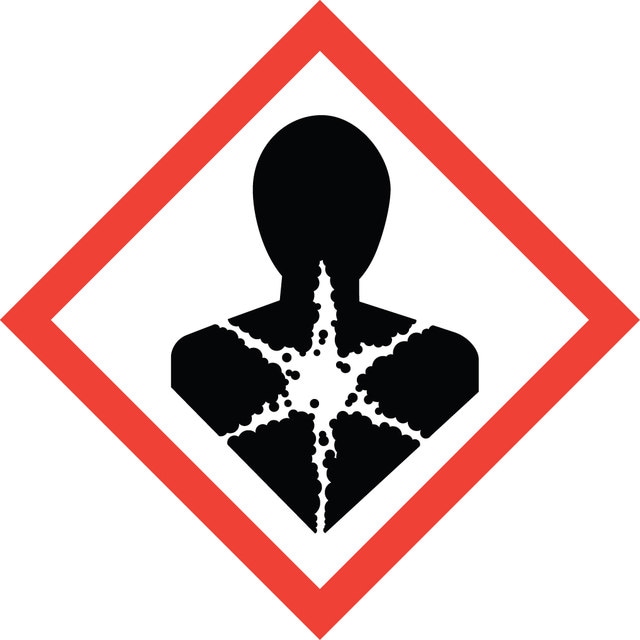
Lungs
Signal Word
Danger
Hazard Codes
Hazard Classifications
STOT RE 1 Inhalation
Choose from one of the most recent versions:
Already Own This Product?
Find documentation for the products that you have recently purchased in the Document Library.