

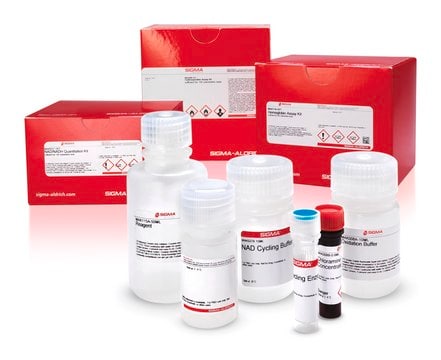

Yes, this product is supplied as a mixture of Reagent A (N (1 naphthyl)ethylenediamine dihydrochloride) and Reagent B (sulfanilamide) with phosphoric acid. To prepare a 1X Griess Reagent, simply add 250 mL water to the bottle. Please refer to the link below to review additional information available in the product datasheet:
https://www.sigmaaldrich.com/deepweb/assets/sigmaaldrich/product/documents/355/046/g4410bul.pdf
G4410

Griess reagent (modified)
Synonym(s):
Greiss, nitrite assay
Sign In to View Organizational & Contract Pricing.
Select a Size
Change View
| Size/SKU | Availability | Price |
|---|---|---|
10 g | Estimated to ship onOctober 19, 2026fromMILWAUKEE | $154.00 |
About This Item
UNSPSC Code:
12352200
EC Number:
215-981-2
NACRES:
NA.32
$154.00
Estimated to ship onOctober 19, 2026Details
General description
Griess reagent is based on Griess reaction. The components include naphthylethylenediamine dihydrochloride suspended in water and sulphanilamide in phosphoric acid. This reagent reacts with nitrite in samples to form a purple azo product, absorbance of which is measured at 546 nm.
Application
Griess reagent (modified) has been used:
- in the nitrite assay of primary spinal cord glial cells stimulated with supernatant of damaged sensory neuron (SDSN)
- for measuring nitrite/nitrate oxidized from nitric oxide in stimulated chondrocytes
- for measuring nitric oxide (NO) degradation in RAW264.7 macrophage cells
- to measure the concentration of nitric oxide(NO) in the conditioned media from cultured macrophages (MΦs)
- to determine the relative levels of NO released by BEAS-2B bronchial cells in the culture supernatants
1 of 1
This Item | |
|---|---|
| description - | description used for detection of nitric oxide metabolites |
| Quality Level 200 | Quality Level 100 |
| form powder | form - |
| usage 10 g | usage sufficient for 100 assays |
Signal Word
Danger
Hazard Codes
Precautionary Statements
Hazard Classifications
Eye Dam. 1 - Skin Corr. 1
Storage Class
8A - Combustible corrosive hazardous materials
WGK
WGK 2
Choose from one of the most recent versions:
Already Own This Product?
Find documentation for the products that you have recently purchased in the Document Library.
-
Does thid item contain both Griess Reagent A and Griess Reagent B reagent. If yes then how to prepare Griess Reagent solution using this product.
1 answer-
Helpful?
-
-
How to store prepared Griess Reagent that j dissolved in liquid? And how long its shelf life?
1 answer-
Following reconstitution with 250 mL of water, the prepared 1X solution may be stored at room temperature for 3 months. Please see the link below to review additional information provided in the product datasheet:
https://www.sigmaaldrich.com/deepweb/assets/sigmaaldrich/product/documents/355/046/g4410bul.pdfHelpful?
-
-
1. Can the griess reagent solution be stored for longer if I keep it in the freezer? 2. Does my sample (a supernatant of cell culture media) has to be centrifuged first before I do the assay? 3. Do I add the reagent to my standard (NaNO2) as well?
1 answer-
We have no information on storing this product in the freezer. Yes, it is best to spin your cell culture sample down before the assay. Yes, you will need to add the reagent to your standards.
Helpful?
-
-
if we dissolve Griess reagent 40 mg/ml in water then what will be its concentration (molarity).
1 answer-
This product is a multi-component reagent, thus a molarity is not available. When prepared according to instructions, the prepared solution will contain 0.288% (w/v) of sulfanilamide and 0.016% (w/v) naphthylethylene diaminedihydrochloride. In addition, the product also includes an unreported amount of phosphoric acid.
Helpful?
-
-
How many grams of reagent powder should be dissolved in 1 ml of distilled water?
1 answer-
This product is tested for solubility at 40 mg/mL in water. The product is intended to be reconstituted in the bottle by adding 250 ml of water. Please see the link below to review the product datasheet:
https://www.sigmaaldrich.com/deepweb/assets/sigmaaldrich/product/documents/355/046/g4410bul.pdfHelpful?
-
-
Since this is a solid, how much quantity of water it should be diluted with?
1 answer-
The 10 g quantity is packaged in a 250 mL bottle. To reconstitute, simply add 250 mL of distilled water.
Please see the link below to review the product datasheet:
https://www.sigmaaldrich.com/deepweb/assets/sigmaaldrich/product/documents/355/046/g4410bul.pdfHelpful?
-
-
how the limit of detection ?
1 answer-
According to T.P. Misko, et al., Analytical Biochemistry, 214, 11-16 (1993), this Griess Reagent, in fluorometric testing, detects to at least 10 nM nitrite. This information has not been validated.
Helpful?
-
-
What is advised for disposal if a solution is made up with H2O?
1 answer-
Please refer to the SDS for disposal information. Per section 13.1, Waste material must be disposed of in accordance with the national and loc No mixing with other waste. Handle uncleaned containers like the product. See www.retrologistik.com for processes regarding the return of chemicals and containers, or contact technical service if you have further questions. https://www.sigmaaldrich.com/sds/sigma/g4410.
Please contact your EHS team or or disposal service group, If there's none, we recommend a national disposal company such as Cleanharbors at https://www.cleanharbors.com/.
Helpful?
-
-
When using Product G4410, Griess' reagent (modified), what product should I use to make a nitrite standard curve?
1 answer-
Sodium nitrite (Product No. S2252 or 237213) can be used to make a standard curve. A typical standard curve would cover the range of 0-100 microMolar nitrite.
Helpful?
-
-
Is there an enzymatic method to convert nitrate to nitrite?
1 answer-
A coupled assay to convert nitrate to nitrite has been published by Grisham, M.B., et al., Quantitation of nitrate and nitrite in extracellular fluids. Methods Enzymol., 268, 237-246 (1996). For this protocol, we recommend using Product No. N7265 (Nitrate Reductase), Product No.L1378 (L-Lactic Dehydrogenase), Product No.N1630 (NADPH), Product No. P8574 (Sodium pyruvate) and Product No. F6625 (Flavin adenine dinucleotide disodium salt).
Helpful?
-