


If this product has an expiration or retest date, it will be shown on the Certificate of Analysis (COA, CofA). If there is no retest or expiration date listed on the product's COA, we do not have suitable stability data to determine a shelf life. For these products, the only date on the COA will be the release date; a retest, expiration, or use-by-date will not be displayed.
For all products, we recommend handling per defined conditions as printed in our product literature and website product descriptions. We recommend that products should be routinely inspected by customers to ensure they perform as expected.
For products without retest or expiration dates, our standard warranty of 1 year from the date of shipment is applicable.
For more information, please refer to the Product Dating Information document: https://www.sigmaaldrich.com/deepweb/assets/sigmaaldrich/marketing/global/documents/418/501/product-dating-information-06-25-mk.pdf
650463

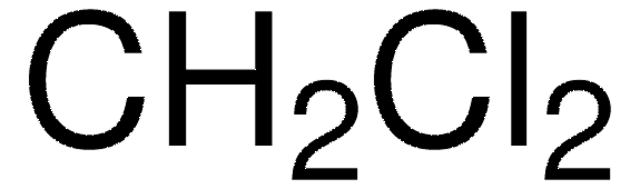
Dichlormethan
HPLC Plus, for HPLC, GC, and residue analysis, ≥99.9%, contains 50-150 ppm amylene as stabilizer
Synonym(e):
Methylenchlorid
Größe auswählen
Über diesen Artikel
gas chromatography (GC): suitable
6.83 psi ( 20 °C)
Fortfahren mit
Produktname
Dichlormethan, HPLC Plus, for HPLC, GC, and residue analysis, ≥99.9%, contains 50-150 ppm amylene as stabilizer
InChI key
YMWUJEATGCHHMB-UHFFFAOYSA-N
InChI
1S/CH2Cl2/c2-1-3/h1H2
SMILES string
ClCCl
grade
HPLC Plus
vapor density
2.9 (vs air)
vapor pressure
24.45 psi ( 55 °C)
6.83 psi ( 20 °C)
assay
≥99.9%
form
liquid
autoignition temp.
1223 °F
contains
50-150 ppm amylene as stabilizer
expl. lim.
22 %
technique(s)
HPLC: suitable
gas chromatography (GC): suitable
impurities
≤ 1.0 ppb Fluorescence (quinine) at 365 nm
≤0.01% water
evapn. residue
≤0.0001%
halogenated residue
≤10 ng/L (as heptachlor epoxide)
refractive index
n20/D 1.424 (lit.)
bp
39.8-40 °C (lit.)
mp
−95 °C (lit.)
density
1.325 g/mL at 25 °C (lit.)
λ
H2O reference
UV absorption
λ: 235 nm Amax: 1.0
λ: 240 nm Amax: 0.10
λ: 250 nm Amax: 0.02
λ: 300-400 nm Amax: 0.005
suitability
suitable for residue analysis
Quality Level
Suchen Sie nach ähnlichen Produkten? Aufrufen Leitfaden zum Produktvergleich
Verwandte Kategorien
1 of 4
Dieser Artikel | 32222-M | 1.06044 | 676853 |
|---|---|---|---|
| grade HPLC Plus, for residue analysis | grade ACS reagent, puriss. p.a. | grade - | grade ACS reagent |
| Quality Level 100 | Quality Level 200 | Quality Level 100 | Quality Level 200 |
| assay ≥99.9% | assay ≥99.9% (GC) | assay ≥99.9% (GC) | assay ≥99.5% |
| technique(s) HPLC: suitable, gas chromatography (GC): suitable | technique(s) - | technique(s) HPLC: suitable | technique(s) - |
| form liquid | form liquid | form liquid | form liquid |
| vapor pressure 24.45 psi ( 55 °C), 6.83 psi ( 20 °C) | vapor pressure 24.45 psi ( 55 °C), 6.83 psi ( 20 °C) | vapor pressure 24.45 psi ( 55 °C), 6.83 psi ( 20 °C) | vapor pressure 24.45 psi ( 55 °C), 6.83 psi ( 20 °C) |
Application
- Extraktion von Neonikotinoiden aus Honigproben zusammen mit Acetonitril unter Verwendung einer dispersiven Flüssig-Flüssig-Mikroextraktion (DLLME)
- Ultraschalllösungsmittelextraktion und Reinigung von gerösteten Kaffeeproben für die Analyse von 7 Pestizidrückständen mittels Flüssigchromatografie-Tandem-Massenspektrometrie (LC-MS/MS)
- DLLME-basierte zusätzliche Vorkonzentration der Probenextrakte für die Analyse von drei Amphenicolen in Lebensmittelprodukten tierischen Ursprungs durch HPLC mit UV-Nachweis
- Entfernen der organischen Phase aus erhaltenen Bodenprobenextrakten beim Bestimmen von zwei Sulfonylharnstoff-Herbiziden mittels HPLC
- Prüfen von vier Extraktionslösungsmitteln bei der Entwicklung eines Verfahrens auf der Grundlage eines amperometrischen HPLC-Nachweises für die Analyse von drei Carbamatresten in flüssigen und festen Lebensmittelproben
- Extraktion von Metrafenon aus Gemüseproben mittels Matrix-Festphasendispersion (MSPD) gefolgt von einer HPLC-Analyse
Other Notes
Packaging
Als weltweit führender Anbieter von Laborreagenzien suchen wir ständig nach neuen Wegen, um die Sicherheit unserer Produkte zu optimieren. Das neu entwickelte Design unserer 4-l-Lösungsmittelflaschen zeichnet sich durch eine fortschrittliche Dichtungstechnologie aus, die Undichtigkeiten verhindert und die Handhabung von Lösungsmitteln sicherer und praktischer macht als je zuvor.
Alle neuen Funktionen finden Sie hier!
Legal Information
signalword
Warning
hcodes
Hazard Classifications
Carc. 2 - Eye Irrit. 2 - Skin Irrit. 2 - STOT SE 3
target_organs
Central nervous system
Lagerklasse
6.1D - Non-combustible acute toxic Cat.3 / toxic hazardous materials or hazardous materials causing chronic effects
wgk
WGK 2
flash_point_f
does not flash
flash_point_c
does not flash
Hier finden Sie alle aktuellen Versionen:
Besitzen Sie dieses Produkt bereits?
In der Dokumentenbibliothek finden Sie die Dokumentation zu den Produkten, die Sie kürzlich erworben haben.
Artikel
Nitrosamines analysis by solid phase extraction (SPE) and subsequent gas chromatography-tandem mass spectrometry (GC-MS/MS) according to GB 5750.10-2023.
Highly accurate HPLC-FLD method for evaluating 15 PAHs in olive oil using Ascentis® Express PAH HPLC column and SPE cleanup, following GB 5009.265-2021.
Protokolle
In the present study we demonstrate compliance of silica gel 60 F254 HPTLC plates with USP requirements, and how HPTLC plates are suitable for the Sildenafil citrate-Limit of Imidazole test.
-
How can I determine the shelf life / expiration / retest date of this product?
1 answer-
Helpful?
-
-
How is shipping temperature determined? And how is it related to the product storage temperature?
1 answer-
Products may be shipped at a different temperature than the recommended long-term storage temperature. If the product quality is sensitive to short-term exposure to conditions other than the recommended long-term storage, it will be shipped on wet or dry-ice. If the product quality is NOT affected by short-term exposure to conditions other than the recommended long-term storage, it will be shipped at ambient temperature. As shipping routes are configured for minimum transit times, shipping at ambient temperature helps control shipping costs for our customers. For more information, please refer to the Storage and Transport Conditions document: https://www.sigmaaldrich.com/deepweb/assets/sigmaaldrich/marketing/global/documents/316/622/storage-transport-conditions-mk.pdf
Helpful?
-
Active Filters
Unser Team von Wissenschaftlern verfügt über Erfahrung in allen Forschungsbereichen einschließlich Life Science, Materialwissenschaften, chemischer Synthese, Chromatographie, Analytik und vielen mehr..
Setzen Sie sich mit dem technischen Dienst in Verbindung