

Long-term storage of anhydrous acetonitrile may contribute to the occurrence of microbubbles in the internal tubing of the Cellenone machine. Unopened bottles have a recommended retest period of three years. However, no specific long-term data is available regarding the effects of storage in tubing.
271004

Acetonitrile
99.8%, anhydrous, suitable for solid phase extraction (SPE)
Acetonitrile
2 of 2 reviewers received a sample product or took part in a promotion
Sinonimo/i:
ACN, Cianometano, Cianuro di metile, Etilnitrile
Autenticati per visualizzare i prezzi riservati alla tua organizzazione & contrattuali
Scegli un formato
Prezzi e disponibilità al momento non sono disponibili
Informazioni su questo articolo
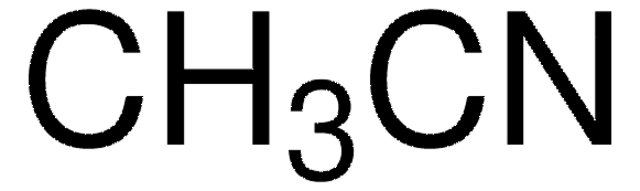
Formula condensata:
CH3CN
Numero CAS:
Peso molecolare:
41.05
Beilstein:
741857
Numero CE:
Numero MDL:
Codice UNSPSC:
12191502
eCl@ss:
39031501
ID PubChem:
NACRES:
NA.21
Vai a
Servizio Tecnico
Hai bisogno di aiuto? Il nostro team di scienziati qualificati è a tua disposizione.
Permettici di aiutartiNome del prodotto
Acetonitrile, anhydrous, 99.8%
Grado
anhydrous
Livello qualitativo
Densità del vapore
1.41 (vs air)
Tensione di vapore
72.8 mmHg ( 20 °C)
Saggio
99.8%
Stato
liquid
Temp. autoaccensione
973 °F
Limite di esplosione
16 %
tecniche
solid phase extraction (SPE): suitable
Impurezze
<0.001% water
<0.005% water (100 mL pkg)
Residuo dopo evaporazione
<0.0005%
Colore
colorless
Indice di rifrazione
n20/D 1.344 (lit.)
P. ebollizione
81-82 °C (lit.)
Punto di fusione
−45 °C (lit.)
Solubilità
water: soluble (completely)
Densità
0.786 g/mL at 25 °C (lit.)
Formato
neat
Stringa SMILE
CC#N
InChI
1S/C2H3N/c1-2-3/h1H3
WEVYAHXRMPXWCK-UHFFFAOYSA-N
Cerchi prodotti simili? Visita Guida al confronto tra prodotti
1 of 4
Questo articolo | 34888-M | 439134 | 82063 |
|---|---|---|---|
| Quality Level 200 | Quality Level - | Quality Level 100 | Quality Level - |
| grade anhydrous | grade for HPLC, for UV | grade gradient grade | grade for preparative HPLC |
| assay 99.8% | assay ≥99.9% | assay ≥99.9% | assay ≥99.8% (GC) |
| technique(s) solid phase extraction (SPE): suitable | technique(s) HPLC: suitable | technique(s) HPLC: suitable, UV/Vis spectroscopy: suitable | technique(s) UV/Vis spectroscopy: suitable |
| solubility water: soluble (completely) | solubility - | solubility water: soluble | solubility - |
| form liquid | form liquid | form liquid | form liquid |
Descrizione generale
L′acetonitrile, un nitrile alifatico, è usato diffusamente come solvente organico e composto intermedio nelle sintesi organiche.[1] Alla luce UV-visibile è trasparente e dunque ben applicabile nelle tecniche spettrofotometriche e fluorimetriche. Grazie alla bassa viscosità, alla elevata forza di eluizione e miscibilità in acqua, il MeCN è utilizzato come componente della fase mobile in molte tecniche cromatografiche. Ha inoltre un ruolo di rilievo come terreno di estrazione nell′estrazione liquido-liquido, in quella in fase solida o nella microestrazione.[2]
Applicazioni
L′acetonitrile può essere usato come solvente per la preparazione di:
Può essere usato anche come reagente per la sintesi di:
- 1,2-azidoalcoli e 1,2-azidoamine attraverso l′apertura assistita dal cloruro di cerio (III) dell′anello di epossidi e aziridine per mezzo di sodio azide.[3]
- Ciano-indolinoni attraverso l′arilalchilazione ossidativa di olefine in presenza di palladio come catalizzatore.[4]
Può essere usato anche come reagente per la sintesi di:
- Bis (difenilfosfino) acetonitrile reagendo con n-butillitio e quindi con clorodifenilfosfino.[5]
- β-acetamidochetoni attraverso la reazione di accoppiamento con chetoni o chetoesteri e aldeidi in presenza di cloruro di cobalto(II).[6]
Confezionamento
Prodotti correlati
N° Catalogo
Descrizione
Determinazione del prezzo
used together
N° Catalogo
Descrizione
Determinazione del prezzo
Avvertenze
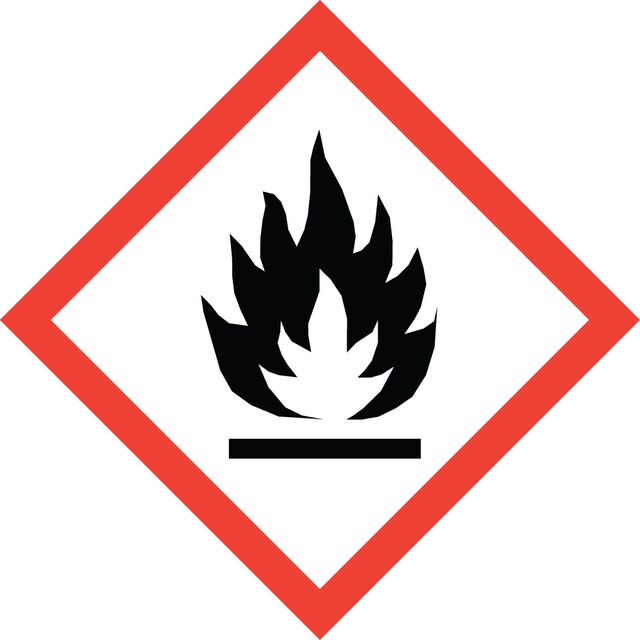
Danger
Indicazioni di pericolo
Classi di pericolo
Acute Tox. 4 Dermal - Acute Tox. 4 Inhalation - Acute Tox. 4 Oral - Eye Irrit. 2 - Flam. Liq. 2
Codice della classe di stoccaggio
3 - Flammable liquids
Classe di pericolosità dell'acqua (WGK)
WGK 2
Punto d’infiammabilità (°F)
35.6 °F - closed cup
Punto d’infiammabilità (°C)
2.0 °C - closed cup
Dispositivi di protezione individuale
Eyeshields, Faceshields, Gloves, type ABEK (EN14387) respirator filter
Scegli una delle versioni più recenti:
Possiedi già questo prodotto?
I documenti relativi ai prodotti acquistati recentemente sono disponibili nell’Archivio dei documenti.
Bis (diphenylphosphino) acetonitrile: Synthesis, ligand properties and application in catalytic carbon?carbon coupling
Braun L, et al.
Dalton Transactions, 14, 1409-1415 (2007)
Cobalt-catalysed three-component coupling involving ketones or ketoesters, aldehydes and acetonitrile: a novel one-pot synthesis of ?-acetamido ketones
Madhavaa Reddy M.
Journal of the Chemical Society. Chemical Communications, 6, 713-714 (1994)
Eagleson M.
Concise Encyclopedia Chemistry, 56-56 (1994)
Palladium-Catalyzed Oxidative Arylalkylation of Activated Alkenes: Dual C-H Bond Cleavage of an Arene and Acetonitrile.
Wu T, et al.
Angewandte Chemie (International Edition in English), 50(52), 12578-12581 (2011)
Cerium (III) chloride promoted highly regioselective ring opening of epoxides and aziridines using NaN3 in acetonitrile: a facile synthesis of 1,2-azidoalcohols and 1,2-azidoamines.
Sabitha G, et al.
Organic Letters, 4(3), 343-345 (2002)
Articoli
Le sostanze si dicono miscibili tra loro se si dissolvono formando una soluzione uniforme. Aggiungi ai preferiti o scarica la nostra tabella di miscibilità per i comuni solventi da laboratorio.
Substances are said to be miscible in one another if they dissolve to form a uniform solution. Bookmark or download our miscibility table for common lab solvents.
Stoffe gelten als miteinander mischbar, wenn sie sich zu einer einheitlichen Lösung auflösen. Setzen Sie ein Lesezeichen oder laden Sie unsere Mischbarkeitstabelle für gängige Laborlösungsmittel herunter.
Des substances sont dites miscibles si elles se dissolvent l'une dans l'autre en formant une solution uniforme. Ajoutez à vos marque-pages ou téléchargez notre tableau de miscibilité incluant les solvants de laboratoire courants.
-
I'm using anhydrous acetonitrile that was opened in 2017. microbubbles frequently occur in the internal tubing(Cellenone machine) . Could this be related to storing it for a long period?
1 answer-
Helpful?
-
-
How can I determine the shelf life / expiration / retest date of this product?
1 answer-
If this product has an expiration or retest date, it will be shown on the Certificate of Analysis (COA, CofA). If there is no retest or expiration date listed on the product's COA, we do not have suitable stability data to determine a shelf life. For these products, the only date on the COA will be the release date; a retest, expiration, or use-by-date will not be displayed.
For all products, we recommend handling per defined conditions as printed in our product literature and website product descriptions. We recommend that products should be routinely inspected by customers to ensure they perform as expected.
For products without retest or expiration dates, our standard warranty of 1 year from the date of shipment is applicable.
For more information, please refer to the Product Dating Information document: https://www.sigmaaldrich.com/deepweb/assets/sigmaaldrich/marketing/global/documents/418/501/product-dating-information-06-25-mk.pdfHelpful?
-
-
How is shipping temperature determined? And how is it related to the product storage temperature?
1 answer-
Products may be shipped at a different temperature than the recommended long-term storage temperature. If the product quality is sensitive to short-term exposure to conditions other than the recommended long-term storage, it will be shipped on wet or dry-ice. If the product quality is NOT affected by short-term exposure to conditions other than the recommended long-term storage, it will be shipped at ambient temperature. As shipping routes are configured for minimum transit times, shipping at ambient temperature helps control shipping costs for our customers. For more information, please refer to the Storage and Transport Conditions document: https://www.sigmaaldrich.com/deepweb/assets/sigmaaldrich/marketing/global/documents/316/622/storage-transport-conditions-mk.pdf
Helpful?
-
-
Hi! By which method is the acetonitrile dried? Is molecular sieve used? Thanks!
1 answer-
Unfortunately, the manufacturing process of this product is proprietary. If necessary, molecular sieves can help to further dry the product before use.
Helpful?
-
-
Hey, my name is Mohammad. We tried to develop sensor ro detect heavy metals. And I fond some peaks in the solution when I added acn 99.8% and I want to know if there is heavy metals and which metals?
1 answer-
Unfortunately, this product is not tested for heavy metals. Should this be a critical issue for the specific application, see product 900667. This product is tested for trace metals and may be a better option. See the link below to review a sample Certificate of Analysis:
https://www.sigmaaldrich.com/certificates/sapfs/PROD/sap/certificate_pdfs/COFA/Q14/900667-BULKSHBR1056.pdfHelpful?
-
Active Filters
Il team dei nostri ricercatori vanta grande esperienza in tutte le aree della ricerca quali Life Science, scienza dei materiali, sintesi chimica, cromatografia, discipline analitiche, ecc..
Contatta l'Assistenza Tecnica