

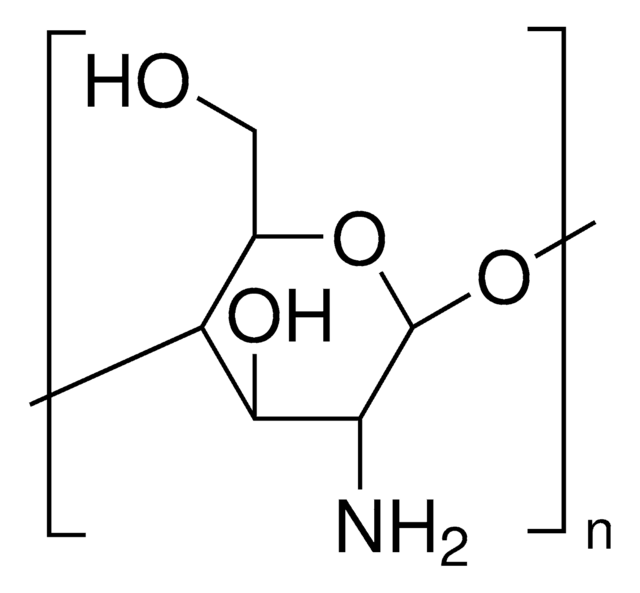
The polydispersity index of this Chitosan product has not been determined.
448869

Chitosan
low molecular weight
Sinonim:
Deacetylated chitin, Poly(D-glucosamine)
Masuk untuk Melihat Harga Organisasi & Kontrak
Pilih Ukuran
Harga dan ketersediaan saat ini tidak tersedia
About This Item
Loncat ke
Layanan Teknis
Butuh bantuan? Tim kami yang terdiri dari para ilmuwan berpengalaman siap membantu Anda.
Biarkan Kami Membantuform
powder
mol wt
50,000-190,000 Da (based on viscosity)
viscosity
20-300 cP, 1 wt. % in 1% acetic acid(25 °C, Brookfield)(lit.)
solubility
dilute aqueous acid: soluble
SMILES string
N([C@H]1[C@@H](O[C@@H]([C@H]([C@@H]1O)O[C@@H]4O[C@@H]([C@H]([C@@H]([C@H]4N)O)O[C@@H]5O[C@@H]([C@H]([C@@H]([C@H]5N)O)O[C@@H]6O[C@@H]([C@H]([C@@H]([C@H]6N)O)O[C@@H]7O[C@@H]([C@H]([C@@H]([C@H]7N)O)O[C@@H]8O[C@@H]([C@H]([C@@H]([C@H]8N)O)O[C@@H]9O[C@@H]([C@H](
InChI
1S/C56H103N9O39/c1-87-56(86)65-28-38(84)46(19(10-74)96-55(28)104-45-18(9-73)95-49(27(64)37(45)83)97-39-12(3-67)88-47(85)20(57)31(39)77)103-54-26(63)36(82)44(17(8-72)94-54)102-53-25(62)35(81)43(16(7-71)93-53)101-52-24(61)34(80)42(15(6-70)92-52)100-51-23(60)33(79)41(14(5-69)91-51)99-50-22(59)32(78)40(13(4-68)90-50)98-48-21(58)30(76)29(75)11(2-66)89-48/h11-55,66-85H,2-10,57-64H2,1H3,(H,65,86)/t11-,12-,13-,14-,15-,16-,17-,18-,19-,20-,21-,22-,23-,24-,25-,26-,27-,28-,29-,30-,31-,32-,33-,34-,35-,36-,37-,38-,39-,40-,41-,42-,43-,44-,45-,46-,47-,48+,49+,50+,51+,52+,53+,54+,55+/m1/s1
InChI key
FLASNYPZGWUPSU-SICDJOISSA-N
Mencari produk serupa? Mengunjungi Panduan Perbandingan Produk
1 of 4
Item ini | 419419 | 937657 | C3646 |
|---|---|---|---|
| solubility dilute aqueous acid: soluble | solubility H2O: insoluble, organic solvents: insoluble | solubility - | solubility acetic acid: water: 10 mg/mL, slightly hazy to hazy (with extensive sonication), H2O: insoluble, organic solvents: insoluble |
| Quality Level 100 | Quality Level 100 | Quality Level 100 | Quality Level 200 |
| form powder | form (Coarse ground flakes and powder) | form powder or chunks (or Fibers) | form powder or flakes |
| mol wt 50,000-190,000 Da (based on viscosity) | mol wt 310000-375000 Da | mol wt >300 kDa | mol wt - |
| viscosity 20-300 cP, 1 wt. % in 1% acetic acid(25 °C, Brookfield)(lit.) | viscosity 800-2000 cP, 1 wt. % in 1% acetic acid(25 °C, Brookfield)(lit.) | viscosity - | viscosity - |
Application
Chitosan may be used as a flocculant, in protein precipitation, encapsulating agent and aqueous thickener.
Forms gels with multivalent anions. Gives clear solutions that dry to strong, clear films.
Features and Benefits
Biocompatible, antibacterial and environmentally friendly polyelectrolyte with a variety of applications including water treatment, chromatography, additives for cosmetics, textile treatment for antimicrobial activity, novel fibers for textiles, photographic papers, biodegradable films, biomedical devices, and microcapsule implants for controlled release in drug delivery.
Biocompatible, antibacterial and environmentally friendly polyelectrolyte.
Physical form
75-85% deacetylated
Kelas Penyimpanan
11 - Combustible Solids
wgk_germany
nwg
flash_point_f
Not applicable
flash_point_c
Not applicable
ppe
Eyeshields, Gloves, type N95 (US)
Pilih salah satu versi terbaru:
Sudah Memiliki Produk Ini?
Temukan dokumentasi untuk produk yang baru saja Anda beli di Perpustakaan Dokumen.
Tsung-Lin Yang et al.
Journal of cellular and molecular medicine, 13(9A), 2853-2863 (2008-07-17)
Chitosan is a widely used biocompatible biomaterial in the tissue regeneration, but its utility and application in the tissue morphogenesis of salivary gland remains unclear. The study aimed to explore the effects of chitosan on the epithelial morphogenesis of submandibular
Ming-Hui Yang et al.
BioMed research international, 2014, 789591-789591 (2014-04-24)
Chitosan nanoparticle, a biocompatible material, was used as a potential drug delivery system widely. Our current investigation studies were the bioeffects of the chitosan nanoparticle uptake by liver cells. In this experiment, the characterizations of chitosan nanoparticles were measured by
Ajay Vijayakumar et al.
AAPS PharmSciTech, 18(3), 875-883 (2016-07-03)
The objective of this study was to formulate and characterize properties of solid lipid nanoparticle (SLN) dispersion containing quercetin. SLN was prepared by ultrasonication method using tripalmitin and lecithin as lipid core and then the surface was coated with chitosan.
Mohammad Ali Khosravi Zanjani et al.
Iranian journal of pharmaceutical research : IJPR, 13(3), 843-852 (2014-10-03)
Microencapsulation as one of the most modern methods has considerable effects on probiotic survival. In this study Lactobacillus casei (ATCC 39392) and Bifidobacterium bifidum (ATCC 29521) were encapsulated using calcium alginate-gelatinized starch, chitosan coating and inulin via emulsion technique, and
Wei-Hsuan Lo et al.
Molecules (Basel, Switzerland), 25(21) (2020-11-07)
(1) Background: Few antifungal drugs are currently available, and drug-resistant strains have rapidly emerged. Thus, the aim of this study is to evaluate the effectiveness of the antifungal activity from a combinational treatment of chitosan with a clinical antifungal drug
Artikel
Polymers, natural or synthetic, are vital in medical advancements, contributing to device and pharmaceutical development in therapy.
Microfluidic assembly improves polyamine nanoencapsulation of nucleic acids, overcoming challenges like polydispersity and poor reproducibility.
Hydrogel-based biomaterials for cell delivery and tissue regeneration applications are discussed.
Chitosan is a naturally occurring polysaccharide ideally suited for use in medical supplies, devices, therapeutics, and diagnostics. The unique natural characteristics of chitosan include its cationic, biocompatible, biodegradable, non-toxic, non-immunogenic, and antimicrobial properties.
-
What is polydispersity index (PDI) of Chitosan cas 9012-76-4 (448869)
1 answer-
Helpful?
-
-
How can I determine the shelf life / expiration / retest date of this product?
1 answer-
If this product has an expiration or retest date, it will be shown on the Certificate of Analysis (COA, CofA). If there is no retest or expiration date listed on the product's COA, we do not have suitable stability data to determine a shelf life. For these products, the only date on the COA will be the release date; a retest, expiration, or use-by-date will not be displayed.
For all products, we recommend handling per defined conditions as printed in our product literature and website product descriptions. We recommend that products should be routinely inspected by customers to ensure they perform as expected.
For products without retest or expiration dates, our standard warranty of 1 year from the date of shipment is applicable.
For more information, please refer to the Product Dating Information document: https://www.sigmaaldrich.com/deepweb/assets/sigmaaldrich/marketing/global/documents/418/501/product-dating-information-06-25-mk.pdfHelpful?
-
-
Where is the origin and what is the particle size in manometer?
1 answer-
This product is sourced from the shells of Pandalus borealis, cold water shrimp. The physical form of this material is powder and/or chips. The particle size is not determined and may be quite variable.
Helpful?
-
-
Dear Sir, could I make a dilution serious of HPLC Chitosan and analysis through HPLC for quantification and calibration curve? and what molecular weight should I use for 250 microgram/mL stock solution?
1 answer-
Yes, a dilution series of HPLC-grade chitosan can be made for HPLC analysis to establish a calibration curve for quantification. However, no molecular weight information is available.
Helpful?
-
-
Dear sir Could we get the (HNMR) and viscosity testing for the determination of the degree of deacetylated chitosan as we used the one with "(50,000–190,000 Da and degree of deacetylation equal or greater than 70%.Polymers Journal requested it.
1 answer-
The result for the degree of deacetylation is provided on the certificate of analysis for each lot of this product. Unfortunately, the assay method may not be shared.
Helpful?
-
-
Can i use this Chitosan for fruit coating?
1 answer-
This product is intended for research use only and is not food grade. Therefore it is not recommended for a fruit coating application.
Helpful?
-
-
How is shipping temperature determined? And how is it related to the product storage temperature?
1 answer-
Products may be shipped at a different temperature than the recommended long-term storage temperature. If the product quality is sensitive to short-term exposure to conditions other than the recommended long-term storage, it will be shipped on wet or dry-ice. If the product quality is NOT affected by short-term exposure to conditions other than the recommended long-term storage, it will be shipped at ambient temperature. As shipping routes are configured for minimum transit times, shipping at ambient temperature helps control shipping costs for our customers. For more information, please refer to the Storage and Transport Conditions document: https://www.sigmaaldrich.com/deepweb/assets/sigmaaldrich/marketing/global/documents/316/622/storage-transport-conditions-mk.pdf
Helpful?
-
-
We need to confirm if this Chitosan (Catalog #448869) is of animal origin (shellfish) or synthetic.
1 answer-
The source information is located on the Certificate of Origin and may vary from lot to lot. Recent lot shows the source of this product is from the shells of Pandalus Borealis, Cold Water Shrimp.
Helpful?
-
-
What is the molecular weight (Mw) of products 448869, 448877, or 419419?
1 answer-
The molecular weight (Mw) of products 448869, 448877, and 419419 are approximately 150-250 kDa, 250-300 kDa, and 340-360 kDa, respectively. These values are calculated based on the viscosity values provided on the product data sheets and the corresponding table of viscosity vs Mw.
Helpful?
-
-
What are the Mark-Houwink–Sakurada parameters (K and alpha) you use for determination of molecular weight through viscosity? Thank you!
1 answer-
The Certificates of Analysis(CofA) for each lot of Product 448869, a low molecular weight Chitosan, do not report a molecular weight. However, the viscosity in 1 percent acetic acid (abbreviated HAc or HOAc) is on the CofA. Values for K and alpha for high molecular weight Chitosan have been published, which might also apply to a low molecular weight Chitosan; see Calculation of Mark–Houwink–Sakurada (MHS) equation viscometric constants for chitosan in any solvent–temperature system using experimentally reported viscometric constants data, by Mohammed R. Kasaai. Carbohydrate Polymers, 68(3), 477-488 (2007).
Helpful?
-
Active Filters
Tim ilmuwan kami memiliki pengalaman di semua bidang penelitian termasuk Ilmu Hayati, Ilmu Material, Sintesis Kimia, Kromatografi, Analitik, dan banyak lainnya.
Hubungi Layanan Teknis