


If this product has an expiration or retest date, it will be shown on the Certificate of Analysis (COA, CofA). If there is no retest or expiration date listed on the product's COA, we do not have suitable stability data to determine a shelf life. For these products, the only date on the COA will be the release date; a retest, expiration, or use-by-date will not be displayed.
For all products, we recommend handling per defined conditions as printed in our product literature and website product descriptions. We recommend that products should be routinely inspected by customers to ensure they perform as expected.
For products without retest or expiration dates, our standard warranty of 1 year from the date of shipment is applicable.
For more information, please refer to the Product Dating Information document: https://www.sigmaaldrich.com/deepweb/assets/sigmaaldrich/marketing/global/documents/418/501/product-dating-information-06-25-mk.pdf
L3771

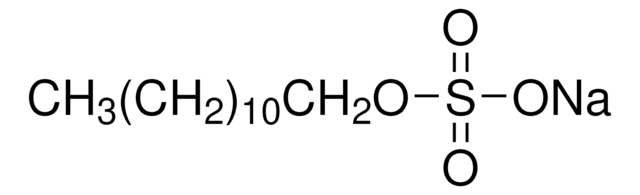
Dodecilsulfatosódico

BioReagent, suitable for electrophoresis, Molecular Biology, ≥98.5% (GC)
Sinónimos:
Dodecil sulfato de sodio, Dodecil sulfato sodium salt, Lauril sulfato sodium salt, Laurilsulfato de sodio, SDS
Seleccione un Tamaño
MXP 1,453.00
MXP 2,270.00
MXP 8,176.00
MXP 12,133.00
MXP 74,980.00
Acerca de este artículo
Saltar a
Nombre del producto
Dodecilsulfatosódico, BioReagent, suitable for electrophoresis, Molecular Biology, ≥98.5% (GC)
InChI key
DBMJMQXJHONAFJ-UHFFFAOYSA-M
InChI
1S/C12H26O4S.Na/c1-2-3-4-5-6-7-8-9-10-11-12-16-17(13,14)15;/h2-12H2,1H3,(H,13,14,15);/q;+1/p-1
SMILES string
[Na+].CCCCCCCCCCCCOS([O-])(=O)=O
biological source
synthetic
grade
Molecular Biology
description
anionic
product line
BioReagent
assay
≥98.5% (GC)
form
powder
mol wt
micellar 18,000
Quality Level
greener alternative product characteristics
Catalysis
Learn more about the Principles of Green Chemistry.
sustainability
Greener Alternative Product
aggregation number
62
technique(s)
electrophoresis: suitable
impurities
≤2.0% water (Karl Fischer)
CMC
7-10 mM (20-25°C)
mp
204-207 °C (lit.)
transition temp
cloud point >100 °C
solubility
water: soluble
density
1.03 g/cm3 at 20 °C (68 °F)
anion traces
chloride (Cl-): ≤500 ppm
phosphate (PO43-): ≤10 ppm
cation traces
heavy metals (as Pb): ≤10 ppm
absorption
≤0.1 at 260 at 3%
≤0.1 at 280 at 3%
HLB
40
suitability
suitable for electrophoresis
foreign activity
DNase, RNase, none detected
greener alternative category
storage temp.
room temp
¿Está buscando productos similares? Visita Guía de comparación de productos
1 of 4
Este artículo | 436143 | L4509 | L6026 |
|---|---|---|---|
| suitability suitable for electrophoresis | suitability - | suitability - | suitability - |
| form powder | form solid | form powder | form powder |
| technique(s) electrophoresis: suitable | technique(s) - | technique(s) - | technique(s) - |
| assay ≥98.5% (GC) | assay ≥99.0% | assay ≥98.5% (GC) | assay ≥99.0% (GC) |
| grade for molecular biology | grade ACS reagent | grade - | grade - |
| aggregation number 62 | aggregation number - | aggregation number 62 | aggregation number 62 |
Features and Benefits
- Tensioactivo muy versátil para su investigación en biología molecular y bioquímica
- Adecuado para aplicaciones de electroforesis
- Confirmación probada de bajas concentraciones de contaminación por metales pesados,asegurando su idoneidad para diversas aplicaciones.
Analysis Note
Application
- en la immunoprecipitación de la cromatina
- en la electroforesis en gel SDS-poliacrilamida (SDS-PAGE)
- como componente de la disolución tampón del ensayo de radioinmunoprecipitación para inmunotransferencia
General description
Más allá del análisis de proteínas, el SDS encuentra también aplicaciones en la separación electroforética de los lípidos, lo que permite el estudio y la caracterización de estos importantes componentes celulares. Además, el SDS se emplea en diversas técnicas de hibridación y biología molecular, lo que demuestra su versatilidad en una amplia gama de áreas de investigación. La eficacia del SDS tanto en condiciones iónicas como aniónicas amplía aún más su utilidad, permitiéndolo adaptarse a diversas configuraciones y requisitos experimentales. Su capacidad para desentrañar proteínas uniéndose a las cadenas peptídicas e impartiendo una carga negativa elimina eficazmente la forma de la proteína como un factor para la separación en el gel, lo que garantiza la determinación exacta del tamaño de la proteína.
Other Notes
Comparable product
signalword
Danger
Hazard Classifications
Acute Tox. 4 Inhalation - Acute Tox. 4 Oral - Aquatic Chronic 3 - Eye Dam. 1 - Flam. Sol. 2 - Skin Irrit. 2 - STOT SE 3
target_organs
Respiratory system
Clase de almacenamiento
4.1B - Flammable solid hazardous materials
wgk
WGK 2
flash_point_f
338.0 °F
flash_point_c
170 °C
ppe
Eyeshields, Faceshields, Gloves, type P3 (EN 143) respirator cartridges
Elija entre una de las versiones más recientes:
¿Ya tiene este producto?
Encuentre la documentación para los productos que ha comprado recientemente en la Biblioteca de documentos.
Protocolos
Resumen de la química del gel de poliacrilamida e instrucciones detalladas para preparar a mano geles de poliacrilamida con los kits de moldeo del gel bis-Tris TurboMix mPAGE®
Preparation of Plasmid DNA by Alkaline Lysis with SDS: Maxipreparation between Cold Spring Harbor Laboratory Press and our research team.
Simplify your SDS-PAGE gel preparation with our pre-mixed solutions and protocols to achieve precise protein separation.
This page shows and discusses three protocols for stripping and reprobing a western blot membrane.
Contenido relacionado
An overview of cell lysis and protein extraction methods including detergent solubilization, freeze-thaw lysis, osmotic shock, sonication, enzymatic cell lysis, and mechanical disruption techniques such as Dounce, Polytron, and mortar and pestle homogenization.
Los métodos de lisis celular y extracción de proteínas abarcan diversas técnicas, desde la solubilización con detergentes hasta la disrupción mecánica, lo que respalda las necesidades de investigación.
Cell lysis and protein extraction methods overview various techniques, from detergent solubilization to mechanical disruption, supporting research needs.
Product Information Sheet
-
How can I determine the shelf life / expiration / retest date of this product?
1 answer-
Helpful?
-
-
How is shipping temperature determined? And how is it related to the product storage temperature?
1 answer-
Products may be shipped at a different temperature than the recommended long-term storage temperature. If the product quality is sensitive to short-term exposure to conditions other than the recommended long-term storage, it will be shipped on wet or dry-ice. If the product quality is NOT affected by short-term exposure to conditions other than the recommended long-term storage, it will be shipped at ambient temperature. As shipping routes are configured for minimum transit times, shipping at ambient temperature helps control shipping costs for our customers. For more information, please refer to the Storage and Transport Conditions document: https://www.sigmaaldrich.com/deepweb/assets/sigmaaldrich/marketing/global/documents/316/622/storage-transport-conditions-mk.pdf
Helpful?
-
-
Is it okay to use 10% SDS dissolved in water that has been autoclaved?
1 answer-
Sodium dodecyl sulfate may decompose with prolonged heating at 40°C or greater. Autoclaving this material is not recommended. Please see the link below to review additional information available in the product datasheet:
https://www.sigmaaldrich.com/deepweb/assets/sigmaaldrich/product/documents/296/475/l3771pis.pdfHelpful?
-
-
What is the storage temperature for the product?
1 answer-
This product is stored at ambient temperature.
Helpful?
-
Active Filters
Nuestro equipo de científicos tiene experiencia en todas las áreas de investigación: Ciencias de la vida, Ciencia de los materiales, Síntesis química, Cromatografía, Analítica y muchas otras.
Póngase en contacto con el Servicio técnico