
BioRenewable solvents are sourced from renewable and sustainable biobased materials, such as soy/palm oil, wood waste, hay or corn byproducts, etc. It is important to highlight that our BioRenewable products do not compete with food production.
911038

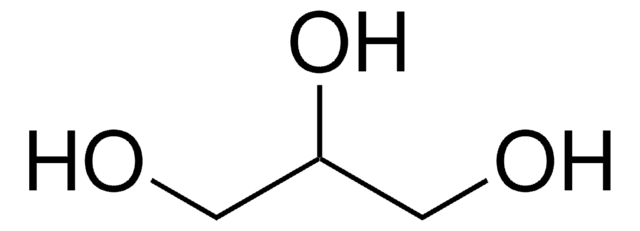
Glycerol
BioRenewable, ACS reagent, ≥99.5%
Sustainability features
Synonym(s):
1,2,3-Propanetriol, Glycerin
Sign In to View Organizational & Contract Pricing.
Select a Size
Change View
| Size/SKU | Availability | Price |
|---|---|---|
4 x 4 L | Check Cart for Availability | $769.00 |
About This Item
Linear Formula:
HOCH2CH(OH)CH2OH
CAS Number:
Molecular Weight:
92.09
UNSPSC Code:
50161901
Beilstein/REAXYS Number:
635685
MDL number:
grade
ACS reagent
vapor density
3.1 (vs air)
vapor pressure
<1 mmHg ( 20 °C)
assay
≥99.5%
form
liquid
autoignition temp.
698 °F
sustainability
Sustainability features
renewable carbon content
100%
refractive index
n20/D 1.474 (lit.)
bp
182 °C/20 mmHg (lit.)
mp
20 °C (lit.)
density
1.25 g/mL (lit.)
SMILES string
OCC(O)CO
InChI
1S/C3H8O3/c4-1-3(6)2-5/h3-6H,1-2H2
InChI key
PEDCQBHIVMGVHV-UHFFFAOYSA-N
General description
We are committed to bringing you Greener Alternative Products, which adhere to one or more of The 12 Principles of Greener Chemistry. Glycerol provides a high boiling point, low flammability, and polarity. Glycerol is non-toxic, biodegradable, and comes from a renewable feedstock, thus it aligns with "Safer Solvents and Auxiliaries", "Use of Renewable Feedstocks", and "Design for Degradation". Click here for more information.
Application
Glycerol can be used in a broad range of applications:
- Sample preparation and gel formation for polyacrylamide gel electrophoresis
- It is used to aid in casting gradient gels and as a protein stabilizer and storage buffer component
- As a solvent in organic synthesis, such as Huisgen cycloaddition of azides
- In pharmaceutical and personal care industries as a humectant and for improved smoothness
Features and Benefits
- ASTM D6866 - Standard Test Methods for Determining the Biobased Content
- Renewable Carbon Content – ≥99.9%
- Made from Renewable Resource –Palm oil
1 of 1
This Item | |||
|---|---|---|---|
| description BioRenewable, ACS reagent, ≥99.5% | description analytical standard | description FCC, FG | description BioReagent, suitable for cell culture, suitable for insect cell culture, suitable for electrophoresis, ≥99% (GC) |
| grade ACS reagent | grade analytical standard | grade FG, Halal, Fragrance grade, Kosher | grade - |
| assay ≥99.5% | assay ≥98.5% (GC) | assay ≥99% (GC) | assay ≥99% (GC) |
| form liquid | form - | form viscous liquid | form viscous liquid |
| mp 20 °C (lit.) | mp 20 °C (lit.) | mp 20 °C (lit.) | mp 20 °C (lit.) |
| vapor pressure <1 mmHg ( 20 °C) | vapor pressure <1 mmHg ( 20 °C) | vapor pressure <1 mmHg ( 20 °C) | vapor pressure <1 mmHg ( 20 °C) |
| greener alternative product characteristics Safer Solvents and Auxiliaries | greener alternative product characteristics Safer Solvents and Auxiliaries | greener alternative product characteristics Safer Solvents and Auxiliaries | greener alternative product characteristics Safer Solvents and Auxiliaries |
Still not finding the right product?
Explore all of our products under Glycerol
Storage Class
10 - Combustible liquids
WGK
WGK 1
Flash Point (°F)
390.2 °F - Pensky-Martens closed cup
Flash Point (°C)
199 °C - Pensky-Martens closed cup
Choose from one of the most recent versions:
Already Own This Product?
Find documentation for the products that you have recently purchased in the Document Library.
-
What is a BioRenewable solvent?
1 answer-
Helpful?
-
-
Do BioRenewable solvents have a similar quality to petroleum-based solvents?
1 answer-
BioRenewable solvents can have the same or higher purity level compared to traditional solvents. These solvents are free of the many byproducts of petroleum manufacturing, such as benzene, aldehydes, and ethers.
Helpful?
-
-
Why should you use BioRenewable solvents?
1 answer-
You will contribute to create a sustainable world, significantly lowering environmental impact. Biorenewable solvents also decrease petroleum sources dependency, have higher recovery rates, and/or are safer for handling and disposal.
Helpful?
-