
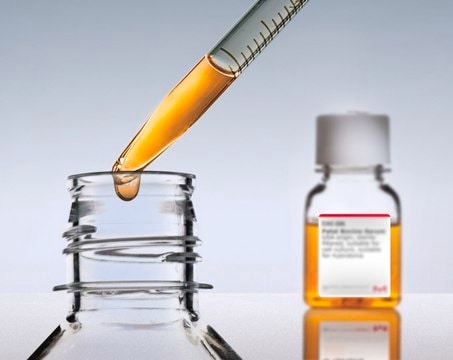
Heat inactivation is required based on the specific application or protocol. It is typically necessary for hybridoma cultures or immunological studies that require the inactivation of complement proteins. However, heat inactivation is not required for all applications.
F2442

Fetal Bovine Serum
USA origin, sterile-filtered, suitable for cell culture, suitable for hybridoma
1 of 1 reviewers took part in a promotion
Synonym(s):
Fetal Bovine Sera, Fetal Calf Serum, FBS, FCS, sera, serum
Sign In to View Organizational & Contract Pricing.
Select a Size
Change View
| Size/SKU | Availability | Price |
|---|---|---|
50 mL | Estimated to ship TODAY | $1630.00 |
100 mL | Estimated to ship onOctober 19, 2026 | $178.00 |
500 mL | Estimated to ship TODAY | $825.00 |
1 L | Estimated to ship onNovember 20, 2026fromSAINT LOUIS | $1,630.00 |
About This Item
Biological source:
bovine fetus
Origin:
USA origin
Sterility:
sterile-filtered
Shipped in:
dry ice
biological source
bovine fetus
Quality Segment
sterility
sterile-filtered
product line
FBS Classic
composition
Bovine IgG, ≤1 mg/mL , Hemoglobin, ≤20 mg/dL
origin
USA origin
technique(s)
cell culture | hybridoma: suitable, cell culture | mammalian: suitable
impurities
≤10 EU/mL endotoxin
shipped in
dry ice
storage temp.
−20°C
General description
Fetal Bovine Serum (FBS) is a complex mixture with low and high molecular weight biomolecules exhibiting optimal growth-enhancing and growth-suppressing functions. FBS contains molecules, such as growth factors, proteins, vitamins, trace elements, hormones etc. These molecules are important for the growth and maintenance of cells. It is a common supplement for cell culture media. FBS is derived from the calf blood. It is devoid of fibrin and clotting factors. Heat inactivation of FBS blocks the complement system. FBS derived from clotted blood is the most widely used undefined supplement in eukaryotic, especially mammalian, cell culture. It is typically used with the classical media that were developed in the 1950s and 1960s. These include many popular media such as Minimum Essential Medium (MEM), Dulbecco′s Modified Eagles Media (DME, DMEM); Iscove′s Modified Eagles Medium (IMDM), M199 and Roswell Park Memorial Institute medium, RPMI-1640.
Application
Biochem/physiol Actions
FBS remains a popular media supplement because it provides a wide array of functions in cell culture. FBS delivers nutrients, growth and attachment factors and protects cells from oxidative damage and apoptosis by mechanisms that are difficult to reproduce in serum-free media (SFM) systems.
Analysis Note
- Endotoxin and hemoglobin tested
- Tested for the presence of bacteria, virus, and mycoplasma
- Triple filtered with 0.1 micron membrane under aseptic conditions
Other Notes
Tested for the presence of bacteria, virus, mycoplasma, endotoxin and for hemoglobin content. Triple filtered with 0.1 micron membrane under aseptic conditions.
1 of 1
This Item | |||
|---|---|---|---|
| description USA origin, sterile-filtered, suitable for cell culture, suitable for hybridoma | description Canada origin, sterile-filtered, suitable for cell culture | description USDA approved, sterile-filtered, suitable for cell culture | description USA origin, Charcoal Stripped, sterile-filtered, suitable for cell culture |
| technique(s) cell culture | mammalian: suitable, cell culture | hybridoma: suitable | technique(s) cell culture | mammalian: suitable | technique(s) cell culture | mammalian: suitable | technique(s) cell culture | mammalian: suitable |
| biological source bovine fetus | biological source bovine fetus | biological source bovine fetus | biological source bovine fetus |
| origin USA origin | origin Canada origin | origin - | origin USA origin |
| sterility sterile-filtered | sterility sterile-filtered | sterility sterile-filtered | sterility sterile-filtered |
| storage temp. −20°C | storage temp. −20°C | storage temp. −20°C | storage temp. −20°C |
| composition Bovine IgG, ≤1 mg/mL , Hemoglobin, ≤20 mg/dL | composition Hemoglobin, ≤25 mg/dL , Bovine IgG, ≤1 mg/mL | composition Hemoglobin, ≤25 mg/dL | composition Hemoglobin, ≤20 mg/dL , Bovine IgG, ≤1 mg/mL |
Still not finding the right product?
Explore all of our products under Fetal Bovine Serum
Storage Class
10 - Combustible liquids
Flash Point (°F)
Not applicable
Flash Point (°C)
Not applicable
PPE (personal protective equipment)
Eyeshields, Gloves
Choose from one of the most recent versions:
Already Own This Product?
Find documentation for the products that you have recently purchased in the Document Library.
-
is heat inactivation necessary?
1 answer-
Helpful?
-
-
How to heat inactivate this serum Fetal Bovine Serum USA origin,(Cat Log - F2442)
1 answer-
Heat inactivation occurs when serum is heated to 56°C for a period of 30 minutes.
Here's a protocol for heat inactivation:
1. Allow serum containers to come to room temperature. Swirl bottles of serum immediately before adding to the water bath.
2. A water-filled control bottles (T1) should be placed in a 56 °C water bath. Place the containers in the water bath up to the serum line. Do not completely submerge the containers. When the temperature of T1 reaches 56 °C, start the timer set for 30 minutes. Do not allow temperatures to exceed 56 °C. Higher temperatures will denature the proteins, gel the serum or alter the performance of the serum.
3. Gently swirl the bottles every 5 to 10 minutes while in the water bath and check the temperature in the control bottle. It is not uncommon for plastic containers to bow slightly after heat treatment. This is not harmful to the serum.
4. At the end of 30 minutes remove the serum bottles from the water bath. Aliquot the serum into smaller volumes and freeze. Sigma-Aldrich does not recommend repeated thaw-freeze cycles.Helpful?
-
-
is this Heat Inactivate FBS?
1 answer-
This product has not been heat inactivated.
Helpful?
-
-
can F2442 FBS be used for culturing peritoneal macrophages? what is the suitable one?
1 answer-
This product is tested for suitability in mammalian cell culture. While it is not specifically tested on macrophages, it is subject to stringent specifications, including low endotoxin, and should perform well. Please see the link below to review a sample Certificate of Analysis:
https://www.sigmaaldrich.com/coa/SIGMA/F2442/23A317Helpful?
-
-
Can this f2442 fbs be used for culture expansion of mesenchymal stem cells? Please confirm Thanks
1 answer-
Fetal Bovine Serum (Cat. no.: F2442) is suitable for use in mammalian cell culture. However, it is not tested specifically in mesenchymal stem cell culture. There is some evidence in the literature that this product would be suitable. See the link below for a relevant reference:
https://www.ncbi.nlm.nih.gov/pmc/articles/PMC4545441/Helpful?
-
-
Once a bottle of Fetal Bovine Serum (FBS) is thawed, for how long can the bottle be used?
1 answer-
Once Fetal Bovine Serum has been thawed, the bottle can be used in cell culture for up to 7 days for most cell types when stored refrigerated at 2-8°C. If the cells are not fastidous (e.g. HeLa or fibroblasts), the thawed and refrigerated serum can be used for up to 30 days. For some extremely fastidious cell lines, it may be necessary to screen individual lots for acceptable performance. For uses such as blocking for various immuno procedures, usage will generally be for 30 days and perhaps somewhat longer when stored at 2-8°C. For other procedures, usage beyond 30 days storage at 2-8°C will need to be determined.
Helpful?
-
-
What is the Department of Transportation shipping information for this product?
1 answer-
Transportation information can be found in Section 14 of the product's (M)SDS.To access the shipping information for this material, use the link on the product detail page for the product.
Helpful?
-
-
Does Sigma-Aldrich offer fetal bovine serum (FBS) that is antibiotic-free?
1 answer-
FBS can be tested for the presence of antibiotics. Products F2442, F0926, and F6178, Fetal Bovine Serum are routinely tested for Tetracycline (by far the most commonly used antibiotic in animals) and the results are reported on the lot specific Certificate of Analysis.Per the USDA, Antibiotics may be given to prevent or treat disease in cattle. A "withdrawal" period is required from the time antibiotics are administered until it is legal to slaughter the animal. This is so residues can exit the animal's system. FSIS randomly samples cattle at slaughter and tests for residues. Data from this Monitoring Plan have shown a very low percentage of residue violations.The USDA does random sampling of all cattle submitted for slaughter in USDA inspected facilities for antibiotics. The mandatory withdrawal period is 24 hours. Based on withdrawal periods required by the USDA, animal testing at slaughter and finished product testing, our serum is antibiotic free.
Helpful?
-
-
Are all Fetal Bovine Serum (FBS) products heat inactivated?
1 answer-
Not all Fetal Bovine Serum products are heat inactivated. Product numbers F4135 and 12306C are heat-inactivated FBS.
Helpful?
-
-
There is a precipitate in my serum. Is my serum contaminated?
1 answer-
Precipitates in serum can often appear as large round bodies, even as doublets per microscopic exam. This can be mistaken as a yeast contamination. Brownian motion may be mistaken for motility. These are lipid aggregates that will be readily dissolved when exposed to lipase. Also, these particles will not gram stain or show any growth in culture on aerobic, anaerobic, or fungal media and culture conditions. The performance of the material is not effected. Centrifugation or filtration of small volumes will remove these particles.
Helpful?
-