

The maximum particle size of this material will be -100 mesh or 150 um. The particle size is not evaluated on a lot to lot basis. However, historical data indicates a D10 of approximately 4 um, a D50 of approximately 25 um, and a D90 of approximately 80 um. Note that this information is based on historical data and not a product specification.
266329

Antimony
powder, -100 mesh, 99.5% trace metals basis
Sinonimo/i:
Antimony black, Antimony element
Autenticati per visualizzare i prezzi riservati alla tua organizzazione & contrattuali
Scegli un formato
250 G
91,90 €
1 KG
188,00 €
91,90 €
Per informazioni sulla disponibilità, contatta il Servizio Clienti.
Informazioni su questo articolo
Formula empirica (notazione di Hill):
Sb
Numero CAS:
Peso molecolare:
121.76
Numero CE:
Numero MDL:
Codice UNSPSC:
12141704
ID PubChem:
NACRES:
NA.23
Vai a
Servizio Tecnico
Hai bisogno di aiuto? Il nostro team di scienziati qualificati è a tua disposizione.
Permettici di aiutartiSaggio
99.5% trace metals basis
Stato
powder
Resistenza
41.7 μΩ-cm
Dimensione particelle
-100 mesh
P. ebollizione
1635 °C (lit.)
Punto di fusione
630 °C (lit.)
Densità
6.69 g/mL at 25 °C (lit.)
Stringa SMILE
[Sb]
InChI
1S/Sb
WATWJIUSRGPENY-UHFFFAOYSA-N
Cerchi prodotti simili? Visita Guida al confronto tra prodotti
1 of 4
Questo articolo | GF14918014 | GF25302091 | GF93993890 |
|---|---|---|---|
| form powder | form powder | form powder | form powder |
| assay 99.5% trace metals basis | assay 99.999% | assay ≥99.5% | assay 99.999% |
| density 6.69 g/mL at 25 °C (lit.) | density 6.69 g/mL at 25 °C (lit.) | density 6.69 g/mL at 25 °C (lit.) | density 6.69 g/mL at 25 °C (lit.) |
| bp 1635 °C (lit.) | bp 1635 °C (lit.) | bp 1635 °C (lit.) | bp 1635 °C (lit.) |
| mp 630 °C (lit.) | mp 630 °C (lit.) | mp 630 °C (lit.) | mp 630 °C (lit.) |
| resistance 41.7 μΩ-cm | resistance 41.7 μΩ-cm | resistance 41.7 μΩ-cm | resistance 41.7 μΩ-cm |
Avvertenze
Warning
Indicazioni di pericolo
Consigli di prudenza
Classi di pericolo
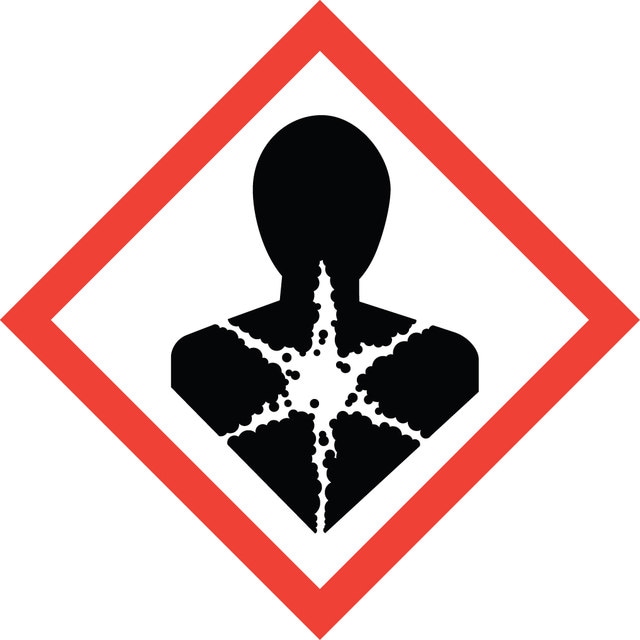
Carc. 2 - STOT RE 2 Inhalation
Organi bersaglio
Lungs
Codice della classe di stoccaggio
6.1D - Non-combustible acute toxic Cat.3 / toxic hazardous materials or hazardous materials causing chronic effects
Classe di pericolosità dell'acqua (WGK)
WGK 3
Punto d’infiammabilità (°F)
Not applicable
Punto d’infiammabilità (°C)
Not applicable
Dispositivi di protezione individuale
Gloves
Elenchi normativi
Forniamo informazioni su eventuali restrizioni prevalentemente per i prodotti chimici. Per altre tipologie di prodotto siamo in grado di fornire soltanto informazioni limitate. Nessuna segnalazione significa che nessuno dei componenti è citato in un elenco. È dovere dell’utilizzatore assicurarsi che il prodotto venga impiegato in maniera sicura e a norme di legge.
EU REACH Annex XVII (Restriction List)
CAS No.
Scegli una delle versioni più recenti:
Possiedi già questo prodotto?
I documenti relativi ai prodotti acquistati recentemente sono disponibili nell’Archivio dei documenti.
Anette Stauch et al.
PLoS neglected tropical diseases, 6(12), e1973-e1973 (2013-01-04)
Pentavalent antimonials have been the mainstay of antileishmanial therapy for decades, but increasing failure rates under antimonial treatment have challenged further use of these drugs in the Indian subcontinent. Experimental evidence has suggested that parasites which are resistant against antimonials
Budhaditya Mukherjee et al.
Proceedings of the National Academy of Sciences of the United States of America, 110(7), E575-E582 (2013-01-24)
The molecular mechanism of antimony-resistant Leishmania donovani (Sb(R)LD)-driven up-regulation of IL-10 and multidrug-resistant protein 1 (MDR1) in infected macrophages (Ms) has been investigated. This study showed that both promastigote and amastigote forms of Sb(R)LD, but not the antimony-sensitive form of
Daoyong Zhang et al.
Bioresource technology, 128, 711-715 (2012-12-19)
Extracellular polymeric substances (EPS) existed ubiquitously in biological systems affect the mobility and availability of heavy metals in the environments. The adsorption-desorption behaviors of Hg(II) and Sb(V) on EPS were investigated. The sorption rates follow Sb(V) > Hg(II), and the
Jian Chen et al.
Chemosphere, 90(6), 1925-1932 (2012-11-15)
Coal is one of the major energy resources in China, with nearly half of produced Chinese coal used for power and heat generation. The large use of coal for power and heat generation in China may result in significant atmospheric
Joseph N Jarvis et al.
Current opinion in infectious diseases, 26(1), 1-9 (2012-12-12)
HIV infection profoundly impairs the immune mechanisms needed to control and clear Leishmania infection, and outcomes in patients with HIV-associated visceral leishmaniasis are poor. This review summarizes recent work describing the epidemiology, presentation and outcomes of HIV-associated visceral leishmaniasis and
-
안녕하십니까 한가지 질문드리고 싶은게 있는데 혹시 이 "Antimony powder, -100 mesh, 99.5% trace metals basis" 이 제품이 100mesh 라고 되어있는데 평균 입자 크기가 어느정도 되는지 여쭤봐도 될까요?(D50기준) 감사합니다.
1 risposta-
Utile?
-
Filtri attivi
Il team dei nostri ricercatori vanta grande esperienza in tutte le aree della ricerca quali Life Science, scienza dei materiali, sintesi chimica, cromatografia, discipline analitiche, ecc..
Contatta l'Assistenza Tecnica