Passa al contenuto
Merck

G2289

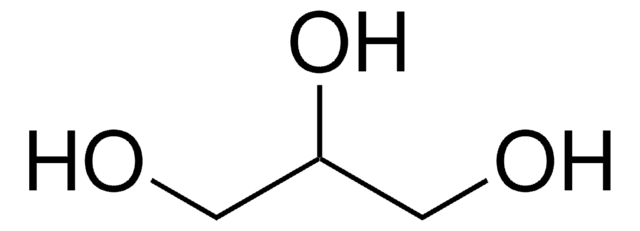
Glycerol

greener alternative

meets USP testing specifications

Sinonimo/i:

1,2,3-Propantriolo, Glicerina

Autenticati per visualizzare i prezzi organizzativi e contrattuali.

Scegli un formato

500 ML

331,00 €

1 L

568,65 €

4 L

1.394,00 €

20 L

1.990,00 €

331,00 €


Per informazioni sulla disponibilità, contatta il Servizio Clienti.

Richiedi un ordine in blocco

Informazioni su questo articolo

Formula condensata:
HOCH2CH(OH)CH2OH
Numero CAS:
Peso molecolare:
92.09
NACRES:
NA.21
PubChem Substance ID:
UNSPSC Code:
12352201
EC Number:
200-289-5
MDL number:
Beilstein/REAXYS Number:
635685

Vai a

Servizio Tecnico
Hai bisogno di aiuto? Il nostro team di scienziati qualificati è a tua disposizione.
Permettici di aiutarti

Nome del prodotto

Glicerolo, meets USP testing specifications

InChI key

PEDCQBHIVMGVHV-UHFFFAOYSA-N

InChI

1S/C3H8O3/c4-1-3(6)2-5/h3-6H,1-2H2

SMILES string

OCC(O)CO

biological source

plant (palm)

agency

USP/NF
meets USP testing specifications

vapor density

3.1 (vs air)

vapor pressure

<1 mmHg ( 20 °C)

assay

99.0-101.0% anhydrous basis

form

viscous liquid

autoignition temp.

698 °F

greener alternative product characteristics

Safer Solvents and Auxiliaries
Design for Degradation
Learn more about the Principles of Green Chemistry.

sustainability

Greener Alternative Product

technique(s)

cryopreservation: suitable
immunofluorescence: suitable

impurities

<0.01% Ash
<5% water (Karl Fischer)

refractive index

n20/D 1.474 (lit.)

bp

182 °C/20 mmHg (lit.)

mp

20 °C (lit.)

solubility

water: miscible

density

1.25 g/mL (lit.)

application(s)

agriculture
life science and biopharma
pharmaceutical (small molecule)
sample preparation

greener alternative category

Quality Level

Cerchi prodotti simili? Visita Guida al confronto tra prodotti

Confronta articoli simili

Visualizza il confronto per intero

Mostra le differenze

1 of 4

Questo articolo
PHR1020770671.37028
Glicerolo meets USP testing specifications

Sigma-Aldrich

G2289

Glicerolo

Glicerolo Pharmaceutical Secondary Standard; Certified Reference Material

Supelco

PHR1020

Glicerolo

Glicerolo analytical standard

Supelco

77067

Glicerolo

Glicerolo anhydrous (vegetable), EMPROVE&#174; EXPERT, Ph. Eur., BP, ChP, JP, ACS, USP

SAFC

1.37028

Glicerolo

biological source

plant (palm)

biological source

-

biological source

-

biological source

-

technique(s)

cryopreservation: suitable, immunofluorescence: suitable

technique(s)

HPLC: suitable, gas chromatography (GC): suitable

technique(s)

HPLC: suitable, gas chromatography (GC): suitable

technique(s)

electrophoresis: suitable

assay

99.0-101.0% anhydrous basis

assay

-

assay

≥98.5% (GC)

assay

≤98.0-101.0% (calculated on anhydrous substance, alkalimetric), ≥99.5% (calculated on anhydrous substance, GC)

Quality Level

300

Quality Level

300

Quality Level

100

Quality Level

500

solubility

water: miscible

solubility

-

solubility

-

solubility

-

form

viscous liquid

form

-

form

-

form

liquid

Application

Glycerol has been used

  • as a cryoprotectant in the sample medium for research related to plant physiology[1]
  • as an optical clearing agent in a study about harmonic generation microscopy[2]

Features and Benefits

  • Can be used in Metabolomics and Biochemical research
  • High-quality compound suitable for multiple research applications

General description

Glycerol, also referred to as glycerin or 1,2,3-propanetriol, is a remarkably versatile compound with its three hydroxyl groups, enabling strong solubility in water and rendering it hygroscopic. This simple but widely accessible substance has multifaceted applications, serving as both a carbon source and a precursor in diverse chemical and biological processes. In the realm of biotechnology, glycerol is an indispensable resource for various microorganisms, allowing them to produce a wide array of bioproducts when used as the sole carbon and energy source. Furthermore, glycerol finds extensive utility in sample preparation, where it enhances sample density and guards against freezing.Glycerol′s significance transcends biotechnology as it excels in sample preparation, such as electrophoresis gel creation. Concentrations of 5% to 10% glycerol are deployed to heighten sample density, ensuring precise layering at the base of the gel. This versatile compound also aids in casting gradient gels and acts as a stabilizer for proteins while playing a pivotal role in storage buffers. It is also a favored choice for enzyme concentration and storage, effectively preventing protein back-diffusion into the buffer. In the context of cell culture, glycerol proves its worth as a cryoprotectant, lowering the freezing point of the culture medium and shielding cells from ice crystal damage during -80°C freezing and storage.Glycerol plays a crucial role in sample preservation and storage in the field of biochemical research. Freezing bacterial cultures alone can have detrimental effects, resulting in dehydration and protein denaturation due to ice crystal formation. By incorporating glycerol, these issues are mitigated, ensuring the effective preservation of bacterial cultures. Storing bacterial cultures in glycerol stocks ensures stability, preventing harm to cell membranes and maintaining cell viability, thus enabling long-term storage. In the context of laboratory research, the preservation of sample integrity is paramount, and glycerol′s role in this process is instrumental, especially when stored in Ultra-low Temperature Freezers at -80°C to maintain sample integrity and ensure their suitability for extensive analysis and research.
We are committed to bringing you Greener Alternative Products, which adhere to one or more of the 12 Principles of Green Chemistry. Glycerol, with its high boiling point, low flammability, and polarity, is a standout choice. As a non-toxic and biodegradable compound, it aligns perfectly with the principles of ′Safer Solvents and Auxiliaries′ and ′Design for Degradation′. Click here for more information.

Other Notes

For additional information on our range of Biochemicals, please complete this form.

Classe di stoccaggio

10 - Combustible liquids

wgk

WGK 1

flash_point_f

390.2 °F - Pensky-Martens closed cup

flash_point_c

199 °C - Pensky-Martens closed cup

ppe

Eyeshields, Gloves, multi-purpose combination respirator cartridge (US)


Scegli una delle versioni più recenti:

Certificati d'analisi (COA)

Lot/Batch Number

Non trovi la versione di tuo interesse?

Se hai bisogno di una versione specifica, puoi cercare il certificato tramite il numero di lotto.

Possiedi già questo prodotto?

I documenti relativi ai prodotti acquistati recentemente sono disponibili nell’Archivio dei documenti.

Visita l’Archivio dei documenti

Starch-Based Superabsorbent Enhances the Growth and Physiological Traits of Ornamental Shrubs
Pacholczak A et al.
Agriculture Science Developments, 13, 1893-1893 (2023)
Jia-Hong Lai et al.
Scientific reports, 11(1), 329-329 (2021-01-13)
Imaging depth and quality of optical microscopy can be enhanced by optical clearing. Here we investigate the optical clearing of the ex vivo human skin by 50% glycerol topical application, which is allowed for cosmetic usage. Harmonic generation microscopy, by
Ruifang Wang et al.
Autophagy, 15(7), 1163-1181 (2019-02-12)
Influenza A virus can evade host innate immune response that is involved in several viral proteins with complicated mechanisms. To date, how influenza A M2 protein modulates the host innate immunity remains unclear. Herein, we showed that M2 protein colocalized
Shelley L Forrest et al.
The Journal of comparative neurology, 522(17), 3900-3927 (2014-07-22)
Artemin is a member of the glial cell line-derived neurotrophic factor (GDNF) family that has been strongly implicated in development and regeneration of autonomic nerves and modulation of nociception. Whereas other members of this family (GDNF and neurturin) primarily target
Nazish Ahmed et al.
Tissue engineering. Part A, 20(15-16), 2224-2233 (2014-03-13)
One of the factors preventing clinical application of regenerative medicine to degenerative cartilage diseases is a suitable source of cells. Chondrocytes, the only cell type of cartilage, grown in vitro under culture conditions to expand cell numbers lose their phenotype

Domande

1–2 di 2 domande  
  1. How can I determine the shelf life / expiration / retest date of this product?

    1 risposta
    1. If this product has an expiration or retest date, it will be shown on the Certificate of Analysis (COA, CofA). If there is no retest or expiration date listed on the product's COA, we do not have suitable stability data to determine a shelf life. For these products, the only date on the COA will be the release date; a retest, expiration, or use-by-date will not be displayed.
      For all products, we recommend handling per defined conditions as printed in our product literature and website product descriptions. We recommend that products should be routinely inspected by customers to ensure they perform as expected.
      For products without retest or expiration dates, our standard warranty of 1 year from the date of shipment is applicable.
      For more information, please refer to the Product Dating Information document: https://www.sigmaaldrich.com/deepweb/assets/sigmaaldrich/marketing/global/documents/418/501/product-dating-information-06-25-mk.pdf

      Utile?

  2. How is shipping temperature determined? And how is it related to the product storage temperature?

    1 risposta
    1. Products may be shipped at a different temperature than the recommended long-term storage temperature. If the product quality is sensitive to short-term exposure to conditions other than the recommended long-term storage, it will be shipped on wet or dry-ice. If the product quality is NOT affected by short-term exposure to conditions other than the recommended long-term storage, it will be shipped at ambient temperature. As shipping routes are configured for minimum transit times, shipping at ambient temperature helps control shipping costs for our customers. For more information, please refer to the Storage and Transport Conditions document: https://www.sigmaaldrich.com/deepweb/assets/sigmaaldrich/marketing/global/documents/316/622/storage-transport-conditions-mk.pdf

      Utile?

Recensioni

Nessuna valutazione

Filtri attivi

Il team dei nostri ricercatori vanta grande esperienza in tutte le aree della ricerca quali Life Science, scienza dei materiali, sintesi chimica, cromatografia, discipline analitiche, ecc..

Contatta l'Assistenza Tecnica
