
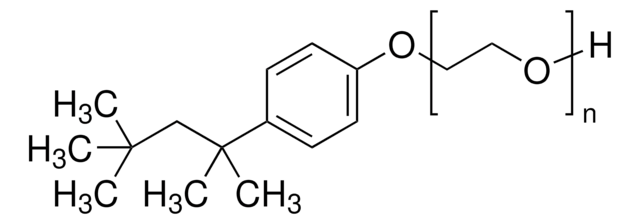




This product is not a certified reference material, nor has it been tested for use in HPLC/MS. As Triton X-100 is typically avoided in Mass Spectrometry, there is no analytical standard currently that is qualified for this application. The end user would have to determine suitability for use in HPLC/MS. However, this material is referenced in an LC/MS publication by Shimadzu. Please see the link below to review:
https://www.shimadzu.com/an/sites/shimadzu.com.an/files/pim/pim_document_file/technical/white_papers/13844/apo21759.pdf
X100

Triton™ X-100
laboratory grade
Triton™ X-100
Sinonimo/i:
t-Octylphenoxypolyethoxyethanol, Polyethylene glycol tert-octylphenyl ether
Autenticati per visualizzare i prezzi organizzativi e contrattuali.
Scegli un formato
5 ML
42,10 €
100 ML
75,30 €
500 ML
93,00 €
1 L
133,00 €
1 GAL
454,00 €
5 GAL
1.510,00 €
42,10 €
Per informazioni sulla disponibilità, contatta il Servizio Clienti.
Informazioni su questo articolo
Formula condensata:
t-Oct-C6H4-(OCH2CH2)xOH, x= 9-10
Numero CAS:
UNSPSC Code:
12161900
NACRES:
NA.21
PubChem Substance ID:
MDL number:
Beilstein/REAXYS Number:
2315025
Vai a
Servizio Tecnico
Hai bisogno di aiuto? Il nostro team di scienziati qualificati è a tua disposizione.
Permettici di aiutartiNome del prodotto
Triton™ X-100, laboratory grade
InChI
1S/C28H50O8/c1-27(2,3)24-28(4,5)25-6-8-26(9-7-25)36-23-22-35-21-20-34-19-18-33-17-16-32-15-14-31-13-12-30-11-10-29/h6-9,29H,10-24H2,1-5H3
SMILES string
CC(C)(C)CC(C)(C)c1ccc(OCCOCCOCCOCCOCCOCCOCCO)cc1
InChI key
HNLXNOZHXNSSPN-UHFFFAOYSA-N
biological source
synthetic
grade
laboratory grade
description
non-ionic
form
liquid
mol wt
micellar avg mol wt 80,000
average mol wt 625
aggregation number
100-155
CMC
0.2-0.9 mM (20-25°C)
mp
6 °C (43 °F)
transition temp
cloud point 65 °C
pour point ~7 °C
solubility
water: 0.1 mL/mL, clear to slightly hazy, colorless to faintly yellow
HLB
13.5
Quality Level
Cerchi prodotti simili? Visita Guida al confronto tra prodotti
Categorie correlate
1 of 4
Questo articolo | X114 | T9284 | 1.08643 |
|---|---|---|---|
| grade laboratory grade | grade laboratory grade | grade - | grade - |
| form liquid | form - | form liquid | form liquid |
| aggregation number 100-155 | aggregation number - | aggregation number 100-155 | aggregation number 100-155 |
| biological source synthetic | biological source - | biological source synthetic | biological source - |
| Quality Level 200 | Quality Level 200 | Quality Level 200 | Quality Level 500 |
| CMC 0.2-0.9 mM (20-25°C) | CMC 0.2 mM (20-25°C) | CMC 0.2-0.9 mM (20-25°C) | CMC 0.2-0.9 mM (20-25°C) |
Application
Il Triton™-X è stato utilizzato:
- per la permeabilizzazione delle cellule da sottoporre a colorazione mediante immunofluorescenza[1]
- come componente del tampone di lisi nel western blotting[1]
- come componente della soluzione salina tamponata con Tris per la preparazione delle sezioni cellulari nella marcatura Immunogold per scopi di microscopia elettronica[1]
Biochem/physiol Actions
Tensioattivo non ionico di uso comune adoperato per il recupero dei componenti di membrana in condizioni delicate non denaturanti.
Features and Benefits
- Ideale per applicazioni di ricerca in biologia cellulare e in biochimica
- Detergente non ionico e non denaturante
- Agente bagnante ed emulsionante di qualità superiore
- Tensioattivo altamente versatile
General description
Triton™ X-100 è un comune tensioattivo ed emulsionante non ionico utilizzato di frequente nelle applicazioni biochimiche per solubilizzare le proteine. È considerato un detergente relativamente delicato, non denaturante, ed è citato in numerosi riferimenti bibliografici come reagente di uso abituale. Viene usato per la lisi cellulare finalizzata all′estrazione di proteine e organuli cellulari. Può inoltre permeabilizzare la membrana delle cellule viventi per la trasfezione.[4][5]
Other Notes
Per ulteriori informazioni sulla nostra gamma di Composti biochimici, compilare questo modulo.
Legal Information
Triton is a trademark of The Dow Chemical Company or an affiliated company of Dow
Comparable product
N° Catalogo
Descrizione
Determinazione del prezzo
Related product
N° Catalogo
Descrizione
Determinazione del prezzo
signalword
Danger
hcodes
Hazard Classifications
Acute Tox. 4 Oral - Aquatic Acute 1 - Aquatic Chronic 1 - Eye Dam. 1 - Skin Irrit. 2
Classe di stoccaggio
10 - Combustible liquids
wgk
WGK 3
flash_point_f
483.8 °F - closed cup
flash_point_c
251 °C - closed cup
ppe
Eyeshields, Faceshields, Gloves, type ABEK (EN14387) respirator filter, type N95 (US)
Scegli una delle versioni più recenti:
Possiedi già questo prodotto?
I documenti relativi ai prodotti acquistati recentemente sono disponibili nell’Archivio dei documenti.
Growth and hydration of Triton X-100 micelles in monovalent alkali salts: a light scattering study
Molina-Bolivar JA, et al.
The Journal of Physical Chemistry B, 106(4), 870-877 (2002)
José Francisco Lima-Barbero et al.
Experimental & applied acarology, 78(4), 555-564 (2019-08-02)
Blood-feeding ectoparasites constitute a growing burden for human and animal health, and animal production worldwide. In particular, mites (Acari: Gamasida) of the genera Dermanyssus (Dermanyssidae) and Ornithonyssus (Macronyssidae) infest birds and cause gamasoidosis in humans. The tropical fowl mite, Ornithonyssus
Knockdown of miR-210 decreases hypoxic glioma stem cells stemness and radioresistance
Yang W, et al.
Experimental Cell Research, 326(1), 22-35 (2003)
alpha -Synuclein Is Degraded by Both Autophagy and the Proteasome
Webb LJ, et al.
The Journal of Biological Chemistry, 278(27), 25009-25013 (2003)
Masoumeh Zangeneh et al.
Materials science & engineering. C, Materials for biological applications, 103, 109739-109739 (2019-07-28)
The purpose of this study was to investigate the radiation dose enhancement effects of gadolinium-doped zinc oxide nanoparticles (Gd-doped ZnO NPs) under the megavoltage (MV) X-ray irradiation. ZnO NPs have preferred photocatalytic properties under UV light for cancer killing. UV
Articoli
Millicell® hanging cell culture inserts for staining and microscopic analysis directly from the insert. Learn to utilize hanging cell culture inserts in barrier measurements.
Protocolli
Enzymatic activity assay for cholesterol oxidase, excluding specific product numbers, providing guidelines for accurate cholesterol oxidase assays.
Techniques for protein antigen molecular weight determination, protein interactions, enzymatic activity, and post-translational modifications.
This page shows how to solubilize membrane proteins with products from Cytiva.
-
Salve Questo è uno standard Certificato oppure un materiale di riferimento? Posso usarlo come standard per retta di taratura in HPLC_MS?
1 risposta-
Utile?
-
-
How can I determine the shelf life / expiration / retest date of this product?
1 risposta-
If this product has an expiration or retest date, it will be shown on the Certificate of Analysis (COA, CofA). If there is no retest or expiration date listed on the product's COA, we do not have suitable stability data to determine a shelf life. For these products, the only date on the COA will be the release date; a retest, expiration, or use-by-date will not be displayed.
For all products, we recommend handling per defined conditions as printed in our product literature and website product descriptions. We recommend that products should be routinely inspected by customers to ensure they perform as expected.
For products without retest or expiration dates, our standard warranty of 1 year from the date of shipment is applicable.
For more information, please refer to the Product Dating Information document: https://www.sigmaaldrich.com/deepweb/assets/sigmaaldrich/marketing/global/documents/418/501/product-dating-information-06-25-mk.pdfUtile?
-
-
What kind of change will be observed if heat up to 55C? Will it attack stacked Al and Ti metal layer? Can it mix with diluted nitric acid to etch Cu/NiV?
1 risposta-
Heating this product to 55°C may lead to changes in viscosity, solubility, or performance characteristics. There is no indication that this product can attack aluminum and titanium metal layers. This product is generally compatible with diluted nitric acid. While no specific incompatibility is reported, the combination may alter the properties of both the surfactant and the acid, potentially affecting the performance of either in applications such as cleaning or etching. Additionally, it is important to consider the concentration and the potential for foaming or other reactions during mixing.
Utile?
-
-
Is this product nuclease-free?
1 risposta-
The product is not tested for RNase or DNase. Please see the link below to review Triton X-100 product options that include RNase and DNase testing:
https://www.sigmaaldrich.com/product/compare?term=triton%20x-100%20nuclease&focus=products&page=1&perpage=30&sort=relevance&type=product&products=T8787%3ASIGMA%3Asial%2C648466%3AMM%3Asial&returnUrl=%2Fsearch%2Ftriton-x-100-nucleaseUtile?
-
-
How long is Triton X-100 stable at -80 degrees in buffer?
1 risposta-
At -80°C, Triton X-100 is generally stable, but the stability can depend on the specific buffer conditions and the concentration of the detergent. In most cases, Triton X-100 remains effective at low temperatures, but it is advisable to avoid repeated freeze-thaw cycles, as these can lead to changes in the detergent's properties and effectiveness. Please note that the shelf life after opening is dependent upon various factors which might affect the stability and, therefore, it is not guaranteed and needs to be determined by the end user.
Utile?
-
-
If a sterilization of Triton X-100 or its dilutions (maximum 10% of Triton X-100 in the total volume) is needed to remove DNAse and RNAse, what's the best approach?
1 risposta-
Autoclaving undiluted Triton X-100 is generally not recommended for sterilization. However, dilute solutions, up to 10%, may be autoclaved. At certain
concentrations, solutions may become cloudy, but dispersible above the cloud point. The solution will clarify with stirring upon cooling. Note that DNAse and RNAse-free products are currently available. Please see the links below to review these product options:
https://www.sigmaaldrich.com/product/sigma/t8787
https://www.sigmaaldrich.com/product/mm/648466
https://www.sigmaaldrich.com/product/sigma/93443Utile?
-
-
How is shipping temperature determined? And how is it related to the product storage temperature?
1 risposta-
Products may be shipped at a different temperature than the recommended long-term storage temperature. If the product quality is sensitive to short-term exposure to conditions other than the recommended long-term storage, it will be shipped on wet or dry-ice. If the product quality is NOT affected by short-term exposure to conditions other than the recommended long-term storage, it will be shipped at ambient temperature. As shipping routes are configured for minimum transit times, shipping at ambient temperature helps control shipping costs for our customers. For more information, please refer to the Storage and Transport Conditions document: https://www.sigmaaldrich.com/deepweb/assets/sigmaaldrich/marketing/global/documents/316/622/storage-transport-conditions-mk.pdf
Utile?
-
-
What are the storage conditions for the Triton 100x? It's not in the COA
1 risposta-
This product may be be stored in room temperature.
Utile?
-
-
What is the correct CAS number for Triton X-100, 9002-93-1 or 9036-19-5?
1 risposta-
CAS 9036-19-5 is a generic CAS number and is correct for Triton® X-100. With this number, neither the substitution pattern of the aromatic ring (para, meta, ortho), nor the amount of the repeating units of the oxyethylene units is specified or described. Triton® X-100 with CAS 9002-93-1 is also correct but it defines only the para-substitution.
Utile?
-
-
Will heating Triton to reduce its viscosity have any negative impact on the product? Does heating negatively affect the activity of Triton?
1 risposta-
Triton X-100 can be frozen, thawed, and used. However, caution is advised when heating it above 50°C, as discoloration may occur. This note indicates that excessive heating can lead to some form of change in Triton X-100. It would be reasonable to assume that the recommended working range is from ambient temperature to 50°C (or slightly lower). If your process requires heating the solution to temperatures higher than 50°C, it is recommended to add Triton X-100 only after the temperature has dropped below 50°C or lower. If you need to work at temperatures exceeding 50°C, it is advisable to conduct solution stability studies to assess potential damage or breakdown of Triton X-100.
Utile?
-
Filtri attivi
Il team dei nostri ricercatori vanta grande esperienza in tutte le aree della ricerca quali Life Science, scienza dei materiali, sintesi chimica, cromatografia, discipline analitiche, ecc..
Contatta l'Assistenza Tecnica