
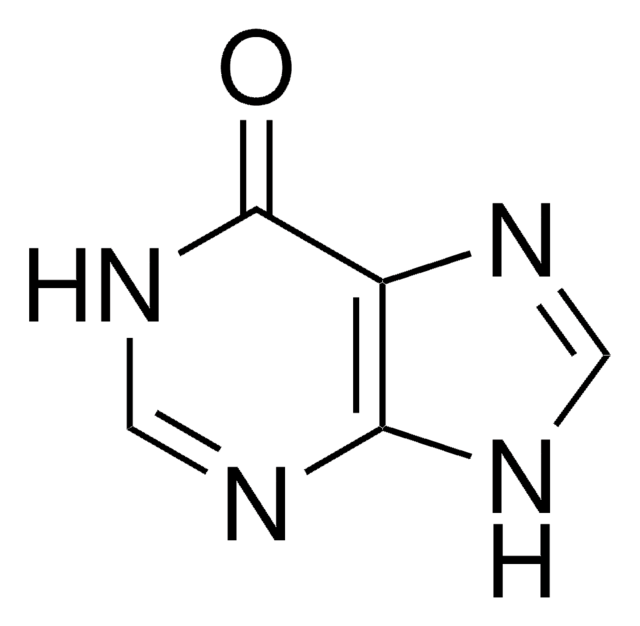
The solubility of H9377 has been tested at a concentration of 50 mg/ml in a mixture of 2 parts formic acid to 1 part water, equivalent to a 5% solution. While this may not represent the maximum solubility in the formic acid water mixture, it is the available data. The molecular weight of Hypoxanthine is 136.11 amu, and a 1M solution can be prepared by dissolving 136.11 grams in 1 liter of solvent, provided that there is a suitable solvent for dissolution. This amount can be scaled down to the desired volume. Aliquots should be stored at -20°C for up to 6 months.
H9377

Hypoxanthine
≥99.0%, synthetic (organic), powder
Sinonimo/i:
6-Hydroxypurine
Autenticati per visualizzare i prezzi organizzativi e contrattuali.
Scegli un formato
1 G
65,70 €
5 G
135,00 €
25 G
203,00 €
100 G
545,00 €
65,70 €
Per informazioni sulla disponibilità, contatta il Servizio Clienti.
Informazioni su questo articolo
Formula empirica (notazione di Hill):
C5H4N4O
Numero CAS:
Peso molecolare:
136.11
NACRES:
NA.51
PubChem Substance ID:
UNSPSC Code:
41106305
EC Number:
200-697-3
MDL number:
Beilstein/REAXYS Number:
5811
Vai a
Servizio Tecnico
Hai bisogno di aiuto? Il nostro team di scienziati qualificati è a tua disposizione.
Permettici di aiutartiNome del prodotto
Hypoxanthine, ≥99.0%
InChI key
FDGQSTZJBFJUBT-UHFFFAOYSA-N
InChI
1S/C5H4N4O/c10-5-3-4(7-1-6-3)8-2-9-5/h1-2H,(H2,6,7,8,9,10)
SMILES string
O=C1NC=Nc2nc[nH]c12
biological source
synthetic (organic)
assay
≥99.0%
form
powder
mp
>300 °C (lit.)
solubility
formic acid: water (2:1): 50 mg/mL, clear to slightly hazy, colorless to yellow
Quality Level
Cerchi prodotti simili? Visita Guida al confronto tra prodotti
Categorie correlate
1 of 4
Questo articolo | H9636 | 1191226 | Y0000441 |
|---|---|---|---|
| biological source synthetic (organic) | biological source - | biological source - | biological source - |
| Quality Level 300 | Quality Level 200 | Quality Level - | Quality Level - |
| form powder | form powder | form - | form - |
| assay ≥99.0% | assay ≥99% | assay - | assay - |
| solubility formic acid: water (2:1): 50 mg/mL, clear to slightly hazy, colorless to yellow | solubility formic acid: water (2:1): 50 mg/mL | solubility - | solubility - |
| mp >300 °C (lit.) | mp >300 °C (lit.) | mp >300 °C (lit.) | mp >300 °C (lit.) |
Application
Hypoxanthine is a nutrient additive for a variety of cell culture applications involving bacterial, parasite (Plasmodium falciparum) and animal cells. Hypoxanthine is a component of selection media used in hybridoma technologies.
Hypoxanthine has been used:
- to gavage mice and to evaluate the activity of xanthine oxidase (XO) in pasteurized whole milk in vivo in potassium oxonate (PO) -induced mouse model of hyperuricemia[1]
- as a supplement in Iscove′s modified Dulbecco′s medium (IMDM) medium to cultivate in-vitro cell line (EL-1 cells)[2]
- as a pure standard for the quantification of hypoxanthine in vitreous fluid sample using high-performance liquid chromatography-ultra-violet (HPLC-UV) for the estimation of post-mortem interval[3]
Biochem/physiol Actions
Hypoxanthine acts as an intermediate in purine metabolism. It elicits a vital role as a 5′-base of the anticodon in a few transfer-RNAs. Though similar to guanine (Gua), it is devoid of the exocyclic amino group at C(2) position.[4] It may be used as a substrate to study the specificity and kinetics of hypoxanthine-guanine phosphoribosyl transferases.[5]
Classe di stoccaggio
11 - Combustible Solids
wgk
WGK 3
flash_point_f
Not applicable
flash_point_c
Not applicable
ppe
Eyeshields, Gloves, type N95 (US)
Scegli una delle versioni più recenti:
Possiedi già questo prodotto?
I documenti relativi ai prodotti acquistati recentemente sono disponibili nell’Archivio dei documenti.
Influence of the nature of death in biochemical analysis of the vitreous humour for the estimation of post-mortem interval
Perez-Martinez C, et al.
Australian journal of public health (2020)
Different processed milk with residual xanthine oxidase activity and risk of increasing serum uric acid level
Sha W, et al.
Food Bioscience (2021)
Dhaksshaginy Rajalingam et al.
International archives of occupational and environmental health, 94(8), 1905-1915 (2021-06-03)
Several studies show that severe social stressors, e.g., in the form of exposure to workplace bullying in humans, is associated with negative mental health effects such as depression and anxiety among those targeted. However, the understanding of the underlying biological
Javier Acosta et al.
Frontiers in bioengineering and biotechnology, 8, 677-677 (2020-07-17)
In our search for novel biocatalysts for the synthesis of nucleic acid derivatives, we found a good candidate in a putative dual-domain hypoxanthine-guanine phosphoribosyltransferase (HGPRT)/adenylate kinase (AMPK) from Zobellia galactanivorans (ZgHGPRT/AMPK). In this respect, we report for the first time
Ultrafast electronic deactivation dynamics of the rare natural nucleobase hypoxanthine
Rottger K, et al.
Chemical Physics Letters (2012)
Articoli
Uric acid present in animal sera impacts serum-supplemented classical cell culture systems, influencing cell culture performance.
-
What are the instructions for preparing a 1M hypoxanthine stock solution?
1 risposta-
Utile?
-
Filtri attivi
Il team dei nostri ricercatori vanta grande esperienza in tutte le aree della ricerca quali Life Science, scienza dei materiali, sintesi chimica, cromatografia, discipline analitiche, ecc..
Contatta l'Assistenza Tecnica