Skip to Content
MilliporeSigma

E29109

2-Ethylhexanal

96%

Synonym(s):

2-Ethylcapronaldehyde

Sign In to View Organizational & Contract Pricing.

Select a Size

5 ML

$37.05

250 ML

$112.50

$37.05

List Price$49.40Save 25%

Available to ship TODAYDetails


Ships Every 4 weeks

About This Item

Linear Formula:
CH3(CH2)3CH(C2H5)CHO
CAS Number:
Molecular Weight:
128.21
UNSPSC Code:
12352100
NACRES:
NA.22
PubChem Substance ID:
EC Number:
204-596-5
Beilstein/REAXYS Number:
1700556
MDL number:

Skip To

Technical Service
Need help? Our team of experienced scientists is here for you.
Let Us Assist

Product Name

2-Ethylhexanal, 96%

InChI key

LGYNIFWIKSEESD-UHFFFAOYSA-N

InChI

1S/C8H16O/c1-3-5-6-8(4-2)7-9/h7-8H,3-6H2,1-2H3

SMILES string

[H]C(=O)C(CC)CCCC

assay

96%

form

liquid

impurities

<4% 2-ethylhexanoic acid

refractive index

n20/D 1.415 (lit.)

bp

55 °C/13.5 mmHg (lit.)

density

0.822 g/mL at 25 °C (lit.)

Quality Level

Looking for similar products? Visit Product Comparison Guide

Compare Similar Items

View Full Comparison

Show Differences

1 of 4

This Item
68938645340185914
assay

96%

assay

≥97.0% (GC)

assay

≥99% (GC)

assay

99%

Quality Level

100

Quality Level

100

Quality Level

200

Quality Level

100

bp

55 °C/13.5 mmHg (lit.)

bp

-

bp

115-117 °C (lit.)

bp

162 °C (lit.)

refractive index

n20/D 1.415 (lit.)

refractive index

n20/D 1.406

refractive index

n20/D 1.438 (lit.)

refractive index

n20/D 1.525 (lit.)

form

liquid

form

liquid

form

-

form

liquid

density

0.822 g/mL at 25 °C (lit.)

density

0.835 g/mL at 20 °C

density

1.183 g/mL at 25 °C (lit.)

density

1.16 g/mL at 25 °C (lit.)

Application

2-Ethylhexanal can be used as:
  • A reductant in the Mukaiyama epoxidation of cis-cyclooctene.[1]
  • A reactant in the Horner-Wadsworth-Emmons reaction to synthesize cis-α,β-unsaturated amides.[2]
  • A starting material to synthesize 2-ethylhexanoic acid using manganese(II) acetate as a catalyst.[3]

General description

2-Ethylhexanal is an aliphatic aldehyde used as an intermediate to produce various useful products such as perfumes, disinfectants, paints, warning agents, insecticides, and leak detectors.[4]

signalword

Warning

Hazard Classifications

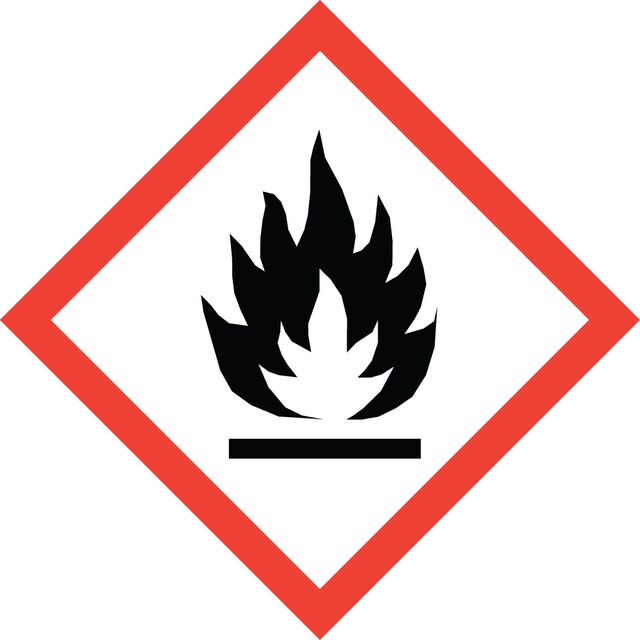
Flam. Liq. 3 - Repr. 2 - Skin Sens. 1

Storage Class

3 - Flammable liquids

wgk

WGK 1

flash_point_f

111.2 °F - closed cup

flash_point_c

44 °C - closed cup

ppe

Eyeshields, Faceshields, Gloves, type ABEK (EN14387) respirator filter


Choose from one of the most recent versions:

Certificates of Analysis (COA)

Lot/Batch Number

Don't see the Right Version?

If you require a particular version, you can look up a specific certificate by the Lot or Batch number.

Already Own This Product?

Find documentation for the products that you have recently purchased in the Document Library.

Visit the Document Library

G Casperson et al.
Journal of basic microbiology, 26(5), 259-269 (1986-01-01)
Analogs of the natural substance (E)-hex-2-en-1-al which occurs naturally in green plants and is known to have microbiocidal properties were synthesized and studied with respect to their antifungal properties. Saturated and unsaturated aldehydes, alcohols, carbon acids and enolacetate were tested
D L Wood et al.
Poultry science, 63(3), 469-477 (1984-03-01)
Di-(2-ethylhexyl) phthalate (DEHP) and three structurally related side-chain analogs were fed to laying hens to determine relationships of structure to effects on lipid metabolism. Hubbard broiler breeder hens were fed either a standard laying mash control diet or the control
Factors affecting the selectivity of air oxidation of 2-ethyhexanal, an α-branched aliphatic aldehyde
Lehtinen C and Brunow G
Organic Process Research & Development, 4, 544-549 (2000)
Continuous catalytic ?one-pot? multi-step synthesis of 2-ethylhexanal from crotonaldehyde
Seki T, et al.
Chemical Communications (Cambridge, England), 3562-3564 (2007)
Heather L Voegtle et al.
Journal of chemical ecology, 34(2), 215-219 (2008-01-24)
E-2-ethyl-2-hexen-1-ol (1), mellein (4), and 4-hydroxymellein (5) were identified as the major volatile compounds in the head and/or thorax of Camponotus quadrisectus. Neither 1 nor 5 have been previously detected in insects. Also identified were small amounts of m-cresol (2)

Questions

Reviews

No rating value

Active Filters

Our team of scientists has experience in all areas of research including Life Science, Material Science, Chemical Synthesis, Chromatography, Analytical and many others.

Contact Technical Service