
N7769

Nivalenol from Fusarium nivale
≥98%
Synonym(s):
3α,4β,7α,15-Tetrahydroxy-12,13-epoxytrichothec-9-en-8-one
Sign In to View Organizational & Contract Pricing
About This Item
Empirical Formula (Hill Notation):
C15H20O7
CAS Number:
Molecular Weight:
312.32
MDL number:
UNSPSC Code:
12352200
Skip To
assay
≥98%
storage temp.
2-8°C
SMILES string
CC1=C[C@H]2O[C@@H]3[C@H](O)[C@@H](O)[C@@](C)([C@]34CO4)[C@@]2(CO)[C@H](O)C1=O
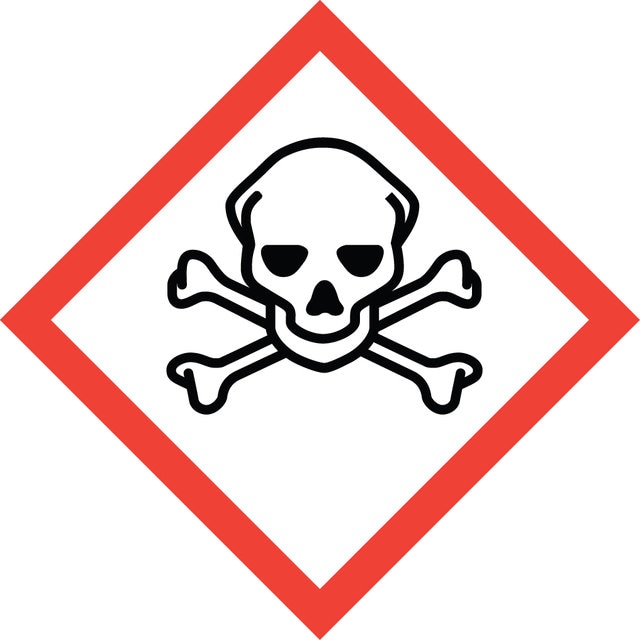
signalword
Danger
hcodes
Hazard Classifications
Acute Tox. 1 Inhalation - Acute Tox. 1 Oral - Acute Tox. 2 Dermal
Storage Class
6.1A - Combustible acute toxic Cat. 1 and 2 / very toxic hazardous materials
wgk_germany
WGK 3
flash_point_f
Not applicable
flash_point_c
Not applicable
ppe
Eyeshields, Faceshields, Gloves, type P3 (EN 143) respirator cartridges
Choose from one of the most recent versions:
Already Own This Product?
Find documentation for the products that you have recently purchased in the Document Library.
Marisanta Del Regno et al.
Toxicology and applied pharmacology, 285(2), 118-127 (2015-04-18)
Mycotoxins are secondary fungal metabolites often found as contaminants in almost all agricultural commodities worldwide, and the consumption of food or feed contaminated by mycotoxins represents a major risk for human and animal health. Reactive oxygen species are normal products
E D Van Asselt et al.
Food additives & contaminants. Part A, Chemistry, analysis, control, exposure & risk assessment, 29(10), 1556-1565 (2012-06-30)
Mycotoxins are secondary metabolites produced by fungi that can cause adverse health effects. Due to climate change, temperatures are expected to rise and changes in rainfall patterns are foreseen. These developments may increase fungal occurrence and mycotoxin concentrations in maize.
G Barros et al.
Food additives & contaminants. Part A, Chemistry, analysis, control, exposure & risk assessment, 29(2), 293-303 (2011-05-21)
Soybean (Glycine max L.), the main source of protein throughout the world, is used both as a food and a feedstuff. Currently, limited information about the occurrence of Fusarium species and mycotoxins in soybean grain and by-products is available. The
Tadahiro Suzuki et al.
Journal of agricultural and food chemistry, 60(37), 9519-9527 (2012-08-18)
Type B trichothecenes, deoxynivalenol (DON) and nivalenol (NIV), are secondary metabolites of Fusarium species and are major pollutants in food and feed products. Recently, the production trend of their derivatives, 3-acetyldeoxynivalenol (3-AcDON), 15-acetyldeoxynivalenol (15-AcDON), and 4-acetylnivalenol (4-AcNIV or fusarenon-X), has
Jungkwan Lee et al.
Applied and environmental microbiology, 78(7), 2161-2167 (2012-01-31)
Fusarium graminearum (Gibberella zeae) is an important pathogen of wheat, maize, barley, and rice in South Korea, and harvested grain often is contaminated with trichothecenes such as deoxynivalenol and nivalenol. In this study, we examined 568 isolates of F. graminearum
Our team of scientists has experience in all areas of research including Life Science, Material Science, Chemical Synthesis, Chromatography, Analytical and many others.
Contact Technical Service