
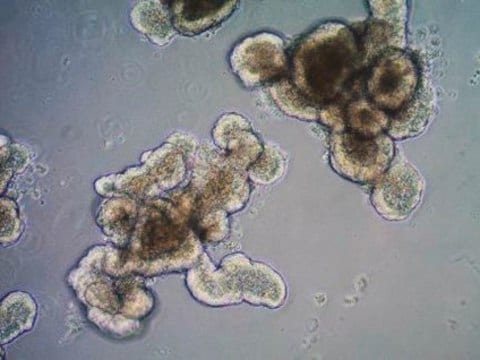


Organoids can be stained with antibodies for immunocytochemical (ICC)/Immunohistochemical (IHC) analysis using either whole-mount or paraffin embedding/sectioning techniques. It is critical to use antibodies prequalified for organoid analysis.
SCM300

3dGRO® Organoid Dissociation Reagent
Chemically defined enzyme-free organoid dissociation solution.
Synonym(s):
Organoid passaging reagent
Sign In to View Organizational & Contract Pricing.
Select a Size
Change View
| Size/SKU | Availability | Price |
|---|---|---|
100 mL | Check Cart for Availability | $76.00 |
About This Item
UNSPSC Code:
12352207
NACRES:
NA.71
eCl@ss:
32160801
$76.00
Check Cart for Availability
form
liquid
technique(s)
cell culture | stem cell: suitable
General description
Organoids are in-vitro derived 3D cell aggregates derived from primary tissue or stem cells that are capable of self-renewal, self-organization and exhibit organ functionality. Organoids address the limitations of existing 2D model systems by providing:
• Similar composition and architecture to primary tissue: Organoids harbor small population of self-renewing stem cells (such as intestinal crypt stem cells) that can differentiate into cells of all major cell lineages, with similar frequency as in physiological conditions.
• Relevant models of in-vivo conditions: Organoids are more biologically relevant to any model system and are amenable to manipulate niche components and gene expression.
• Stable system for extended cultivation: Organoids can be cryopreserved as biobanks and expanded indefinitely by leveraging self-renewal and the differentiation capability of the stem cell populations.
The 3dGRO Organoid Dissociation Reagent is a proprietary chemically defined enzyme-free dissociation solution used to passage multiple organoid cell types (etc. mouse intestinal organoids, human colon and lung organoids). Due to its chemically defined nature, the reagent produces consistent organoid passaging results. 3dGRO Organoid Dissociation Reagent can be used in combination with the 3dGRO R-Spondin-1 Conditioned Media Supplement (SCM104) to isolate and passage primary intestinal organoids from mice or in combination with the 3dGRO Human iPSC Derived Colon Organoid Expansion Medium (SCM304) to expand human iPSC derived colon organoids (SCC300).
• Similar composition and architecture to primary tissue: Organoids harbor small population of self-renewing stem cells (such as intestinal crypt stem cells) that can differentiate into cells of all major cell lineages, with similar frequency as in physiological conditions.
• Relevant models of in-vivo conditions: Organoids are more biologically relevant to any model system and are amenable to manipulate niche components and gene expression.
• Stable system for extended cultivation: Organoids can be cryopreserved as biobanks and expanded indefinitely by leveraging self-renewal and the differentiation capability of the stem cell populations.
The 3dGRO Organoid Dissociation Reagent is a proprietary chemically defined enzyme-free dissociation solution used to passage multiple organoid cell types (etc. mouse intestinal organoids, human colon and lung organoids). Due to its chemically defined nature, the reagent produces consistent organoid passaging results. 3dGRO Organoid Dissociation Reagent can be used in combination with the 3dGRO R-Spondin-1 Conditioned Media Supplement (SCM104) to isolate and passage primary intestinal organoids from mice or in combination with the 3dGRO Human iPSC Derived Colon Organoid Expansion Medium (SCM304) to expand human iPSC derived colon organoids (SCC300).
Application
Chemically defined enzyme-free organoid dissociation solution.
Research Category
Cell Culture
Stem Cell Research
Cell Culture
Stem Cell Research
Preparation Note
Store the 3dGRO Organoid Dissociation Reagent at room temperature. Aliquot into smaller working aliquots before use to avoid reagent contamination issues.
Analysis Note
Appearance: Clear, Liquid
Osmolality: 340-370 mOsm
Sterility Tested: No Growth/Pass
Endotoxin; <2 EU/ml
pH: 7.2-7.4
Osmolality: 340-370 mOsm
Sterility Tested: No Growth/Pass
Endotoxin; <2 EU/ml
pH: 7.2-7.4
Legal Information
3dGRO is a registered trademark of Merck KGaA, Darmstadt, Germany
Disclaimer
Unless otherwise stated in our catalog or other company documentation accompanying the product(s), our products are intended for research use only and are not to be used for any other purpose, which includes but is not limited to, unauthorized commercial uses, in vitro diagnostic uses, ex vivo or in vivo therapeutic uses or any type of consumption or application to humans or animals.
1 of 1
This Item | |||
|---|---|---|---|
| description Chemically defined enzyme-free organoid dissociation solution. | description Complete serum-free organoid media for the expansion and long-term 3D culture of human intestinal colon organoids. | description Optimized cryopreservation media for multiple organoids cell types. | description Normal Adjacent (CRC), Colon, Age: 40, Male, Mutation: None |
| form liquid | form liquid | form liquid | form - |
| technique(s) cell culture | stem cell: suitable | technique(s) cell culture | stem cell: suitable | technique(s) cell culture | stem cell: suitable | technique(s) cell culture: suitable |
Storage Class
12 - Non Combustible Liquids
WGK
WGK 2
Flash Point (°F)
Not applicable
Flash Point (°C)
Not applicable
Choose from one of the most recent versions:
Already Own This Product?
Find documentation for the products that you have recently purchased in the Document Library.
-
How do you stain organoids with antibodies?
1 answer-
Helpful?
-
-
How Do you Extract RNA/DNA from Organoids in Cultured in Matrigel?
1 answer-
Traditional DNA/RNA isolation kits can be used to prepare genomic material for sequencing (RNA-seq, scRNA-seq, WGS, CHIP-seq etc). For some applications with large organoids, tissue specific DNA/RNA extraction kits are recommended. TRI Reagent (T9424) can be added to the dissociated organoids before RNA extraction and can be stored at -80 °C until future use.
Helpful?
-
-
How are organoids cultured?
1 answer-
Once isolated, organoids are cultured in specialized media embedded in a rich extracellular matrix (ECM) basement membrane extract hydrogel such as Growth Factor Reduced Matrigel. Media is replenished every other day and cells are passaged once per week (7-12 days) before cells become too large or necrotic. Cells can be passaged in either small clump fragments or as single cells using mechanical dissociation/enzyme-free passaging reagents. Depending on organoid type and confluency, split ratios of roughly 1:3-1:4 can be used when passaging organoids. For sensitive organoid types, ROCKi (Y27632) (SCM075) can be added during passaging to help in promoting cell viability.
Helpful?
-