



If this product has an expiration or retest date, it will be shown on the Certificate of Analysis (COA, CofA). If there is no retest or expiration date listed on the product's COA, we do not have suitable stability data to determine a shelf life. For these products, the only date on the COA will be the release date; a retest, expiration, or use-by-date will not be displayed.
For all products, we recommend handling per defined conditions as printed in our product literature and website product descriptions. We recommend that products should be routinely inspected by customers to ensure they perform as expected.
For products without retest or expiration dates, our standard warranty of 1 year from the date of shipment is applicable.
For more information, please refer to the Product Dating Information document: https://www.sigmaaldrich.com/deepweb/assets/sigmaaldrich/marketing/global/documents/418/501/product-dating-information-06-25-mk.pdf
360481

1,4-Dioxane
ACS reagent, ≥99.0%, contains ≤50 ppm BHT as stabilizer
Synonym(s):
Diethylene oxide, Dioxane
Select a Size
| Size/SKU | Availability | Price |
|---|
About This Item
grade
ACS reagent
Quality Segment
vapor density
3 (vs air)
vapor pressure
27 mmHg ( 20 °C), 40 mmHg ( 25 °C)
assay
≥99.0%
form
liquid
autoignition temp.
356 °F
contains
≤50 ppm BHT as stabilizer
expl. lim.
22 %
dilution
(for analytical testing)
impurities
≤0.0016 meq/g Titr. acid, ≤0.005% Peroxide (as H2O2), ≤0.01% Carbonyl (as HCHO), ≤0.05% water
evapn. residue
≤0.005%
color
APHA: ≤20
refractive index
n20/D 1.422 (lit.)
pH
6.0-8 (20 °C, 500 g/L)
bp
100-102 °C (lit.)
mp
10-12 °C (lit.)
transition temp
freezing point ≥11.0
density
1.034 g/mL at 25 °C (lit.)
SMILES string
C1COCCO1
InChI
1S/C4H8O2/c1-2-6-4-3-5-1/h1-4H2
InChI key
RYHBNJHYFVUHQT-UHFFFAOYSA-N
General description
Premium ACS Solvents: Our solvents meet or exceed the stringent standards set by the American Chemical Society, ensuring high quality and reliability for your laboratory applications.
Replicable and Publishable Results: Designed for consistency, our solvents deliver results that can be reliably reproduced, making them ideal for research that requires publication.
Versatile Applications: Suitable for routine chemical synthesis, drying, purification, and critical labware cleaning, our solvents cater to a wide range of research needs in the laboratory.
Application
- A solvent in the N-methylation of amines by reductive functionalization of CO2 in the presence of NaBH4 as the reducing reagent.
- An additive to synthesize 3-hydroxylisoindolin-1-ones via hydroxylhydrative aza-cyclization of 2-alkynylbenzamide.
A mixture of 1,4-dioxane/ethanol/formic acid solvent system can be used in the depolymerization of lignin to synthesize value-added phenolic monomers.
1 of 1
This Item | |||
|---|---|---|---|
| description ACS reagent, ≥99.0%, contains ≤50 ppm BHT as stabilizer | description anhydrous, ZerO2®, 99.8% | description Pharmaceutical Secondary Standard; Certified Reference Material | description ReagentPlus®, ≥99%, contains ≤50 ppm BHT as stabilizer |
| grade ACS reagent | grade ZerO2® | grade pharmaceutical secondary standard, certified reference material | grade - |
| assay ≥99.0% | assay 99.8% | assay - | assay ≥99% |
| Quality Level 200 | Quality Level 100 | Quality Level 300 | Quality Level 100 |
| form liquid | form liquid | form - | form liquid |
| refractive index n20/D 1.422 (lit.) | refractive index n20/D 1.422 (lit.) | refractive index n20/D 1.422 (lit.) | refractive index n20/D 1.422 (lit.) |
| vapor pressure 27 mmHg ( 20 °C), 40 mmHg ( 25 °C) | vapor pressure 27 mmHg ( 20 °C), 40 mmHg ( 25 °C) | vapor pressure 40 mmHg ( 25 °C), 27 mmHg ( 20 °C) | vapor pressure 40 mmHg ( 25 °C), 27 mmHg ( 20 °C) |
Still not finding the right product?
Explore all of our products under 1,4-Dioxane
Signal Word
Danger
Hazard Codes
Hazard Classifications
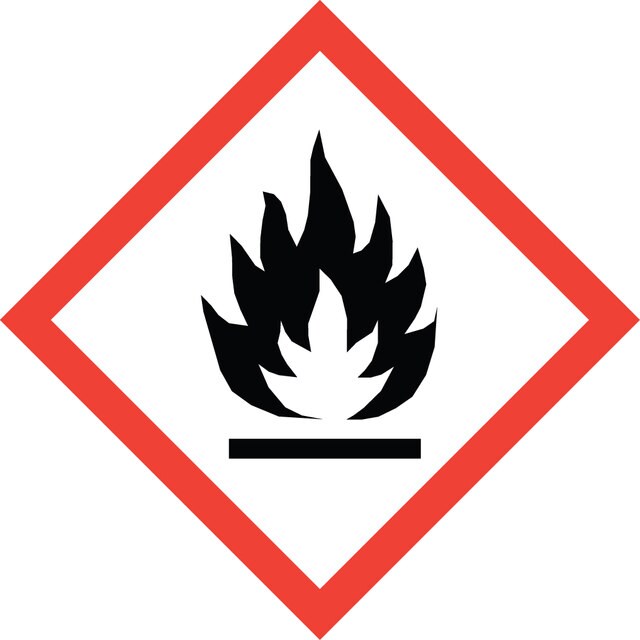
Carc. 1B - Eye Irrit. 2 - Flam. Liq. 2 - STOT SE 3
Target Organs
Respiratory system
supp_hazards
Storage Class
3 - Flammable liquids
Flash Point (°F)
51.8 °F - closed cup
Flash Point (°C)
11 °C - closed cup
Precautionary Statements
Choose from one of the most recent versions:
Already Own This Product?
Find documentation for the products that you have recently purchased in the Document Library.
-
How can I determine the shelf life / expiration / retest date of this product?
1 answer-
Helpful?
-
-
How is shipping temperature determined? And how is it related to the product storage temperature?
1 answer-
Products may be shipped at a different temperature than the recommended long-term storage temperature. If the product quality is sensitive to short-term exposure to conditions other than the recommended long-term storage, it will be shipped on wet or dry-ice. If the product quality is NOT affected by short-term exposure to conditions other than the recommended long-term storage, it will be shipped at ambient temperature. As shipping routes are configured for minimum transit times, shipping at ambient temperature helps control shipping costs for our customers. For more information, please refer to the Storage and Transport Conditions document: https://www.sigmaaldrich.com/deepweb/assets/sigmaaldrich/marketing/global/documents/316/622/storage-transport-conditions-mk.pdf
Helpful?
-