
MABS2205

Anti-Extrahepatic biliary cells Antibody, clone hGB6
Größe auswählen
CHF 156.00
CHF 393.00
CHF 156.00
Über diesen Artikel
Fortfahren mit
Biologische Quelle
mouse
Qualitätsniveau
Konjugat
unconjugated
Antikörperform
purified antibody
Antikörper-Produkttyp
primary antibodies
Klon
hGB6, monoclonal
Speziesreaktivität
human
Verpackung
antibody small pack of 100 μg
Methode(n)
flow cytometry: suitable
immunofluorescence: suitable
immunohistochemistry (formalin-fixed, paraffin-embedded sections): suitable
Isotyp
IgMκ
Epitopsequenz
Unknown
Versandbedingung
dry ice
Posttranslationale Modifikation Target
unmodified
1 of 4
Dieser Artikel | MABS2215 | MABS2190 | MABN2635 |
|---|---|---|---|
| conjugate unconjugated | conjugate unconjugated | conjugate unconjugated | conjugate unconjugated |
| antibody form purified antibody | antibody form purified antibody | antibody form purified antibody | antibody form purified antibody |
| biological source mouse | biological source mouse | biological source mouse | biological source mouse |
| species reactivity human | species reactivity human | species reactivity human | species reactivity human, monkey |
| clone hGB6, monoclonal | clone hGB1, monoclonal | clone hGB10, monoclonal | clone C65-2, monoclonal |
| shipped in dry ice | shipped in ambient | shipped in ambient | shipped in ambient |


Allgemeine Beschreibung
Immunogen
Anwendung
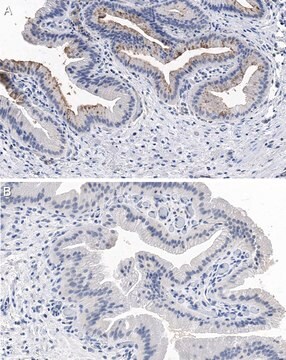
Evaluated by Immunohistochemistry (Paraffin) in human gallbladder tissue sections.
Immunohistochemistry (Paraffin) Analysis: A 1:50 dilution of this antibody detected all mucosal epithelium, a subset of lamina propria, peribiliary glands and surrounding connective tissue in human gallbladder tissue sections.
Tested Applications
Immunohistochemistry (Paraffin) Analysis: A representative lot detected Extrahepatic biliary cells in Immunohistochemistry applications (Galivo, F.H., et al. (2015). Stem Cell Res. 15(1):172-81).
Immunofluorescence Analysis: A representative lot detected Extrahepatic biliary cells in Immunofluorescence applications (Galivo, F.H., et al. (2015). Stem Cell Res. 15(1):172-81).
Flow Cytometry Analysis: A representative lot detected Extrahepatic biliary cells in Flow Cytometry applications (Galivo, F.H., et al. (2015). Stem Cell Res. 15(1):172-81).
Note: Actual optimal working dilutions must be determined by end user as specimens, and experimental conditions may vary with the end user
Biochem./physiol. Wirkung
Physikalische Form
Angaben zur Herstellung
Sonstige Hinweise
Haftungsausschluss
Sie haben nicht das passende Produkt gefunden?
Probieren Sie unser Produkt-Auswahlhilfe. aus.
Lagerklassenschlüssel
12 - Non Combustible Liquids
WGK
WGK 2
Flammpunkt (°F)
Not applicable
Flammpunkt (°C)
Not applicable
Analysenzertifikate (COA)
Suchen Sie nach Analysenzertifikate (COA), indem Sie die Lot-/Chargennummer des Produkts eingeben. Lot- und Chargennummern sind auf dem Produktetikett hinter den Wörtern ‘Lot’ oder ‘Batch’ (Lot oder Charge) zu finden.
Besitzen Sie dieses Produkt bereits?
In der Dokumentenbibliothek finden Sie die Dokumentation zu den Produkten, die Sie kürzlich erworben haben.
Active Filters
Unser Team von Wissenschaftlern verfügt über Erfahrung in allen Forschungsbereichen einschließlich Life Science, Materialwissenschaften, chemischer Synthese, Chromatographie, Analytik und vielen mehr..
Setzen Sie sich mit dem technischen Dienst in Verbindung