




If this product has an expiration or retest date, it will be shown on the Certificate of Analysis (COA, CofA). If there is no retest or expiration date listed on the product's COA, we do not have suitable stability data to determine a shelf life. For these products, the only date on the COA will be the release date; a retest, expiration, or use-by-date will not be displayed.
For all products, we recommend handling per defined conditions as printed in our product literature and website product descriptions. We recommend that products should be routinely inspected by customers to ensure they perform as expected.
For products without retest or expiration dates, our standard warranty of 1 year from the date of shipment is applicable.
For more information, please refer to the Product Dating Information document: https://www.sigmaaldrich.com/deepweb/assets/sigmaaldrich/marketing/global/documents/418/501/product-dating-information-06-25-mk.pdf
P6148

Paraformaldehyd
reagent grade, crystalline
Synonym(e):
Polyoxymethylen
Größe auswählen
CHF 79.30
CHF 85.40
CHF 4’640.00
Über diesen Artikel
Fortfahren mit
Produktname
Paraformaldehyd, reagent grade, crystalline
SMILES string
[O-]#[C+H2]
InChI
1S/CH2O/c1-2/h1H2
InChI key
WSFSSNUMVMOOMR-UHFFFAOYSA-N
grade
reagent grade
vapor density
1.03 (vs air)
vapor pressure
<1.45 mmHg ( 25 °C)
form
crystalline
autoignition temp.
572 °F
expl. lim.
73 %
dilution
(for analytical testing)
mp
120-170 °C (lit.)
density
0.88 g/mL at 25 °C (lit.)
storage temp.
2-8°C
Quality Level
Suchen Sie nach ähnlichen Produkten? Aufrufen Leitfaden zum Produktvergleich
1 of 4
Dieser Artikel | 158127 | 441244 | 16005 |
|---|---|---|---|
| Quality Level 200 | Quality Level 200 | Quality Level 200 | Quality Level 200 |
| grade reagent grade | grade - | grade - | grade - |
| form crystalline | form powder | form prilled | form pellets |
| vapor density 1.03 (vs air) | vapor density 1.03 (vs air) | vapor density 1.03 (vs air) | vapor density 1.03 (vs air) |
| mp 120-170 °C (lit.) | mp 120-170 °C (lit.) | mp 120-170 °C (lit.) | mp 120-170 °C (lit.) |
| density 0.88 g/mL at 25 °C (lit.) | density 0.88 g/mL at 25 °C (lit.) | density 0.88 g/mL at 25 °C (lit.) | density 0.88 g/mL at 25 °C (lit.) |
Application
General description
Ähnliches Produkt
signalword
Danger
Hazard Classifications
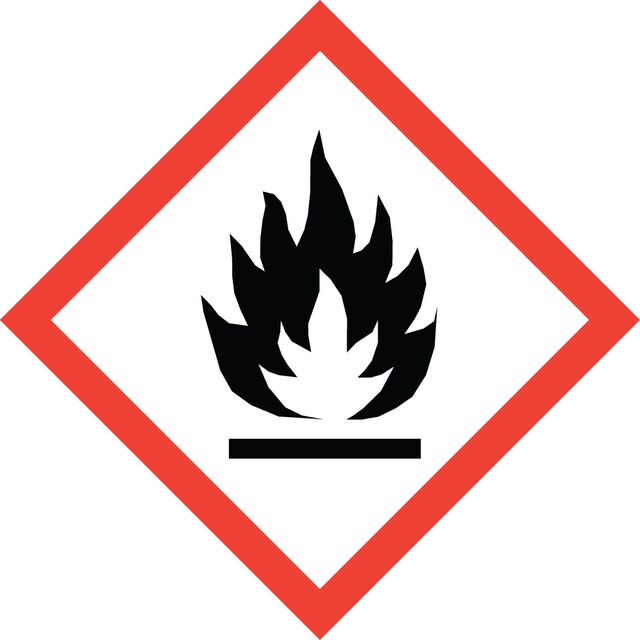
Acute Tox. 4 Inhalation - Acute Tox. 4 Oral - Carc. 1B - Eye Dam. 1 - Flam. Sol. 2 - Muta. 2 - Skin Irrit. 2 - Skin Sens. 1 - STOT SE 3
target_organs
Respiratory system
Lagerklasse
4.1B - Flammable solid hazardous materials
wgk
WGK 2
flash_point_f
Not applicable
flash_point_c
Not applicable
ppe
Eyeshields, Faceshields, Gloves, type P3 (EN 143) respirator cartridges
Hier finden Sie alle aktuellen Versionen:
Besitzen Sie dieses Produkt bereits?
In der Dokumentenbibliothek finden Sie die Dokumentation zu den Produkten, die Sie kürzlich erworben haben.
Artikel
Verfügbare Verfahren zur Fluoreszenz-in-situ-Hybridisierung (FISH), Reagenzien und Ausstattung.
Available Fluorescent in situ hybridization (FISH) procedures, reagents and equipment.
Protokolle
Cell staining can be divided into four steps: cell preparation, fixation, application of antibody, and evaluation.
Verwandter Inhalt
Three-dimensional (3D) printing of biological tissue is rapidly becoming an integral part of tissue engineering.
-
How can I determine the shelf life / expiration / retest date of this product?
1 answer-
Helpful?
-
-
How is shipping temperature determined? And how is it related to the product storage temperature?
1 answer-
Products may be shipped at a different temperature than the recommended long-term storage temperature. If the product quality is sensitive to short-term exposure to conditions other than the recommended long-term storage, it will be shipped on wet or dry-ice. If the product quality is NOT affected by short-term exposure to conditions other than the recommended long-term storage, it will be shipped at ambient temperature. As shipping routes are configured for minimum transit times, shipping at ambient temperature helps control shipping costs for our customers. For more information, please refer to the Storage and Transport Conditions document: https://www.sigmaaldrich.com/deepweb/assets/sigmaaldrich/marketing/global/documents/316/622/storage-transport-conditions-mk.pdf
Helpful?
-
-
What is the difference between formaldehyde and paraformaldehyde?
1 answer-
Paraformaldehyde is the polymeric form of formaldehyde. It is a solid. Formaldehyde is a gas which when dissolved in water gives a formaldehyde solution. Commercially available formaldehyde solutions usually contain 10-15% methanol, which prevents the formaldehyde from forming the polymeric paraformaldehyde.
Helpful?
-
-
What is the shelf life of Product P6148, Paraformaldehyde?
1 answer-
The shelf life has not been assigned but guarantee of quality is 1 year from the time of receipt for unopened bottles stored at 2-8 °C. We expect the product to be of good quality for at least 2 years.
Helpful?
-
-
What is the difference between formaldehyde and paraformaldehyde?
1 answer-
Paraformaldehyde is the polymeric form of formaldehyde. Paraformaldehyde is a solid, and formaldehyde is a gas. Formaldehyde solutions consist of formaldehyde gas dissolved in a solvent of some kind.
Helpful?
-
-
How to prepare solutions of Product P6148, Paraformaldehyde?
1 answer-
Paraformaldehyde does not dissolve but rather can be depolymerized in solution. Depolymerized solutions can be prepared in water with heating to 55-60°C. If necessary, further addition of 1-2 drops of a sodium hydroxide solution may be required. Some protocols suggest that paraformaldehyde should be prepared in buffered solutions such as phosphate buffer or PBS at approximately pH 7.
Helpful?
-
-
What is the Department of Transportation shipping information for this product?
1 answer-
Transportation information can be found in Section 14 of the product's (M)SDS.To access the shipping information for this material, use the link on the product detail page for the product.
Helpful?
-
-
How stable are Product P6148, Paraformaldehyde, solutions?
1 answer-
Buffered solutions of 2-4% can be stored protected from light for 2-3 weeks at 2-8°C.
Helpful?
-
Active Filters
Unser Team von Wissenschaftlern verfügt über Erfahrung in allen Forschungsbereichen einschließlich Life Science, Materialwissenschaften, chemischer Synthese, Chromatographie, Analytik und vielen mehr..
Setzen Sie sich mit dem technischen Dienst in Verbindung