

If this product has an expiration or retest date, it will be shown on the Certificate of Analysis (COA, CofA). If there is no retest or expiration date listed on the product's COA, we do not have suitable stability data to determine a shelf life. For these products, the only date on the COA will be the release date; a retest, expiration, or use-by-date will not be displayed.
For all products, we recommend handling per defined conditions as printed in our product literature and website product descriptions. We recommend that products should be routinely inspected by customers to ensure they perform as expected.
For products without retest or expiration dates, our standard warranty of 1 year from the date of shipment is applicable.
For more information, please refer to the Product Dating Information document: https://www.sigmaaldrich.com/deepweb/assets/sigmaaldrich/marketing/global/documents/418/501/product-dating-information-06-25-mk.pdf
319902

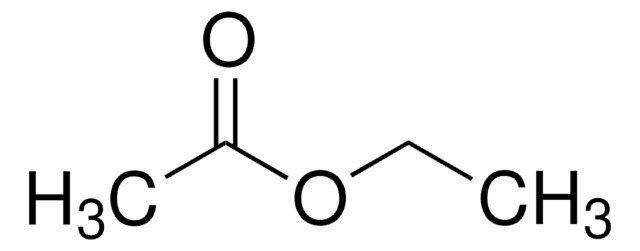
Ethylacetat
ACS reagent, ≥99.5%
Synonym(e):
EtOAc
Größe auswählen
CHF 77.30
CHF 105.00
CHF 189.00
CHF 263.00
CHF 1’180.00
CHF 5’990.00
Über diesen Artikel
Fortfahren mit
Qualität
ACS reagent
Qualitätsniveau
Agentur
suitable for EPA ACB B21-02
suitable for EPA ACB B23-05b
Dampfdichte
3 (20 °C, vs air)
Dampfdruck
73 mmHg ( 20 °C)
Assay
≥99.5%
Form
liquid
Selbstzündungstemp.
801 °F
Expl.-Gr.
2.2-11.5 %, 38 °F
dilution
(for analytical testing)
Verunreinigungen
H2SO4, passes test (darkened)
≤0.0009 meq/g Titr. acid
≤0.200% water
Abdampfrückstand
≤0.0030%
Farbe
APHA: ≤10
Brechungsindex
n20/D 1.3720 (lit.)
bp
76.5-77.5 °C (lit.)
mp (Schmelzpunkt)
−84 °C (lit.)
Dichte
0.902 g/mL at 25 °C (lit.)
Format
neat
SMILES String
CCOC(C)=O
InChI
1S/C4H8O2/c1-3-6-4(2)5/h3H2,1-2H3
InChIKey
XEKOWRVHYACXOJ-UHFFFAOYSA-N
Suchen Sie nach ähnlichen Produkten? Aufrufen Leitfaden zum Produktvergleich
Verwandte Kategorien
1 of 4
Dieser Artikel | 33211-M | 27227-M | 676810 |
|---|---|---|---|
| grade ACS reagent | grade ACS reagent, puriss. p.a. | grade - | grade ACS reagent |
| Quality Level 200 | Quality Level 200 | Quality Level 100 | Quality Level 200 |
| assay ≥99.5% | assay ≥99.5% (GC) | assay ≥99.5% (GC) | assay ≥99.5% |
| form liquid | form liquid | form liquid | form liquid |
| expl. lim. 2.2-11.5 %, 38 °F | expl. lim. 2.2-11.5 %, 38 °F | expl. lim. 2.2-11.5 %, 38 °F | expl. lim. 2.2-11.5 %, 38 °F |
| refractive index n20/D 1.3720 (lit.) | refractive index n20/D 1.3710-1.3730, n20/D 1.3720 (lit.) | refractive index n20/D 1.371-1.373, n20/D 1.3720 (lit.) | refractive index n20/D 1.3720 (lit.) |
Allgemeine Beschreibung
Ethylacetat-Lösungsmittel in ACS-Qualität wird für folgende Anwendungen eingesetzt:
- Chemische Routine-Synthese
- Trocknung und Aufreinigung
- Reinigung kritischer Laborgeräte
Premium ACS Solvents: Our solvents meet or exceed the stringent standards set by the American Chemical Society, ensuring high quality and reliability for your laboratory applications.
Replicable and Publishable Results: Designed for consistency, our solvents deliver results that can be reliably reproduced, making them ideal for research that requires publication.
Versatile Applications: Suitable for routine chemical synthesis, drying, purification, and critical labware cleaning, our solvents cater to a wide range of research needs in the laboratory.
Anwendung
Ähnliches Produkt
Signalwort
Danger
H-Sätze
Gefahreneinstufungen
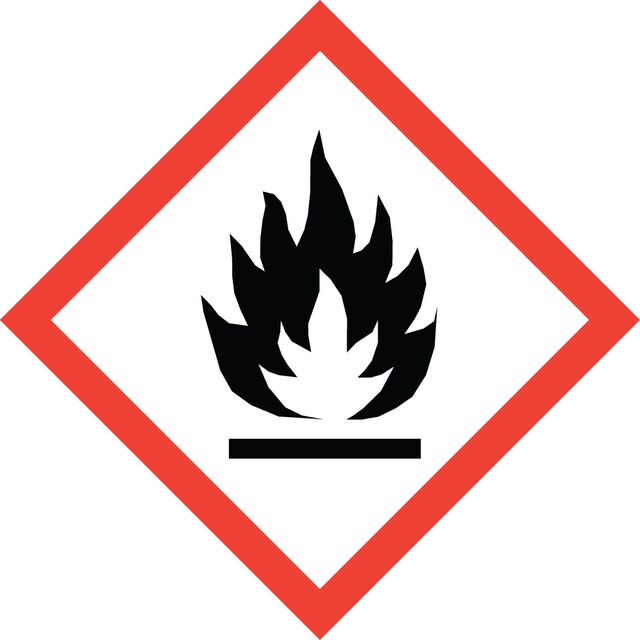
Eye Irrit. 2 - Flam. Liq. 2 - STOT SE 3
Zielorgane
Central nervous system
Zusätzliche Gefahrenhinweise
Lagerklassenschlüssel
3 - Flammable liquids
WGK
WGK 1
Flammpunkt (°F)
24.8 °F - closed cup
Flammpunkt (°C)
-4 °C - closed cup
Hier finden Sie alle aktuellen Versionen:
Besitzen Sie dieses Produkt bereits?
In der Dokumentenbibliothek finden Sie die Dokumentation zu den Produkten, die Sie kürzlich erworben haben.
-
How can I determine the shelf life / expiration / retest date of this product?
1 answer-
Helpful?
-
-
How is shipping temperature determined? And how is it related to the product storage temperature?
1 answer-
Products may be shipped at a different temperature than the recommended long-term storage temperature. If the product quality is sensitive to short-term exposure to conditions other than the recommended long-term storage, it will be shipped on wet or dry-ice. If the product quality is NOT affected by short-term exposure to conditions other than the recommended long-term storage, it will be shipped at ambient temperature. As shipping routes are configured for minimum transit times, shipping at ambient temperature helps control shipping costs for our customers. For more information, please refer to the Storage and Transport Conditions document: https://www.sigmaaldrich.com/deepweb/assets/sigmaaldrich/marketing/global/documents/316/622/storage-transport-conditions-mk.pdf
Helpful?
-
-
What methods or procedures should be followed to perform the measurements of 'Residue on Evaporation' and 'Titratable Acid', as outlined in the COA for product 319902?
1 answer-
For an MQ 200 quality level product, it is typically not possible to share test methods. However, in the case of an ACS grade product, one can refer directly to the available ACS monograph.
The monograph provides specific instructions for conducting the residue on evaporation test, which involves evaporating 40.0 g (45.0 mL) of the sample to dryness in a tared, preconditioned dish on a hot plate (~100 °C). Subsequently, the residue is dried at 105 °C for a duration of 30 minutes.
Regarding the titratable acid test, the monograph advises adding 0.10 mL of phenolphthalein indicator solution to 10 mL of ethyl alcohol and neutralizing it with 0.01 N sodium hydroxide. Then, 9.0 g (10.0 mL) of the sample should be added, gently mixed, and titrated with 0.01 N sodium hydroxide until the pink color persists for 15 seconds. The requirement is that the usage of sodium hydroxide should not exceed 0.80 mL.Helpful?
-
Active Filters
Unser Team von Wissenschaftlern verfügt über Erfahrung in allen Forschungsbereichen einschließlich Life Science, Materialwissenschaften, chemischer Synthese, Chromatographie, Analytik und vielen mehr..
Setzen Sie sich mit dem technischen Dienst in Verbindung