Accéder au contenu
Merck

E1895

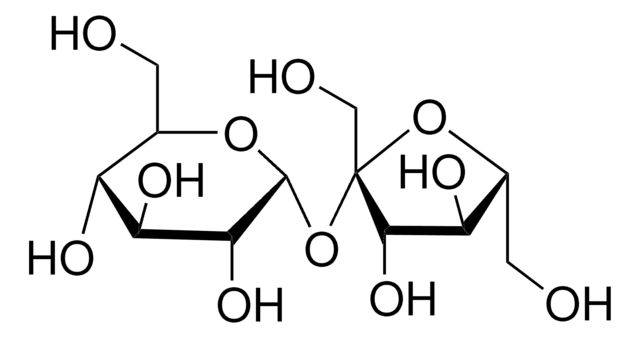
Erlose

≥94% (HPLC)

Synonyme(s) :

α-D-Glc-(1→4)-α-D-Glc-(1→2)-β-D-Fru, α-Maltosyl β-fructofuranoside

Se connecter pour consulter vos tarifs contractuels et ceux de votre entreprise/organisme

Sélectionner une taille de conditionnement

50 MG

469,00 €

469,00 €


Vérifier la disponibilité des articles du panier

Demander une commande groupée

A propos de cet article

Formule empirique (notation de Hill) :
C18H32O16
Numéro CAS:
Poids moléculaire :
504.44
Numéro MDL:
Code UNSPSC :
12352201
ID de substance PubChem :
Nomenclature NACRES :
NA.25

Passer à

Service technique
Besoin d'aide ? Notre équipe de scientifiques expérimentés est là pour vous.
Laissez-nous vous aider

Source biologique

plant

Essai

≥94% (HPLC)

Forme

powder

Activité optique

[α]20/D 108.5 to 112.0 °, c = 0.84% (w/v) in water

Conditions de stockage

desiccated

Impuretés

≤12.5% water (Karl Fischer)

Couleur

white to off-white

Solubilité

H2O: 50 mg/mL, clear to slightly hazy, colorless to faintly yellow

Température de stockage

−20°C

Chaîne SMILES 

OC[C@H]1O[C@H](O[C@H]2[C@H](O)[C@@H](O)[C@H](O[C@@H]2CO)O[C@]3(CO)O[C@H](CO)[C@@H](O)[C@@H]3O)[C@H](O)[C@@H](O)[C@@H]1O

InChI

1S/C18H32O16/c19-1-5-8(23)10(25)12(27)16(30-5)32-14-7(3-21)31-17(13(28)11(14)26)34-18(4-22)15(29)9(24)6(2-20)33-18/h5-17,19-29H,1-4H2/t5-,6-,7-,8-,9-,10+,11-,12-,13-,14-,15+,16-,17-,18+/m1/s1

Clé InChI

FVVCFHXLWDDRHG-KKNDGLDKSA-N

Comparer avec des articles similaires

Voir la comparaison complète

Montrer les différences

1 of 4

Cet article
S4001S8501S5391
biological source

plant

biological source

plant (Stachys tuberifera)

biological source

sugar cane

biological source

sugar cane

assay

≥94% (HPLC)

assay

≥98% (HPLC)

assay

≥99.5% (GC)

assay

≥99.5% (GC)

Quality Level

200

Quality Level

200

Quality Level

300

Quality Level

300

solubility

H2O: 50 mg/mL, clear to slightly hazy, colorless to faintly yellow

solubility

water: 50 mg/mL, clear to very slightly hazy, colorless

solubility

H2O: 0.5 g/mL, clear, colorless to faintly yellow

solubility

H2O: 0.5 g/mL, clear, colorless to faintly yellow

form

powder

form

powder

form

powder

form

powder

storage temp.

−20°C

storage temp.

-

storage temp.

room temp

storage temp.

room temp

Application

Erlose, a triose sugar (trisaccharide), is used in studies on dietary preference and utilization of triose sugars from aphid honeydew by various insects, such as honey bees and ants. Erlose may be used as a reference compound in assays that analyze the sugars of foods such as royal jelly and honey.[1][2]

Autres remarques

To gain a comprehensive understanding of our extensive range of Oligosaccharides for your research, we encourage you to visit our Carbohydrates Category page.

Clause de non-responsabilité

moisture sensitive

Code de la classe de stockage

11 - Combustible Solids

Classe de danger pour l'eau (WGK)

WGK 3

Point d'éclair (°F)

Not applicable

Point d'éclair (°C)

Not applicable

Équipement de protection individuelle

Eyeshields, Gloves, type N95 (US)


Faites votre choix parmi les versions les plus récentes :

Certificats d'analyse (COA)

Lot/Batch Number

Vous ne trouvez pas la bonne version ?

Si vous avez besoin d'une version particulière, vous pouvez rechercher un certificat spécifique par le numéro de lot.

Déjà en possession de ce produit ?

Retrouvez la documentation relative aux produits que vous avez récemment achetés dans la Bibliothèque de documents.

Consulter la Bibliothèque de documents

Daniela Fischer et al.
The FEBS journal, 273(1), 137-149 (2005-12-22)
Little is known about the structure and function of oligosaccharides in cyanobacteria. In this study, a new class of saccharides from Nostoc was identified by MS and NMR techniques, consisting of alpha-D-glucopyranosyl-(1-->2)-[alpha-D-glucopyranosyl-(1-->2)]n-beta-D-fructofuranosides ranging from the trisaccharide (n = 1) to
Roberto Consonni et al.
Journal of agricultural and food chemistry, 60(18), 4526-4534 (2012-04-19)
The saccharide profiles of 5 different botanical species in 86 Italian honey samples were investigated by ¹H and ¹H-¹³C NMR spectroscopy. Nineteen saccharides were identified in the aqueous extracts, namely, fructose, glucose, gentiobiose, isomaltose, kojibiose, maltose, maltulose, melibiose, nigerose, palatinose
T Taga et al.
Carbohydrate research, 240, 39-45 (1993-02-24)
Erlose [O-beta-D-fructofuranosyl-(1-->2)-O-alpha-D-glucopyranosyl-(1-->4)- alpha-D-glucopyranoside] monohydrate, C18H32O16.H2O, M(r) = 522.45, is orthorhombic, P2(1)2(1)2(1) with a = 30.748 (3), b = 8.757 (1), c = 8.270 (1) A, and Z = 4. The structure was solved by direct methods, and refined to R
Gaëlle Daniele et al.
Food chemistry, 134(2), 1025-1029 (2012-10-31)
A gas chromatographic method was developed to quantify the major and minor sugars of 400 Royal Jellies (RJs). Their contents were compared in relation to the geographical origins and different production methods. A reliable database was established from the analysis
S Hojo et al.
Infection and immunity, 55(3), 698-703 (1987-03-01)
Resting-cell suspensions of oral microorganisms grown in sucrose were studied for the production of acid from glucosylsucrose and maltosylsucrose. Most oral microorganisms fermented these sugars to only a limited extent. Streptococcus salivarius, however, metabolized glucosylsucrose as well as sucrose. We

Questions

Évaluations

Aucune valeur de notation

Filtres actifs

Notre équipe de scientifiques dispose d'une expérience dans tous les secteurs de la recherche, notamment en sciences de la vie, science des matériaux, synthèse chimique, chromatographie, analyse et dans de nombreux autres domaines..

Contacter notre Service technique