
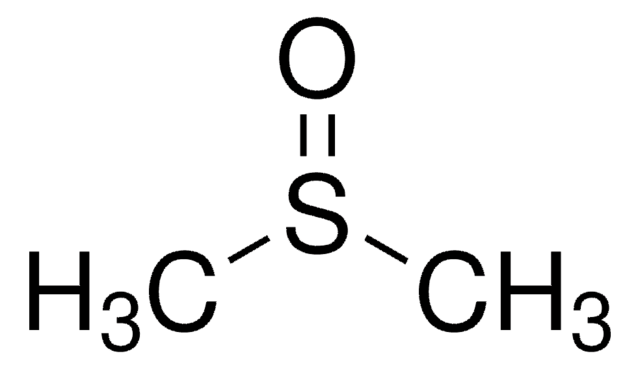

This product is not anhydrous. The maximum allowable water content is < 0.1%. Please see the link below to review an anhydrous product option.
276855
https://www.sigmaaldrich.com/product/sial/276855
D8418

Dimetil solfossido
Molecular Biology
Dimethyl sulfoxide
Sinonimo/i:
DMSO per biologia molecolare, Metilsolfinilmetano, Metilsolfossido, DMSO
Autenticati per visualizzare i prezzi organizzativi e contrattuali.
Scegli un formato
50 ML
72,90 €
100 ML
124,00 €
250 ML
211,00 €
500 ML
290,00 €
1 L
425,00 €
72,90 €
Per informazioni sulla disponibilità, contatta il Servizio Clienti.
Informazioni su questo articolo
Formula condensata:
(CH3)2SO
Numero CAS:
Peso molecolare:
78.13
UNSPSC Code:
12191502
NACRES:
NA.52
PubChem Substance ID:
EC Number:
200-664-3
Beilstein/REAXYS Number:
506008
MDL number:
Grade:
Molecular Biology
Assay:
≥99.9%
Technique(s):
DNA sequencing: suitable
PCR: suitable
transfection: suitable
PCR: suitable
transfection: suitable
Bp:
189 °C (lit.)
Vapor pressure:
0.42 mmHg ( 20 °C)
Vai a
Servizio Tecnico
Hai bisogno di aiuto? Il nostro team di scienziati qualificati è a tua disposizione.
Permettici di aiutartiNome del prodotto
Dimetil solfossido, Molecular Biology
InChI key
IAZDPXIOMUYVGZ-UHFFFAOYSA-N
InChI
1S/C2H6OS/c1-4(2)3/h1-2H3
SMILES string
CS(C)=O
grade
Molecular Biology
vapor density
2.7 (vs air)
vapor pressure
0.42 mmHg ( 20 °C)
product line
BioReagent
assay
≥99.9%
form
liquid
autoignition temp.
573 °F
shelf life
Recommended retest period - 2 years
expl. lim.
42 %, 63 °F
technique(s)
DNA sequencing: suitable
PCR: suitable
transfection: suitable
impurities
≤0.001 meq/g Titratable acid
≤0.1% water (Karl Fischer)
color
colorless
refractive index
n20/D 1.479 (lit.)
bp
189 °C (lit.)
mp
16-19 °C (lit.)
solubility
H2O: miscible (completely)
density
1.10 g/mL (lit.)
absorption
passes test
suitability
suitable for molecular biology
foreign activity
DNase and RNase, none detected
storage temp.
room temp
Quality Level
Cerchi prodotti simili? Visita Guida al confronto tra prodotti
1 of 4
Questo articolo | 41639 | D9170 | PHR1309 |
|---|---|---|---|
| assay ≥99.9% | assay ≥99.5% (GC) | assay ≥99.5% | assay - |
| Quality Level 200 | Quality Level 200 | Quality Level 200 | Quality Level 300 |
| grade for molecular biology | grade for molecular biology | grade PCR Reagent | grade certified reference material, pharmaceutical secondary standard |
| technique(s) DNA sequencing: suitable, transfection: suitable, PCR: suitable | technique(s) - | technique(s) PCR: suitable | technique(s) HPLC: suitable, gas chromatography (GC): suitable |
| solubility H2O: miscible (completely) | solubility H2O: miscible (completely) | solubility H2O: miscible (completely) | solubility - |
| form liquid | form liquid | form liquid | form - |
Application
Il DMSO (dimetilsolfossido) è un solvente organico aprotico altamente polare con molte applicazioni in chimica organica e in biologia molecolare. Il DMSO viene comunemente utilizzato in applicazioni quali:
Il dimetilsolfossido è utilizzato:
- la reazione a catena della polimerasi (PCR)
- l′ amplificazione di librerie di cDNA
- il sequenziamento del DNA
- il tampone di caricamento per colonna per l′isolamento di RNA con coda di poli A (poli (A) + RNA)
- il tampone per la trasformazione di E. coli competenti
- nei protocolli per la trasfezione
Il dimetilsolfossido è utilizzato:
- come solvente degli oligonucleotidi negli spotted microarrays[1]
- come solvente durante l'analisi di microarray di miRNA e nella real-time PCR quantitativa (qRT-PCR)
- per la lisi cellulare durante il test MTT (3-(4,5-dimetiltiazol-2-il)-2,5-difeniltetrazolio bromuro)
- per la preparazione della soluzione madre durante la valutazione citofluorimetrica del MMP (potenziale di membrana mitocondriale)
- come crioprotettore nella conservazione di linee cellulari umane e animali e di batteriofagi λ congelati
Disclaimer
Si sottoraffredda facilmente e rifonde lentamente a temperatura ambiente. Il prodotto solidificato può liquefarsi nuovamente senza subire danni se riscaldato a temperatura ambiente.
Features and Benefits
Prodotto privo di Dnasi, Rnasi, fosfatasi e proteasi.
General description
Caratteristiche e pregi:
Il dimetilsolfossido (DMSO) è un reagente organico altamente polare con eccezionali proprietà solventi sia nei confronti delle sostanze organiche, sia di quelle inorganiche.
Questo prodotto è di grado “Biologia molecolare” e quindi adatto per applicazioni di biologia molecolare. E′ stato testato per la presenza di nucleasi e proteasi.
- adatto per applicazioni di biologia molecolare
- DMSO privo di nucleasi
- Privo di DNasi, RNasi, proteasi e fosfatasi
- DMSO per biologia molecolare
Il dimetilsolfossido (DMSO) è un reagente organico altamente polare con eccezionali proprietà solventi sia nei confronti delle sostanze organiche, sia di quelle inorganiche.
Questo prodotto è di grado “Biologia molecolare” e quindi adatto per applicazioni di biologia molecolare. E′ stato testato per la presenza di nucleasi e proteasi.
Related product
N° Catalogo
Descrizione
Determinazione del prezzo
used together
N° Catalogo
Descrizione
Determinazione del prezzo
Classe di stoccaggio
10 - Combustible liquids
wgk
WGK 1
flash_point_f
188.6 °F - closed cup
flash_point_c
87 °C - closed cup
ppe
Eyeshields, Gloves, type ABEK (EN14387) respirator filter
Scegli una delle versioni più recenti:
Possiedi già questo prodotto?
I documenti relativi ai prodotti acquistati recentemente sono disponibili nell’Archivio dei documenti.
Caroline Godfrey et al.
Human molecular genetics, 24(15), 4225-4237 (2015-05-03)
Splice modulation therapy has shown great clinical promise in Duchenne muscular dystrophy, resulting in the production of dystrophin protein. Despite this, the relationship between restoring dystrophin to established dystrophic muscle and its ability to induce clinically relevant changes in muscle
Claudia C Faria et al.
Cancer research, 75(1), 134-146 (2014-11-14)
Medulloblastoma is the most common malignant pediatric brain tumor, with metastases present at diagnosis conferring a poor prognosis. Mechanisms of dissemination are poorly understood and metastatic lesions are genetically divergent from the matched primary tumor. Effective and less toxic therapies
Phillip McDonagh et al.
Veterinary microbiology, 174(3-4), 438-447 (2014-12-04)
Feline infectious peritonitis (FIP), a feline coronavirus (FCoV) induced disease, is almost invariably fatal with median life expectancy measured in days. Current treatment options are, at best, palliative. The objectives of this study were to evaluate a panel of nineteen
Rory W Blackler et al.
British journal of pharmacology, 172(4), 992-1004 (2014-10-10)
Hydrogen sulphide is an important mediator of gastrointestinal mucosal defence. The use of non-steroidal anti-inflammatory drugs (NSAIDs) is significantly limited by their toxicity in the gastrointestinal tract. Particularly concerning is the lack of effective preventative or curative treatments for NSAID-induced
A Oguro-Ando et al.
Molecular psychiatry, 20(9), 1069-1078 (2014-10-15)
Rare maternally inherited duplications at 15q11-13 are observed in ~1% of individuals with an autism spectrum disorder (ASD), making it among the most common causes of ASD. 15q11-13 comprises a complex region, and as this copy number variation encompasses many
Articoli
Transformation introduces exogenous DNA into cells, a fundamental genetic modification process demonstrated in Streptococcus pneumoniae.
SeqPlex™-I WTA kit amplifies RNA for NGS, enabling genomic studies from limited samples.
Protocolli
A step-by-step protocol for released N-linked glycan analysis of the monoclonal antibody adalimumab, based on UHPLC-FLR-MS and procainamide labeling.
Yeasts are considered model systems for eukaryotic studies as they exhibit fast growth and have dispersed cells.
Learn how to cultivate similar-sized iPSC-derived colon organoids using Millicell® Microwell plates and perform a forskolin-induced swelling assay.
Contenuto correlato
KOD One™ PCR Master Mix overview for ultra-fast PCR with high specificity, fidelity, and yield
Product Information Sheet
-
Is this product anhydrous?
1 risposta-
Utile?
-
-
May I know the concentration (mg/ml) for DMSO (cat no. D8418)?
1 risposta-
This product is supplied as a neat or pure liquid with a density of 1.10 g/mL and a molecular weight of 78.13 g/mol. The minimum purity is 99.9%, thus the molarity will vary slightly from lot to lot. The molarity is 14.1 M.
Utile?
-
-
Is Product D8418, Dimethyl sulfoxide, also compatible with PET material?
1 risposta-
Yes, Dimethyl sulfoxide (DMSO) is generally considered to be compatible with Polyethylene terephthalate (PET) material. The following information can be found on the Product Data Sheet:
-Compatible: LDPE, HDPE, polypropylene, PPCO (polypropylene copolymer), polymethylpentene, nylon, teflon FEP
-Moderately compatible: polystyrene, ECTFE/ETFE
-Incompatible: polysulfone, flexible and rigid PVC tubing, polycarbonatehttps://www.sigmaaldrich.com/deepweb/assets/sigmaaldrich/product/documents/944/265/d2650pis.pdf
Utile?
-
-
Is this product sterile?
1 risposta-
This product is not sterile. To prepare a sterile filtered DMSO solution, it is recommended to use a Teflon, polypropylene, or nylon membrane. See products D2650 or D2438 for sterile DMSO product options. Please review these products at the links provided below:
https://www.sigmaaldrich.com/product/sigma/d2650
https://www.sigmaaldrich.com/product/sigma/d2438Utile?
-
-
Is Dimethyl sulfoxide a sterile product?
1 risposta-
No, this product is not considered sterile. Product Nos. D2560 and D2438 are sterile-filtered.
Utile?
-
-
What is the Department of Transportation shipping information for this product?
1 risposta-
Transportation information can be found in Section 14 of the product's (M)SDS.To access the shipping information for this material, use the link on the product detail page for the product.
Utile?
-
-
Does DMSO have any synthetic utility?
1 risposta-
DMSO has been used to oxidize thiols and disulfides to sulfonic acids, hydrolysis of epoxides, thioalkylation of phenols, and oxidation of primary alcohols and halides, and esters of primary alcohols to aldehydes.
Utile?
-
-
Is Product D8418, Dimethyl sulfoxide, assayed for DNase, RNase and protease?
1 risposta-
Yes. It is a molecular biology grade product, and it is tested for DNase, RNase and protease. For a lot to pass none of those enzymes may be detected.
Utile?
-
-
With what materials is Product D8418, Dimethyl sulfoxide, compatible?
1 risposta-
The compatibility of DMSO with various materials is listed here: Compatible: LDPE, HDPE, polypropylene, PPCO (polypropylene copolymer), polymethylpentene, nylon, PTFE (Teflon) and FEP. Moderately compatible: polystyrene, ECTFE/ETFE. Incompatible: polysulfone, flexible and rigid PVC tubing, polycarbonate.
Utile?
-
-
Where does DMSO come from?
1 risposta-
DMSO is known to have been isolated from tree bark in the past. It is now a commericially synthesized solvent.
Utile?
-
Filtri attivi
Il team dei nostri ricercatori vanta grande esperienza in tutte le aree della ricerca quali Life Science, scienza dei materiali, sintesi chimica, cromatografia, discipline analitiche, ecc..
Contatta l'Assistenza Tecnica