



If this product has an expiration or retest date, it will be shown on the Certificate of Analysis (COA, CofA). If there is no retest or expiration date listed on the product's COA, we do not have suitable stability data to determine a shelf life. For these products, the only date on the COA will be the release date; a retest, expiration, or use-by-date will not be displayed.
For all products, we recommend handling per defined conditions as printed in our product literature and website product descriptions. We recommend that products should be routinely inspected by customers to ensure they perform as expected.
For products without retest or expiration dates, our standard warranty of 1 year from the date of shipment is applicable.
For more information, please refer to the Product Dating Information document: https://www.sigmaaldrich.com/deepweb/assets/sigmaaldrich/marketing/global/documents/418/501/product-dating-information-06-25-mk.pdf
676829

Reagent Alcohol

anhydrous, contains 5% isopropyl alcohol and 5% methyl alcohol as denaturant
Synonym(e):
Ethanol ( "Reagent alcohol")
Größe auswählen
Über diesen Artikel
Fortfahren mit
Produktname
Reagent Alcohol, anhydrous, ≤0.005% water
Qualität
anhydrous
Qualitätsniveau
Dampfdichte
1.59 (vs air)
Form
liquid
Enthält
5% isopropyl alcohol as denaturant
5% methyl alcohol as denaturant
Expl.-Gr.
3.1-27.7 % (lit.)
Grünere Alternativprodukt-Eigenschaften
Safer Solvents and Auxiliaries
Learn more about the Principles of Green Chemistry.
sustainability
Greener Alternative Product
Konzentration
100%
Verunreinigungen
≤0.005% water
Abdampfrückstand
≤0.0005%
bp
78 °C (lit.)
mp (Schmelzpunkt)
−130 °C
Grünere Alternativprodukt-Kategorie
SMILES String
OCC
InChI
1S/C2H6O/c1-2-3/h3H,2H2,1H3
InChIKey
LFQSCWFLJHTTHZ-UHFFFAOYSA-N
Suchen Sie nach ähnlichen Produkten? Aufrufen Leitfaden zum Produktvergleich
Verwandte Kategorien
1 of 4
Dieser Artikel | 51976 | 459836 | NIST2897A |
|---|---|---|---|
| grade anhydrous | grade for molecular biology | grade anhydrous | grade certified reference material |
| Quality Level 100 | Quality Level 200 | Quality Level 200 | Quality Level 100 |
| form liquid | form liquid | form liquid | form - |
| mp −130 °C | mp −114 °C (lit.) | mp -114 °C | mp - |
| expl. lim. 3.1-27.7 % (lit.) | expl. lim. 19 %, 60 °F | expl. lim. 3.1-27.7 % | expl. lim. - |
| vapor density 1.59 (vs air) | vapor density 1.59 (vs air) | vapor density 1.59 (vs air) | vapor density - |
Allgemeine Beschreibung
Anwendung
- Microfluidically Assisted Synthesis of Calcium Carbonate Submicron Particles with Improved Loading Properties: Research on microfluidically synthesized calcium carbonate submicron particles shows enhanced loading properties, offering potential advancements in drug delivery systems and other nanotechnology applications (Ermakov AV, et al., 2023).
- Recent Developments in CaCO3 Nano-Drug Delivery Systems: Advancing Biomedicine in Tumor Diagnosis and Treatment: A review focusing on recent advancements in the development of calcium carbonate-based nano-drug delivery systems, which have significant potential to improve tumor diagnosis and therapy (Lin C, et al., 2024).
Leistungsmerkmale und Vorteile
Sonstige Hinweise
greener alternative product
Signalwort
Danger
H-Sätze
Gefahreneinstufungen
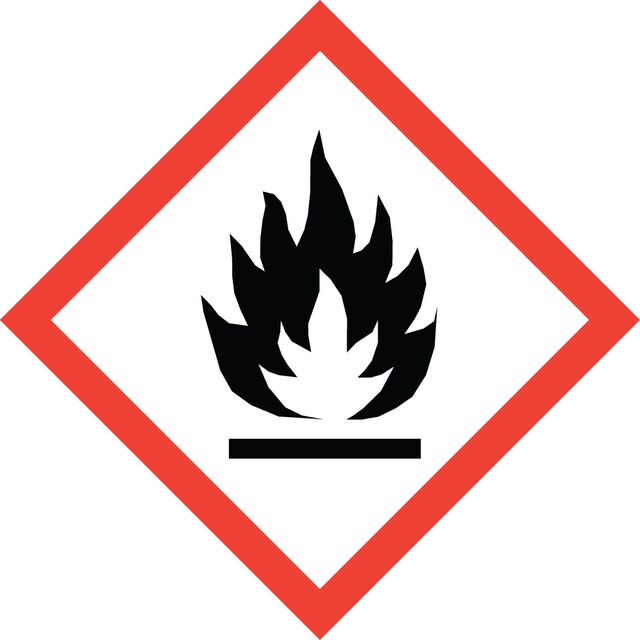
Eye Irrit. 2 - Flam. Liq. 2 - STOT SE 2
Zielorgane
Eyes,Central nervous system
Lagerklassenschlüssel
3 - Flammable liquids
WGK
WGK 2
Flammpunkt (°F)
48.2 °F - closed cup
Flammpunkt (°C)
9 °C - closed cup
Persönliche Schutzausrüstung
Eyeshields, Faceshields, Gloves, type ABEK (EN14387) respirator filter
Hier finden Sie alle aktuellen Versionen:
Besitzen Sie dieses Produkt bereits?
In der Dokumentenbibliothek finden Sie die Dokumentation zu den Produkten, die Sie kürzlich erworben haben.
-
How can I determine the shelf life / expiration / retest date of this product?
1 answer-
Helpful?
-
-
How is shipping temperature determined? And how is it related to the product storage temperature?
1 answer-
Products may be shipped at a different temperature than the recommended long-term storage temperature. If the product quality is sensitive to short-term exposure to conditions other than the recommended long-term storage, it will be shipped on wet or dry-ice. If the product quality is NOT affected by short-term exposure to conditions other than the recommended long-term storage, it will be shipped at ambient temperature. As shipping routes are configured for minimum transit times, shipping at ambient temperature helps control shipping costs for our customers. For more information, please refer to the Storage and Transport Conditions document: https://www.sigmaaldrich.com/deepweb/assets/sigmaaldrich/marketing/global/documents/316/622/storage-transport-conditions-mk.pdf
Helpful?
-
Active Filters
Unser Team von Wissenschaftlern verfügt über Erfahrung in allen Forschungsbereichen einschließlich Life Science, Materialwissenschaften, chemischer Synthese, Chromatographie, Analytik und vielen mehr..
Setzen Sie sich mit dem technischen Dienst in Verbindung