Direkt zum Inhalt
Merck

1012772

USP

Dehydrated Alcohol

United States Pharmacopeia (USP) Reference Standard

Synonym(e):

Ethanol, Ethylalkohol

Anmelden Preise für Organisationen und Verträge anzeigen

Größe auswählen

Preise und Verfügbarkeit sind derzeit nicht verfügbar.

Über diesen Artikel

Lineare Formel:
CH3CH2OH
CAS-Nummer:
Molekulargewicht:
46.07
Beilstein:
1718733
MDL-Nummer:
UNSPSC-Code:
41116107
PubChem Substanz-ID:
NACRES:
NA.24

Fortfahren mit

Technischer Dienst
Benötigen Sie Hilfe? Unser Team von erfahrenen Wissenschaftlern ist für Sie da.
Unterstützung erhalten

Qualität

pharmaceutical primary standard

Dampfdichte

1.59 (vs air)

Dampfdruck

44.6 mmHg ( 20 °C)

Selbstzündungstemp.

683 °F

Expl.-Gr.

19 %, 60 °F

Verpackung

ampule of 5x1.2 mL

Hersteller/Markenname

USP

Brechungsindex

n20/D 1.3600 (lit.)

bp

78 °C (lit.)

mp (Schmelzpunkt)

−114 °C (lit.)

Anwendung(en)

pharmaceutical (small molecule)

Format

neat

SMILES String

CCO

InChI

1S/C2H6O/c1-2-3/h3H,2H2,1H3

InChIKey

LFQSCWFLJHTTHZ-UHFFFAOYSA-N

Suchen Sie nach ähnlichen Produkten? Aufrufen Leitfaden zum Produktvergleich

Ähnliche Artikel vergleichen

Vollständigen Vergleich anzeigen

Unterschiede anzeigen

1 of 4

Dieser Artikel
PHR1070PHR13731.00971
Alkohol Pharmaceutical Secondary Standard; Certified Reference Material

Supelco

PHR1373

Alkohol

Ethanol 96%, EMPROVE® EXPERT, Ph. Eur., BP, ChP

SAFC

1.00971

Ethanol

grade

pharmaceutical primary standard

grade

certified reference material, pharmaceutical secondary standard

grade

certified reference material, pharmaceutical secondary standard

grade

-

manufacturer/tradename

USP

manufacturer/tradename

-

manufacturer/tradename

-

manufacturer/tradename

-

format

neat

format

neat

format

neat

format

neat

application(s)

pharmaceutical (small molecule)

application(s)

pharmaceutical (small molecule)

application(s)

pharmaceutical (small molecule)

application(s)

liquid formulation
parenterals
pharma/biopharma processes
pharmaceutical
semi-solid formulation

vapor density

1.59 (vs air)

vapor density

1.59 (vs air)

vapor density

1.59 (vs air)

vapor density

1.59 (vs air)

vapor pressure

44.6 mmHg ( 20 °C)

vapor pressure

44.6 mmHg ( 20 °C)

vapor pressure

44.6 mmHg ( 20 °C)

vapor pressure

44.6 mmHg ( 20 °C)

Allgemeine Beschreibung

This product is provided as delivered and specified by the issuing Pharmacopoeia. All information provided in support of this product, including SDS and any product information leaflets have been developed and issued under the Authority of the issuing Pharmacopoeia.For further information and support please go to the website of the issuing Pharmacopoeia.

Anwendung

Dehydrated Alcohol USP reference standard, intended for use in specified quality tests and assays as specified in the USP compendia.

Hinweis zur Analyse

These products are for test and assay use only. They are not meant for administration to humans or animals and cannot be used to diagnose, treat, or cure diseases of any kind.  ​

Sonstige Hinweise

1Der Vertrieb und der Einsatz von Ethylalkohol in der Schweiz erfordert eine Lizenz der Eidgenössischen Alkoholverwaltung
Sales restrictions may apply.

Ähnliches Produkt

Produkt-Nr.
Beschreibung
Preisangaben

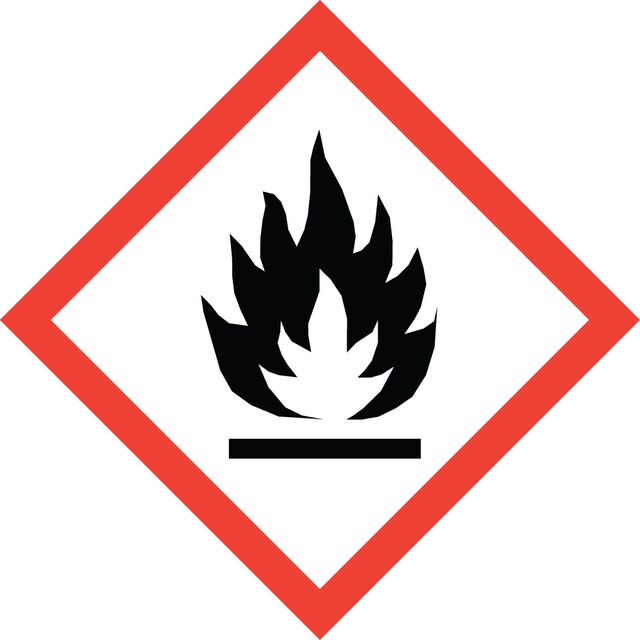
Piktogramme

FlameExclamation mark

Signalwort

Danger

H-Sätze

Gefahreneinstufungen

Eye Irrit. 2 - Flam. Liq. 2

Lagerklassenschlüssel

3 - Flammable liquids

WGK

WGK 1

Flammpunkt (°F)

55.4 °F - closed cup

Flammpunkt (°C)

13 °C - closed cup


Hier finden Sie alle aktuellen Versionen:

Analysenzertifikate (COA)

Lot/Batch Number

It looks like we've run into a problem, but you can still download Certificates of Analysis from our Dokumente section.

Wenn Sie Hilfe benötigen, wenden Sie sich bitte an Kundensupport

Besitzen Sie dieses Produkt bereits?

In der Dokumentenbibliothek finden Sie die Dokumentation zu den Produkten, die Sie kürzlich erworben haben.

Die Dokumentenbibliothek aufrufen

Cecilia E Hanzel et al.
Neurobiology of aging, 35(10), 2249-2262 (2014-05-17)
Chronic brain inflammation is associated with Alzheimer's disease (AD) and is classically attributed to amyloid plaque deposition. However, whether the amyloid pathology can trigger early inflammatory processes before plaque deposition remains a matter of debate. To address the possibility that
N Di Girolamo et al.
Stem cells (Dayton, Ohio), 33(1), 157-169 (2014-06-27)
Stem cell (SC) division, deployment, and differentiation are processes that contribute to corneal epithelial renewal. Until now studying the destiny of these cells in a living mammal has not been possible. However, the advent of inducible multicolor genetic tagging and
Zahra Jamsazzadeh Kermani et al.
Food chemistry, 161, 199-207 (2014-05-20)
The objective of this research was to evaluate whether mango peel is a potential source of functional cell wall polymers. To reach this objective, the native pectin polymers (NPP) extracted as alcohol insoluble residue from mango peel, were characterised in
Cem Kuscu et al.
Nature biotechnology, 32(7), 677-683 (2014-05-20)
RNA-guided genome editing with the CRISPR-Cas9 system has great potential for basic and clinical research, but the determinants of targeting specificity and the extent of off-target cleavage remain insufficiently understood. Using chromatin immunoprecipitation and high-throughput sequencing (ChIP-seq), we mapped genome-wide
Stefan Wieland et al.
Hepatology (Baltimore, Md.), 59(6), 2121-2130 (2013-10-15)
Approximately 50% of patients with chronic hepatitis C (CHC) have ongoing expression of interferon stimulated genes (ISGs) in the liver. It is unclear why this endogenous antiviral response is inefficient in eradicating the infection. Several viral escape strategies have been

Questions

Reviews

No rating value

Active Filters

Unser Team von Wissenschaftlern verfügt über Erfahrung in allen Forschungsbereichen einschließlich Life Science, Materialwissenschaften, chemischer Synthese, Chromatographie, Analytik und vielen mehr..

Setzen Sie sich mit dem technischen Dienst in Verbindung