
If this product has an expiration or retest date, it will be shown on the Certificate of Analysis (COA, CofA). If there is no retest or expiration date listed on the product's COA, we do not have suitable stability data to determine a shelf life. For these products, the only date on the COA will be the release date; a retest, expiration, or use-by-date will not be displayed.
For all products, we recommend handling per defined conditions as printed in our product literature and website product descriptions. We recommend that products should be routinely inspected by customers to ensure they perform as expected.
For products without retest or expiration dates, our standard warranty of 1 year from the date of shipment is applicable.
For more information, please refer to the Product Dating Information document: https://www.sigmaaldrich.com/deepweb/assets/sigmaaldrich/marketing/global/documents/418/501/product-dating-information-06-25-mk.pdf
S0389

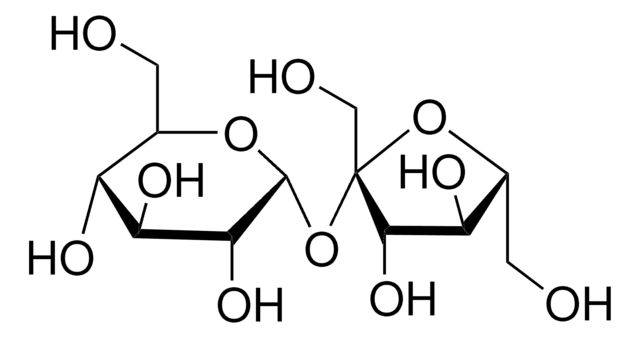
Saccarosio
Molecular Biology, ≥99.5% (GC)
Sinonimo/i:
αα-D-Glc-(1→2)-β-D-Fru, αα-D-glucopiranosil β-D-fruttofuranoside, ββ-D-fruttofuranosil-α-D-glucopiranoside, D(+)-saccarosio, Zucchero
Scegli un formato
151,00 €
244,00 €
693,00 €
151,00 €
Informazioni su questo articolo
Vai a
Nome del prodotto
Saccarosio, Molecular Biology, ≥99.5% (GC)
InChI key
CZMRCDWAGMRECN-UGDNZRGBSA-N
InChI
1S/C12H22O11/c13-1-4-6(16)8(18)9(19)11(21-4)23-12(3-15)10(20)7(17)5(2-14)22-12/h4-11,13-20H,1-3H2/t4-,5-,6-,7-,8+,9-,10+,11-,12+/m1/s1
SMILES string
OC[C@H]1O[C@H](O[C@]2(CO)O[C@H](CO)[C@@H](O)[C@@H]2O)[C@H](O)[C@@H](O)[C@@H]1O
biological source
sugar cane
grade
Molecular Biology
assay
≥99.5% (GC)
form
crystals
technique(s)
HPLC: suitable
cryopreservation: suitable
electron microscopy: suitable
enzyme immunoassay: suitable
gas chromatography (GC): suitable
immunohistochemistry: suitable
impurities
≤0.1% free glucose
color
white
useful pH range
5.5-7 (25 °C, 342 g/L)
mp
185-187 °C (lit.)
solubility
H2O: soluble 50 g + 50 mL
cation traces
heavy metals (as Pb): ≤5 ppm
absorption
≤0.15 at 280 at 50%
≤0.20 at 260 at 50%
suitability
suitable for molecular biology
application(s)
agriculture
agriculture
life science and biopharma
metabolomics
sample preservation
foreign activity
DNase, RNase, protease, none detected
storage temp.
room temp
Quality Level
Cerchi prodotti simili? Visita Guida al confronto tra prodotti
Categorie correlate
1 of 4
Questo articolo | S5016 | 84100 | 1.07651 |
|---|---|---|---|
| technique(s) HPLC: suitable, electron microscopy: suitable, gas chromatography (GC): suitable, cryopreservation: suitable, immunohistochemistry: suitable, enzyme immunoassay: suitable | technique(s) HPLC: suitable, cryopreservation: suitable, immunohistochemistry: suitable | technique(s) - | technique(s) - |
| grade for molecular biology | grade ACS reagent | grade ACS reagent | grade - |
| biological source sugar cane | biological source sugar cane | biological source - | biological source - |
| assay ≥99.5% (GC) | assay - | assay ≥99.0% (HPLC) | assay - |
| Quality Level 300 | Quality Level 300 | Quality Level 200 | Quality Level 200 |
| solubility H2O: soluble 50 g + 50 mL | solubility soluble 342 g/L at 20 °C (completely) | solubility H2O: 0.1 g/mL, clear, colorless | solubility - |
Application
- per la crioprotezione di tessuti renali
- come componente nel terreno di germinazione solido per la germinazione di granuli pollinici
- nel test del trifeniltetrazolio cloruro (TTC) per verificare la vitalità dei granuli pollinici
- nella crioprotezione di tessuto cerebrale fissato per immunoistochimica.
Biochem/physiol Actions
Features and Benefits
- Indicato per la ricerca in ambito biochimico e in biologia molecolare
- Sottoposto a test che ne confermano i bassi livelli di contaminazione da metalli pesanti, garantendone l′idoneità per un ampio ventaglio di applicazioni
- Sottoposto a controllo per Dnasi, Rnasi e proteasi.
- Saccarosio di grado biologia molecolare, estratto dalla canna da zucchero
General description
Other Notes
Comparable product
Classe di stoccaggio
11 - Combustible Solids
wgk
WGK 1
flash_point_f
Not applicable
flash_point_c
Not applicable
ppe
Eyeshields, Gloves, type N95 (US)
Scegli una delle versioni più recenti:
Possiedi già questo prodotto?
I documenti relativi ai prodotti acquistati recentemente sono disponibili nell’Archivio dei documenti.
Articoli
Centrifugation enables the separation of particles by sedimentation. Learn how to separate particles using a centrifuge and how to use Stokes' law to calculate the velocity of sedimentation.
Explore how carbohydrates function as excipients and carriers in drug delivery, with insights into mechanisms, case studies, and future trends.
Discover the role of carbohydrates in drug delivery, from solubility and stability improvement to advanced controlled-release systems.
Protocolli
Protocol for the preparation of Antibody Sensitized Sheep Erythrocytes. Includes product numbers and links.
Contenuto correlato
Product Information Sheet
-
How can I determine the shelf life / expiration / retest date of this product?
1 risposta-
Utile?
-
-
Can you provide information regarding the particle size or diameter of the crystals for this product (Sucrose, Sigma-Aldrich S0389)?
1 risposta-
The particle size or diameter of the crystals is not tested for this product.
Utile?
-
-
How is shipping temperature determined? And how is it related to the product storage temperature?
1 risposta-
Products may be shipped at a different temperature than the recommended long-term storage temperature. If the product quality is sensitive to short-term exposure to conditions other than the recommended long-term storage, it will be shipped on wet or dry-ice. If the product quality is NOT affected by short-term exposure to conditions other than the recommended long-term storage, it will be shipped at ambient temperature. As shipping routes are configured for minimum transit times, shipping at ambient temperature helps control shipping costs for our customers. For more information, please refer to the Storage and Transport Conditions document: https://www.sigmaaldrich.com/deepweb/assets/sigmaaldrich/marketing/global/documents/316/622/storage-transport-conditions-mk.pdf
Utile?
-
Filtri attivi
Il team dei nostri ricercatori vanta grande esperienza in tutte le aree della ricerca quali Life Science, scienza dei materiali, sintesi chimica, cromatografia, discipline analitiche, ecc..
Contatta l'Assistenza Tecnica