




This product is not fatty acid free. Currently, a fatty acid free version of this material is not available.
A9771

Albumin–fluorescein isothiocyanate conjugate
protein bovine
Synonym(s):
FITC-albumin
Sign In to View Organizational & Contract Pricing.
Select a Size
50 MG
$109.00
100 MG
$197.00
250 MG
$321.00
1 G
$967.00
5 G
$3,930.00
About This Item
Skip To
Product Name
Albumin–fluorescein isothiocyanate conjugate, protein bovine
biological source
protein from bovine
form
powder
extent of labeling
≥7 mol FITCmol albumin
technique(s)
ELISA: suitable
solubility
10 mM Tris pH 7.0: 10 mg/mL
application(s)
detection
storage temp.
2-8°C
Quality Level
Looking for similar products? Visit Product Comparison Guide
Related Categories
1 of 4
This Item | A4737 | A4378 | A1900 |
|---|---|---|---|
| technique(s) ELISA: suitable | technique(s) ligand binding assay: suitable | technique(s) ELISA: suitable | technique(s) SDS-PAGE: suitable |
| solubility 10 mM Tris pH 7.0: 10 mg/mL | solubility H2O: soluble 50 mg/mL | solubility water: soluble (50 mg/ml) | solubility H2O: soluble 50 mg/mL |
| form powder | form lyophilized powder | form lyophilized powder | form lyophilized powder |
| application(s) detection | application(s) - | application(s) - | application(s) - |
| Quality Level 200 | Quality Level 200 | Quality Level 200 | Quality Level 200 |
| storage temp. 2-8°C | storage temp. 2-8°C | storage temp. 2-8°C | storage temp. 2-8°C |
Application
Albumin−fluorescein isothiocyanate conjugate has been used:
- as a control to compare the intracellular delivery efficiency of proteins with or without carrier[1]
- for the fluorescent visualization of proteins and cells[2][3]
- as a blocking agent in ELISA[4]
- as a chemical for brain perfusion and fixation[5]
- for in vivo capillary–epithelial permeability experiment[6]
- for confocal microscopy of right ventricular (RV) vasculature in rats[7]
General description
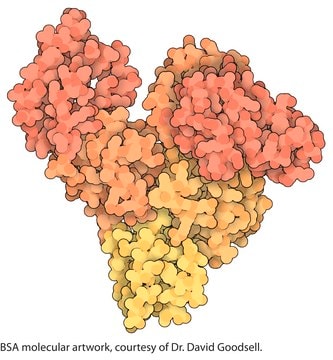
Albumin makes up 60% of the plasma protein,[8] which is produced by the liver.[9] It regulates colloid osmotic pressure. Albumin is implicated in the transportation, distribution and metabolism of fatty acids, thyroid hormones and drugs.[9] It reduces weight gain, blocks pulmonary edema, decreases ascites and lowers tissue edema.[10]
Preparation Note
Prepared from crystallized and lyophilized albumin (A 4378).
signalword
Danger
hcodes
Hazard Classifications
Resp. Sens. 1 - Skin Sens. 1
Storage Class
11 - Combustible Solids
wgk
WGK 3
flash_point_f
Not applicable
flash_point_c
Not applicable
Choose from one of the most recent versions:
Already Own This Product?
Find documentation for the products that you have recently purchased in the Document Library.
Ischemia-induced Drp1 and Fis1-mediated mitochondrial fission and right ventricular dysfunction in pulmonary hypertension
Tian L, et al
Journal of Molecular Medicine, 95(4), 381-393 (2017)
Antonio Brante et al.
The Journal of experimental biology, 212(Pt 14), 2287-2295 (2009-06-30)
Encapsulation is a common strategy among marine invertebrate species. It has been shown that oxygen and food availability independently constrain embryo development during intracapsular development. However, it is unclear how embryos of species with different feeding strategies perceive these two
Molecular mechanisms of proteinuria
Molecular and Genetic Basis of Renal Disease (2008)
Layer-by-layer approach for a uniformed fabrication of a cell patterned vessel-like construct
Wilkens CA, et al.
Biofabrication, 9(1), 015001-015001 (2016)
What is the best way to fluid-resuscitate a patient with sepsis?
Evidence-Based Practice of Critical Care, 198-205 (2010)
Related Content
Product Information Sheet
-
Is this albumin "Fatty Acid Free"?
1 answer-
Helpful?
-
-
Is the conjugate chromophore based 5-fluorescein, 6-fluorescein, or is based on an isomeric (5/6-) mixture?
1 answer-
The chromaphore used to prepare this product is Fluorescein 5-isothiocyanate.
Helpful?
-
-
Is there any free FITC present in Product A9771, Albumin-fluorescein isothiocyanate conjugate?
1 answer-
We would not expect there to be free FITC. The final product is dialyzed against distilled water using dialysis tubing with a molecular weight cutoff of 12,000 prior to it being lyophilized.
Helpful?
-
-
What are the excitation and emission maxima for Product A9771, Albumin-fluorescein isothiocyanate conjugate (FITC-albumin)?
1 answer-
The excitation maximum is 495 nm and the emission maximum is 520 nm.
Helpful?
-
-
How is the FITC bound to the albumin in Product A9771, Albumin-fluorescein isothiocyanate conjugate (FITC-albumin)?
1 answer-
The FITC is bound through the epsilon amino group of the lysine amino acid residues. Each lot number will have a varying number of FITC molecules bound.
Helpful?
-
-
What is the Department of Transportation shipping information for this product?
1 answer-
Transportation information can be found in Section 14 of the product's (M)SDS.To access the shipping information for this material, use the link on the product detail page for the product.
Helpful?
-
Active Filters
Our team of scientists has experience in all areas of research including Life Science, Material Science, Chemical Synthesis, Chromatography, Analytical and many others.
Contact Technical Service