


If this product has an expiration or retest date, it will be shown on the Certificate of Analysis (COA, CofA). If there is no retest or expiration date listed on the product's COA, we do not have suitable stability data to determine a shelf life. For these products, the only date on the COA will be the release date; a retest, expiration, or use-by-date will not be displayed.
For all products, we recommend handling per defined conditions as printed in our product literature and website product descriptions. We recommend that products should be routinely inspected by customers to ensure they perform as expected.
For products without retest or expiration dates, our standard warranty of 1 year from the date of shipment is applicable.
For more information, please refer to the Product Dating Information document: https://www.sigmaaldrich.com/deepweb/assets/sigmaaldrich/marketing/global/documents/418/501/product-dating-information-06-25-mk.pdf
L3771

Dodecilsulfato de sódio

BioReagent, suitable for electrophoresis, Molecular Biology, ≥98.5% (GC)
Sinônimo(s):
Dodecil sulfato de sódio, Dodecilsulfato, Lauril sulfato, Lauril sulfato de sódio, SDS
Selecione um tamanho
R$ 414,00
R$ 837,00
R$ 1.764,00
R$ 3.321,00
R$ 22.321,00
Sobre este item
Pular para
Nome do produto
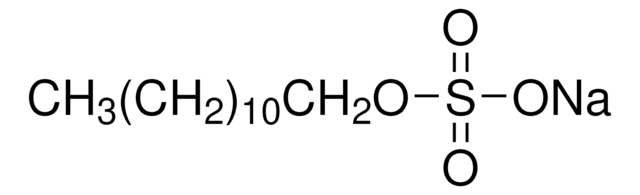
Dodecilsulfato de sódio, BioReagent, suitable for electrophoresis, Molecular Biology, ≥98.5% (GC)
InChI key
DBMJMQXJHONAFJ-UHFFFAOYSA-M
InChI
1S/C12H26O4S.Na/c1-2-3-4-5-6-7-8-9-10-11-12-16-17(13,14)15;/h2-12H2,1H3,(H,13,14,15);/q;+1/p-1
SMILES string
[Na+].CCCCCCCCCCCCOS([O-])(=O)=O
biological source
synthetic
grade
Molecular Biology
description
anionic
product line
BioReagent
assay
≥98.5% (GC)
form
powder
mol wt
micellar 18,000
Quality Level
greener alternative product characteristics
Catalysis
Learn more about the Principles of Green Chemistry.
sustainability
Greener Alternative Product
aggregation number
62
technique(s)
electrophoresis: suitable
impurities
≤2.0% water (Karl Fischer)
CMC
7-10 mM (20-25°C)
mp
204-207 °C (lit.)
transition temp
cloud point >100 °C
solubility
water: soluble
density
1.03 g/cm3 at 20 °C (68 °F)
anion traces
chloride (Cl-): ≤500 ppm
phosphate (PO43-): ≤10 ppm
cation traces
heavy metals (as Pb): ≤10 ppm
absorption
≤0.1 at 260 at 3%
≤0.1 at 280 at 3%
HLB
40
suitability
suitable for electrophoresis
foreign activity
DNase, RNase, none detected
greener alternative category
storage temp.
room temp
Procurando produtos similares? Visita Guia de comparação de produtos
1 of 4
Este Item | 436143 | L4509 | L6026 |
|---|---|---|---|
| suitability suitable for electrophoresis | suitability - | suitability - | suitability - |
| form powder | form solid | form powder | form powder |
| technique(s) electrophoresis: suitable | technique(s) - | technique(s) - | technique(s) - |
| assay ≥98.5% (GC) | assay ≥99.0% | assay ≥98.5% (GC) | assay ≥99.0% (GC) |
| grade for molecular biology | grade ACS reagent | grade - | grade - |
| aggregation number 62 | aggregation number - | aggregation number 62 | aggregation number 62 |
Analysis Note
Application
- na imunoprecipitação de cromatina
- em eletroforese com gel de poliacrilamida-SDS (SDS-PAGE)
- como um componente de tampão de ensaio de radioimunoprecipitação para imunoblotting
Features and Benefits
- Surfactante altamente versátil para suas pesquisas em biologia molecular e bioquímica
- Adequado para aplicações de eletroforese
- Testado para confirmar baixos níveis de contaminação por metais pesados,garantindo a adequabilidade para várias aplicações.
General description
Além da análise de proteínas, o SDS também encontra aplicações na separação eletroforética de lipídios, permitindo o estudo e a caracterização desses importantes componentes celulares. Além disso, o SDS é empregado em várias técnicas de hibridização e biologia molecular, demonstrando sua versatilidade em uma variedade de áreas de pesquisa. A eficácia do SDS em condições iônicas e aniônicas expande ainda mais sua utilidade, permitindo que ele se adapte a diversas configurações e requisitos experimentais. Sua capacidade de desvendar proteínas ligando-se a cadeias de peptídeos e conferindo uma carga negativa elimina efetivamente o formato da proteína como um fator para a separação em gel, garantindo a determinação precisa do tamanho da proteína.
Other Notes
Comparable product
signalword
Danger
Hazard Classifications
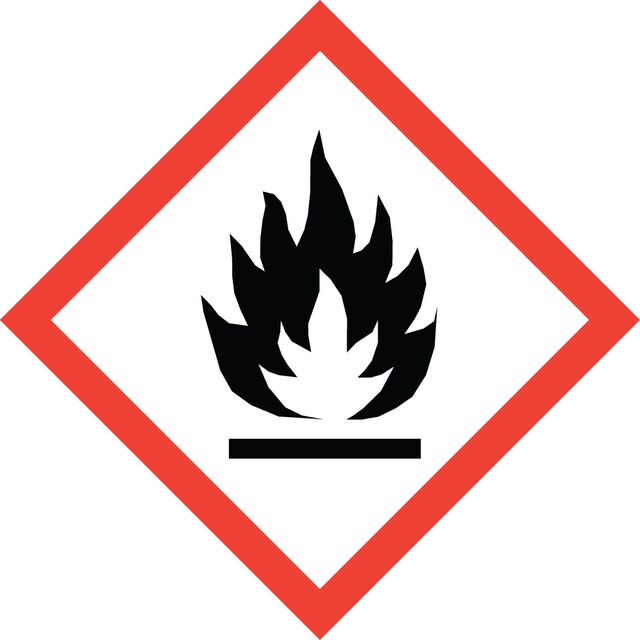
Acute Tox. 4 Inhalation - Acute Tox. 4 Oral - Aquatic Chronic 3 - Eye Dam. 1 - Flam. Sol. 2 - Skin Irrit. 2 - STOT SE 3
target_organs
Respiratory system
Classe de armazenamento
4.1B - Flammable solid hazardous materials
wgk
WGK 2
flash_point_f
338.0 °F
flash_point_c
170 °C
ppe
Eyeshields, Faceshields, Gloves, type P3 (EN 143) respirator cartridges
Escolha uma das versões mais recentes:
Já possui este produto?
Encontre a documentação dos produtos que você adquiriu recentemente na biblioteca de documentos.
Protocolos
Visão geral da química de géis de poliacrilamida e instruções detalhadas para moldagem manual de géis de poliacrilamida com o uso dos kits de moldagem de géis bis-tris mPAGE® TurboMix.
Simplify your SDS-PAGE gel preparation with our pre-mixed solutions and protocols to achieve precise protein separation.
This page shows and discusses three protocols for stripping and reprobing a western blot membrane.
Preparation of Plasmid DNA by Alkaline Lysis with SDS: Maxipreparation between Cold Spring Harbor Laboratory Press and our research team.
Conteúdo relacionado
Cell lysis and protein extraction methods overview various techniques, from detergent solubilization to mechanical disruption, supporting research needs.
Os métodos de lise celular e de extração de proteínas apresentam uma visão geral de várias técnicas, desde a solubilização com detergente até o rompimento mecânico, dando suporte às necessidades de pesquisa.
-
How can I determine the shelf life / expiration / retest date of this product?
1 answer-
Helpful?
-
-
How is shipping temperature determined? And how is it related to the product storage temperature?
1 answer-
Products may be shipped at a different temperature than the recommended long-term storage temperature. If the product quality is sensitive to short-term exposure to conditions other than the recommended long-term storage, it will be shipped on wet or dry-ice. If the product quality is NOT affected by short-term exposure to conditions other than the recommended long-term storage, it will be shipped at ambient temperature. As shipping routes are configured for minimum transit times, shipping at ambient temperature helps control shipping costs for our customers. For more information, please refer to the Storage and Transport Conditions document: https://www.sigmaaldrich.com/deepweb/assets/sigmaaldrich/marketing/global/documents/316/622/storage-transport-conditions-mk.pdf
Helpful?
-
-
Is it okay to use 10% SDS dissolved in water that has been autoclaved?
1 answer-
Sodium dodecyl sulfate may decompose with prolonged heating at 40°C or greater. Autoclaving this material is not recommended. Please see the link below to review additional information available in the product datasheet:
https://www.sigmaaldrich.com/deepweb/assets/sigmaaldrich/product/documents/296/475/l3771pis.pdfHelpful?
-
-
What is the storage temperature for the product?
1 answer-
This product is stored at ambient temperature.
Helpful?
-
Active Filters
Nossa equipe de cientistas tem experiência em todas as áreas de pesquisa, incluindo Life Sciences, ciência de materiais, síntese química, cromatografia, química analítica e muitas outras.
Entre em contato com a assistência técnica