

If this product has an expiration or retest date, it will be shown on the Certificate of Analysis (COA, CofA). If there is no retest or expiration date listed on the product's COA, we do not have suitable stability data to determine a shelf life. For these products, the only date on the COA will be the release date; a retest, expiration, or use-by-date will not be displayed.
For all products, we recommend handling per defined conditions as printed in our product literature and website product descriptions. We recommend that products should be routinely inspected by customers to ensure they perform as expected.
For products without retest or expiration dates, our standard warranty of 1 year from the date of shipment is applicable.
For more information, please refer to the Product Dating Information document: https://www.sigmaaldrich.com/deepweb/assets/sigmaaldrich/marketing/global/documents/418/501/product-dating-information-06-25-mk.pdf
75746

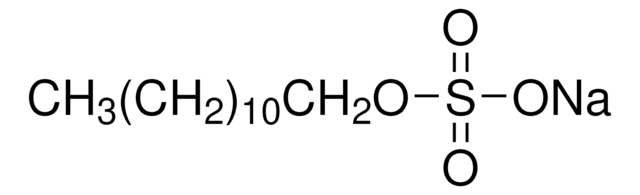
Natriumdodecylsulfat

≥99.0% (GC), dust-free pellets
Synonym(e):
Dodecylsulfat Natriumsalz, Laurylsulfat Natriumsalz, Natriumlaurylsulfat, SDS
Größe auswählen
CHF 74.40
CHF 285.00
Über diesen Artikel
Fortfahren mit
Produktname
Natriumdodecylsulfat, ≥99.0% (GC), dust-free pellets
InChI
1S/C12H26O4S.Na/c1-2-3-4-5-6-7-8-9-10-11-12-16-17(13,14)15;/h2-12H2,1H3,(H,13,14,15);/q;+1/p-1
InChI key
DBMJMQXJHONAFJ-UHFFFAOYSA-M
SMILES string
[Na+].CCCCCCCCCCCCOS([O-])(=O)=O
description
anionic
assay
≥99.0% (GC)
form
rod
mol wt
average mol wt 18,000
Quality Level
greener alternative product characteristics
Catalysis
Learn more about the Principles of Green Chemistry.
sustainability
Greener Alternative Product
aggregation number
62
loss
≤5% loss on drying
CMC
7-10 (lit.)
mp
204 - 207 °C (399 - 405 °F)
204-207 °C (lit.)
transition temp
cloud point >100 °C(lit.)
solubility
H2O: soluble 0.29 gm in 10ml, clear, colorless
H2O: 0.1 M at 20 °C, clear, colorless
130 g/L at 20 °C (68 °F)
density
1 g/cm3
anion traces
chloride (Cl-): ≤200 mg/kg
cation traces
Ca: ≤25 mg/kg
Cd: ≤5 mg/kg
Co: ≤5 mg/kg
Cr: ≤5 mg/kg
Cu: ≤5 mg/kg
Fe: ≤10 mg/kg
K: ≤200 mg/kg
Mg: ≤20 mg/kg
Mn: ≤5 mg/kg
Ni: ≤5 mg/kg
Pb: ≤5 mg/kg
Zn: ≤5 mg/kg
HLB
40(lit.)
greener alternative category
Suchen Sie nach ähnlichen Produkten? Aufrufen Leitfaden zum Produktvergleich
Verwandte Kategorien
1 of 4
Dieser Artikel | L6026 | 436143 | L4509 |
|---|---|---|---|
| form rod | form powder | form solid | form powder |
| assay ≥99.0% (GC) | assay ≥99.0% (GC) | assay ≥99.0% | assay ≥98.5% (GC) |
| aggregation number 62 | aggregation number 62 | aggregation number - | aggregation number 62 |
| Quality Level 200 | Quality Level 200 | Quality Level 200 | Quality Level 200 |
| description anionic | description anionic | description anionic, 62 | description anionic |
| mol wt average mol wt 18,000 | mol wt micellar avg mol wt 18,000 | mol wt 288.38 g/mol | mol wt micellar avg mol wt 18,000 |
Application
- als negativ geladenes Tensid zum Untersuchen seiner Wirkung auf den Filtrationsfluss und das Membranfouling während der Mikrofiltration der tensidstabilisierten Ölemulsion
- als Komponente von Pflanzenextraktionspuffer und Transferpuffer für Western Blot
- als Komponente von 5X-Laemmli-Probenpuffer (5X LB) und 10X-SDS-Laufpuffer für SDS-PAGE (sodium dodecyl-sulfate polyacrylamide gel electrophoresis) und Immunblot
Biochem/physiol Actions
Features and Benefits
- In Tests bestätigte niedrige Schwermetallkontamination, somit geeignet für verschiedene Anwendungen
- Getestet auf Spuren von Anionen und Kationen
- Hochreines Produkt, ideal für biochemische Forschungszwecke
General description
Other Notes
Comparable product
signalword
Danger
hcodes
Hazard Classifications
Acute Tox. 4 Oral - Aquatic Chronic 3 - Eye Dam. 1 - Skin Irrit. 2
Lagerklasse
11 - Combustible Solids
wgk
WGK 2
flash_point_f
338.0 °F
flash_point_c
170 °C
ppe
Eyeshields, Faceshields, Gloves, type P3 (EN 143) respirator cartridges
Hier finden Sie alle aktuellen Versionen:
Besitzen Sie dieses Produkt bereits?
In der Dokumentenbibliothek finden Sie die Dokumentation zu den Produkten, die Sie kürzlich erworben haben.
-
How can I determine the shelf life / expiration / retest date of this product?
1 answer-
Helpful?
-
-
How is shipping temperature determined? And how is it related to the product storage temperature?
1 answer-
Products may be shipped at a different temperature than the recommended long-term storage temperature. If the product quality is sensitive to short-term exposure to conditions other than the recommended long-term storage, it will be shipped on wet or dry-ice. If the product quality is NOT affected by short-term exposure to conditions other than the recommended long-term storage, it will be shipped at ambient temperature. As shipping routes are configured for minimum transit times, shipping at ambient temperature helps control shipping costs for our customers. For more information, please refer to the Storage and Transport Conditions document: https://www.sigmaaldrich.com/deepweb/assets/sigmaaldrich/marketing/global/documents/316/622/storage-transport-conditions-mk.pdf
Helpful?
-
Active Filters
Unser Team von Wissenschaftlern verfügt über Erfahrung in allen Forschungsbereichen einschließlich Life Science, Materialwissenschaften, chemischer Synthese, Chromatographie, Analytik und vielen mehr..
Setzen Sie sich mit dem technischen Dienst in Verbindung