


If this product has an expiration or retest date, it will be shown on the Certificate of Analysis (COA, CofA). If there is no retest or expiration date listed on the product's COA, we do not have suitable stability data to determine a shelf life. For these products, the only date on the COA will be the release date; a retest, expiration, or use-by-date will not be displayed.
For all products, we recommend handling per defined conditions as printed in our product literature and website product descriptions. We recommend that products should be routinely inspected by customers to ensure they perform as expected.
For products without retest or expiration dates, our standard warranty of 1 year from the date of shipment is applicable.
For more information, please refer to the Product Dating Information document: https://www.sigmaaldrich.com/deepweb/assets/sigmaaldrich/marketing/global/documents/418/501/product-dating-information-06-25-mk.pdf
L3771

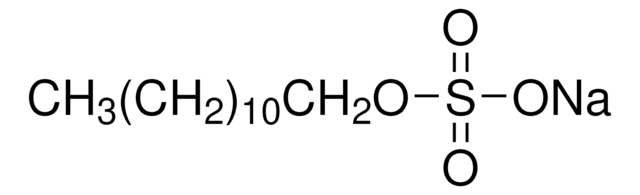
Natriumdodecylsulfat

BioReagent, suitable for electrophoresis, Molecular Biology, ≥98.5% (GC)
Synonym(e):
Dodecylsulfat Natriumsalz, Laurylsulfat Natriumsalz, Natriumlaurylsulfat, SDS
Größe auswählen
CHF 90.00
CHF 215.00
CHF 665.00
CHF 1’030.00
CHF 3’480.00
Über diesen Artikel
Fortfahren mit
Biologische Quelle
synthetic
Qualitätsniveau
Qualität
Molecular Biology
Beschreibung
anionic
Produktlinie
BioReagent
Assay
≥98.5% (GC)
Form
powder
Mol-Gew.
micellar 18,000
Grünere Alternativprodukt-Eigenschaften
Catalysis
Learn more about the Principles of Green Chemistry.
sustainability
Greener Alternative Product
Aggregatnummer
62
Methode(n)
electrophoresis: suitable
Verunreinigungen
≤2.0% water (Karl Fischer)
CMC
7-10 mM (20-25°C)
mp (Schmelzpunkt)
204-207 °C (lit.)
Übergangstemp.
cloud point >100 °C
Löslichkeit
water: soluble
Dichte
1.03 g/cm3 at 20 °C (68 °F)
Anionenspuren
chloride (Cl-): ≤500 ppm
phosphate (PO43-): ≤10 ppm
Kationenspuren
heavy metals (as Pb): ≤10 ppm
Absorption
≤0.1 at 260 at 3%
≤0.1 at 280 at 3%
HLB
40
Eignung
suitable for electrophoresis
Fremdaktivität
DNase, RNase, none detected
Grünere Alternativprodukt-Kategorie
Lagertemp.
room temp
SMILES String
[Na+].CCCCCCCCCCCCOS([O-])(=O)=O
InChI
1S/C12H26O4S.Na/c1-2-3-4-5-6-7-8-9-10-11-12-16-17(13,14)15;/h2-12H2,1H3,(H,13,14,15);/q;+1/p-1
InChIKey
DBMJMQXJHONAFJ-UHFFFAOYSA-M
Suchen Sie nach ähnlichen Produkten? Aufrufen Leitfaden zum Produktvergleich
Verwandte Kategorien
1 of 4
Dieser Artikel | 436143 | L4509 | L6026 |
|---|---|---|---|
| suitability suitable for electrophoresis | suitability - | suitability - | suitability - |
| form powder | form solid | form powder | form powder |
| technique(s) electrophoresis: suitable | technique(s) - | technique(s) - | technique(s) - |
| assay ≥98.5% (GC) | assay ≥99.0% | assay ≥98.5% (GC) | assay ≥99.0% (GC) |
| grade for molecular biology | grade ACS reagent | grade - | grade - |
| aggregation number 62 | aggregation number - | aggregation number 62 | aggregation number 62 |
Allgemeine Beschreibung
Neben der Proteinanalyse findet SDS auch Anwendungen bei der elektrophoretischen Auftrennung von Lipiden, was die Untersuchung und Charakterisierung dieser wichtigen zellulären Komponenten ermöglicht. Darüber hinaus wird SDS in verschiedenen Hybridisierungs- und Molekularbiologieverfahren eingesetzt, was seine Vielseitigkeit in einer Reihe von Forschungsbereichen demonstriert. Die Wirksamkeit von SDS bei ionischen und anionischen Bedingungen erweitert die Nutzbarkeit von SDS weiter, sodass es sich an verschiedene Experimente und Anforderungen anpassen kann. Seine Fähigkeit, Proteine durch Bindung an Peptidketten aufzulösen und eine negative Ladung zu verleihen, beseitigt effektiv die Proteinform als Faktor für die Geltrennung und stellt so eine genaue Bestimmung der Proteingröße sicher.
Anwendung
- Bei der Chromatin-Immunpräzipitation
- Bei der SDS-Polyacrylamid-Gelelektrophorese (SDS-PAGE)
- Als Komponente von Radioimmunpräzipitationspuffer für Immunblots
Leistungsmerkmale und Vorteile
- Vielseitig verwendbares Tensid für Ihre Molekularbiologie und biochemische Forschung
- Geeignet für Elektrophoreseanwendungen
- In Tests bestätigte niedrige Schwermetallkontaminationzur Sicherstellung der Eignung für verschiedene Anwendungen.
Hinweis zur Analyse
Sonstige Hinweise
Vergleichbares Produkt
Signalwort
Danger
Gefahreneinstufungen
Acute Tox. 4 Inhalation - Acute Tox. 4 Oral - Aquatic Chronic 3 - Eye Dam. 1 - Flam. Sol. 2 - Skin Irrit. 2 - STOT SE 3
Zielorgane
Respiratory system
Lagerklassenschlüssel
4.1B - Flammable solid hazardous materials
WGK
WGK 2
Flammpunkt (°F)
338.0 °F
Flammpunkt (°C)
170 °C
Persönliche Schutzausrüstung
Eyeshields, Faceshields, Gloves, type P3 (EN 143) respirator cartridges
Hier finden Sie alle aktuellen Versionen:
Besitzen Sie dieses Produkt bereits?
In der Dokumentenbibliothek finden Sie die Dokumentation zu den Produkten, die Sie kürzlich erworben haben.
Protokolle
Preparation of Plasmid DNA by Alkaline Lysis with SDS: Maxipreparation between Cold Spring Harbor Laboratory Press and our research team.
Simplify your SDS-PAGE gel preparation with our pre-mixed solutions and protocols to achieve precise protein separation.
This page shows and discusses three protocols for stripping and reprobing a western blot membrane.
Panoramica sulla chimica dei gel di poliacrilammide e istruzioni dettagliate per la colatura manuale con i kit PAGE® TurboMix per la colatura di gel Bis-Tris
Verwandter Inhalt
Cell lysis and protein extraction methods overview various techniques, from detergent solubilization to mechanical disruption, supporting research needs.
Cell lysis and protein extraction methods overview various techniques, from detergent solubilization to mechanical disruption, supporting research needs.
Cell lysis and protein extraction methods overview various techniques, from detergent solubilization to mechanical disruption, supporting research needs.
Product Information Sheet
-
How can I determine the shelf life / expiration / retest date of this product?
1 answer-
Helpful?
-
-
How is shipping temperature determined? And how is it related to the product storage temperature?
1 answer-
Products may be shipped at a different temperature than the recommended long-term storage temperature. If the product quality is sensitive to short-term exposure to conditions other than the recommended long-term storage, it will be shipped on wet or dry-ice. If the product quality is NOT affected by short-term exposure to conditions other than the recommended long-term storage, it will be shipped at ambient temperature. As shipping routes are configured for minimum transit times, shipping at ambient temperature helps control shipping costs for our customers. For more information, please refer to the Storage and Transport Conditions document: https://www.sigmaaldrich.com/deepweb/assets/sigmaaldrich/marketing/global/documents/316/622/storage-transport-conditions-mk.pdf
Helpful?
-
-
Is it okay to use 10% SDS dissolved in water that has been autoclaved?
1 answer-
Sodium dodecyl sulfate may decompose with prolonged heating at 40°C or greater. Autoclaving this material is not recommended. Please see the link below to review additional information available in the product datasheet:
https://www.sigmaaldrich.com/deepweb/assets/sigmaaldrich/product/documents/296/475/l3771pis.pdfHelpful?
-
-
What is the storage temperature for the product?
1 answer-
This product is stored at ambient temperature.
Helpful?
-
Active Filters
Unser Team von Wissenschaftlern verfügt über Erfahrung in allen Forschungsbereichen einschließlich Life Science, Materialwissenschaften, chemischer Synthese, Chromatographie, Analytik und vielen mehr..
Setzen Sie sich mit dem technischen Dienst in Verbindung