Direkt zum Inhalt
Merck

O0877

Oxolinsäure

quinolone antibiotic

Synonym(e):

5,8-Dihydro-5-ethyl-8-oxo-1,3-dioxolo[4,5-g]chinolin-7-carbonsäure

Anmelden zur Ansicht der Organisations- und Vertragspreise.

Größe auswählen

5 G

€ 103,00

25 G

€ 417,00

€ 103,00


Warenkorb auf Verfügbarkeit prüfen

Großbestellung anfragen

Über diesen Artikel

Empirische Formel (Hill-System):
C13H11NO5
CAS-Nummer:
Molekulargewicht:
261.23
UNSPSC Code:
51282935
NACRES:
NA.85
PubChem Substance ID:
EC Number:
238-750-8
Beilstein/REAXYS Number:
620635
MDL number:

Fortfahren mit

Technischer Dienst
Benötigen Sie Hilfe? Unser Team von erfahrenen Wissenschaftlern ist für Sie da.
Unterstützung erhalten

InChI key

KYGZCKSPAKDVKC-UHFFFAOYSA-N

InChI

1S/C13H11NO5/c1-2-14-5-8(13(16)17)12(15)7-3-10-11(4-9(7)14)19-6-18-10/h3-5H,2,6H2,1H3,(H,16,17)

SMILES string

CCN1C=C(C(O)=O)C(=O)c2cc3OCOc3cc12

Quality Level

antibiotic activity spectrum

Gram-negative bacteria

mode of action

DNA synthesis | interferes, enzyme | inhibits

storage temp.

2-8°C

Suchen Sie nach ähnlichen Produkten? Aufrufen Leitfaden zum Produktvergleich

Verwandte Kategorien

Ähnliche Artikel vergleichen

Vollständigen Vergleich anzeigen

Unterschiede anzeigen

1 of 4

Dieser Artikel
67126O0240000C8645
Oxolinic acid European Pharmacopoeia (EP) Reference Standard

O0240000

Oxolinic acid

antibiotic activity spectrum

Gram-negative bacteria

antibiotic activity spectrum

-

antibiotic activity spectrum

-

antibiotic activity spectrum

Gram-negative bacteria

mode of action

DNA synthesis | interferes, enzyme | inhibits

mode of action

-

mode of action

-

mode of action

DNA synthesis | interferes, enzyme | inhibits

Quality Level

200

Quality Level

100

Quality Level

-

Quality Level

200

solubility

0.5 M NaOH: soluble 50 mg/mL

solubility

-

solubility

-

solubility

-

storage temp.

2-8°C

storage temp.

2-8°C

storage temp.

2-8°C

storage temp.

-

General description

Chemical structure: quinolone

Application

Oxolinic acid is used to study new transmissible resistance mechanisms qnrA, qnrB, qnrS, and aac(6′)Ib-cr, in Escherichia coli and Salmonella enterica. Oxolinic acid is added to culture medium for the isolation of Gardnerella vaginalis[1].

Biochem/physiol Actions

Oxolinic acid is a quinolone antibiotic. It is a DNA-gyrase (topoisomerase II) inhibitor used for studies on DNA winding and coiling and acts as a dopamine reuptake inhibitor for studies on dopaminergic neurotransmission processes.

Other Notes

5g,25g
Keep container tightly closed in a dry and well-ventilated place.

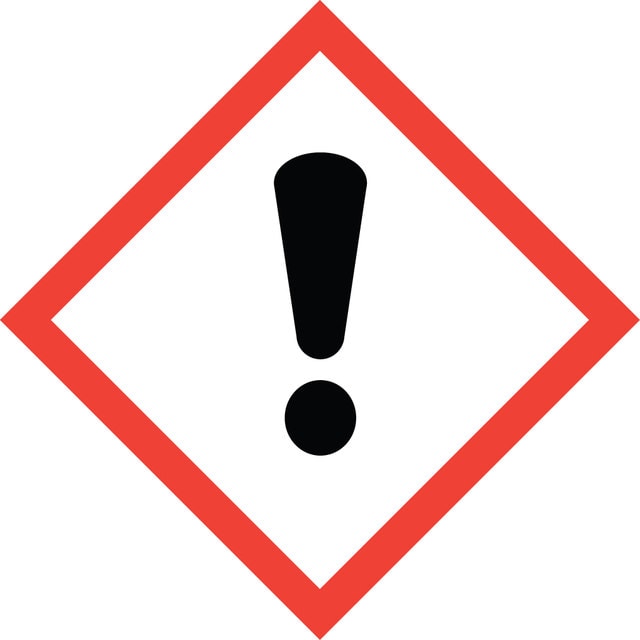
pictograms

Exclamation mark

signalword

Warning

hcodes

Hazard Classifications

Acute Tox. 4 Oral

Lagerklasse

11 - Combustible Solids

flash_point_f

Not applicable

flash_point_c

Not applicable

ppe

dust mask type N95 (US), Eyeshields, Gloves


Hier finden Sie alle aktuellen Versionen:

Analysenzertifikate (COA)

Lot/Batch Number

Die passende Version wird nicht angezeigt?

Wenn Sie eine bestimmte Version benötigen, können Sie anhand der Lot- oder Chargennummer nach einem spezifischen Zertifikat suchen.

Besitzen Sie dieses Produkt bereits?

In der Dokumentenbibliothek finden Sie die Dokumentation zu den Produkten, die Sie kürzlich erworben haben.

Die Dokumentenbibliothek aufrufen

J Garcia de Mateos-Verchere et al.
European neuropsychopharmacology : the journal of the European College of Neuropsychopharmacology, 8(4), 255-259 (1999-02-03)
The antimicrobial agent oxolinic acid, injected i.p. in mice, induced a dose dependent increase in locomotor activity. This stimulation culminated at the 32 mg/kg dose and became smaller for higher doses (64-128 mg/kg). When opposed to increasing doses (50-100-200 microg/kg
J S Thompson
Journal of clinical microbiology, 21(5), 843-843 (1985-05-01)
Colistin-oxolinic acid medium is proposed as a selective isolation medium for Gardnerella vaginalis. The medium is effective in inhibiting staphylococci and gram-negative bacteria while allowing growth of G. vaginalis.
Xiuhong Wang et al.
The Journal of antimicrobial chemotherapy, 65(3), 520-524 (2010-01-14)
Quinolone-mediated death of Escherichia coli has been proposed to occur by two pathways. One is blocked by inhibitors of protein synthesis; the other is not. It is currently unknown how these two pathways fit with the recent observation that hydroxyl
Hyeok Ran Kwon et al.
Pest management science, 66(6), 634-639 (2010-02-13)
Pine wilt disease (PWD) is very complex and has been reported to be caused by pine wood nematode, Bursaphelenchus xylophilus (Steiner & Buhrer) Nickle, and its accompanying bacteria. However, there is no report on the control of PWD by antibacterial
Antonio V Herrera-Herrera et al.
Journal of chromatography. A, 1218(42), 7608-7614 (2011-06-21)
The present work describes a method based on solid-phase extraction (SPE) and ultra-performance liquid chromatography tandem mass spectrometry (UPLC-MS/MS) for the simultaneous determination of three quinolones (pipemidic acid, oxolinic acid and flumequine) and twelve fluoroquinolones (marbofloxacin, fleroxacin, pefloxacin, levofloxacin, norfloxacin

Verwandter Inhalt

Product Information Sheet

Questions

Reviews

No rating value

Active Filters

Unser Team von Wissenschaftlern verfügt über Erfahrung in allen Forschungsbereichen einschließlich Life Science, Materialwissenschaften, chemischer Synthese, Chromatographie, Analytik und vielen mehr..

Setzen Sie sich mit dem technischen Dienst in Verbindung