Skip to Content
MilliporeSigma

Skip To

STA20

Starch (GO/P) Assay Kit

sufficient for 20 assays

Synonym(s):

Starch Measurement Kit

Sign In to View Organizational & Contract Pricing.

Select a Size

Change View
Pack SizeSKUAvailabilityPrice
1 kit
Check Cart for Availability
$395.00

About This Item

NACRES:
NA.84
UNSPSC Code:
12164500

$395.00


Check Cart for Availability

Request a Bulk Order
Technical Service
Need help? Our team of experienced scientists is here for you.
Let Us Assist

usage

sufficient for 20 assays

Quality Level

application(s)

food and beverages
general analytical

storage temp.

2-8°C

Compare Similar Items

View Full Comparison

Show Differences

1 of 1

This Item
CS0260CAT100MAK368
Quality Level

100

Quality Level

200

Quality Level

200

Quality Level

-

usage

sufficient for 20 assays

usage

sufficient for 700 assays

usage

sufficient for ≥100 tests enzymatic

usage

sufficient for 100 colorimetric or fluorometric tests

storage temp.

2-8°C

storage temp.

2-8°C

storage temp.

2-8°C

storage temp.

−20°C

application(s)

food and beverages
general analytical

application(s)

-

application(s)

-

application(s)

-

microbialanalysis
microbialanalysis

-

-

-

General description

Starch (GO/P) Assay Kit was used to determine the starch content, during an experimental study done in order to investigate the composition and structure of sorghum spent grains (SSG), which is a brewery co-product and is reported to have potential applications thereby adding value to the product. It was also used in starch extraction and quantification, during investigating the importance of OsGA2ox5 in GAs homeostasis, development, gravity responses and stress tolerance in rice. Furthermore, it also found application in being used in analysing factors affecting polyhydroxybutyrate accumulation , which are basically linear biodegradable polyesters produced by bacteria as a carbon store, in mesophyll cells of sugarcane and switchgrass.

Application

Suitable for the quantitative, enzymatic determination of starch infood and other materials.
This kit is for the quantitative, enzymatic determination of starch in food and other materials. The hydrolysis of starch to glucose is catalyzed by α-amylase and amyloglucosidase. Glucose is oxidized to gluconic acid and hydrogen peroxide by glucose oxidase. Hydrogen peroxide reacts with o-dianisidine in the presence of peroxidase to form a colored product. Oxidized o-dianisidine reacts with sulfuric acid to form a more stable colored product. The intensity of the pink color measured at 540 nm is proportional to the original glucose concentration.
Starch (GO/P) Assay Kit was used to determine the starch content, during an experimental study done in order to investigate the composition and structure of sorghum spent grains (SSG), which is a brewery co-product and is reported to have potential applications thereby adding value to the product. It was also used in starch extraction and quantification, during investigating the importance of OsGA2ox5 in GAs homeostasis, development, gravity responses and stress tolerance in rice. Furthermore, it also found application in being used in analysing factors affecting polyhydroxybutyrate accumulation , which are basically linear biodegradable polyesters produced by bacteria as a carbon store, in mesophyll cells of sugarcane and switchgrass.[1]

Biochem/physiol Actions

This kit is for the quantitative, enzymatic determination of starch in food and other materials. The hydrolysis of starch to glucose is catalyzed by α-amylase and amyloglucosidase. Glucose is oxidized to gluconic acid and hydrogen peroxide by glucose oxidase. Hydrogen peroxide reacts with o-dianisidine in the presence of peroxidase to form a colored product. Oxidized o-dianisidine reacts with sulfuric acid to form a more stable colored product. The intensity of the pink color measured at 540 nm is proportional to the original glucose concentration.

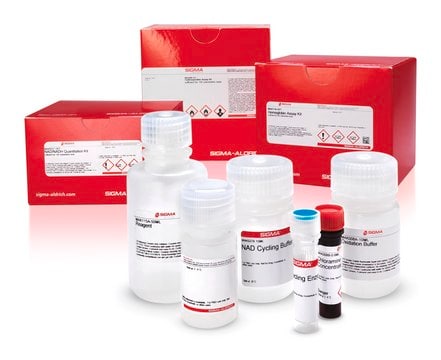
Kit Components Only

Product No.
Description

  • α-Amylase, Heat Stable .5 mL

  • Starch Assay Reagent 1 mL/vial

  • Glucose Oxidase/Peroxidase Reagent 1 capsule

  • o-Dianisidine Reagent 5 mg

  • Glucose Standard Solution .5 mL

  • Wheat Starch 1 g

  • Corn Starch 1 g

signalword

Danger

Hazard Classifications

Acute Tox. 4 Oral - Carc. 1B - Eye Dam. 1 - Resp. Sens. 1 - Skin Corr. 1 - STOT SE 3

target_organs

Respiratory system

Storage Class

6.1C - Combustible acute toxic Cat.3 / toxic compounds or compounds which causing chronic effects

flash_point_f

Not applicable

flash_point_c

Not applicable

wgk

WGK 3


Choose from one of the most recent versions:

Certificates of Analysis (COA)

Lot/Batch Number

Don't see the Right Version?

If you require a particular version, you can look up a specific certificate by the Lot or Batch number.

Already Own This Product?

Find documentation for the products that you have recently purchased in the Document Library.

Visit the Document Library

Wenxuan Dong et al.
Asian-Australasian journal of animal sciences, 33(11), 1787-1796 (2020-02-15)
The objective of this study was to determine the digestible energy (DE) and metabolizable energy (ME) of yellow dent corn sourced from different meteorological origins fed to growing pigs and develop equations to predict the DE and ME of yellow
J Mason Earles et al.
The New phytologist, 219(1), 89-97 (2018-04-18)
Rising temperatures and extended periods of drought compromise tree hydraulic and carbohydrate systems, threatening forest health globally. Despite winter's biological significance to many forests, the effects of warmer and dryer winters on tree hydraulic and carbohydrate status have largely been
Zeyu Zhang et al.
Journal of animal science, 97(2), 768-778 (2018-12-20)
Two experiments were conducted to investigate the effect of inclusion level of corn germ meal (CGM) on the DE and ME values of CGM and to evaluate the ileal AA digestibility of CGM fed to growing pigs. In Exp. 1
M N Smit et al.
Journal of animal science, 95(6), 2496-2508 (2017-07-21)
Feeding cake with remaining oil contributes dietary energy (fat) in addition to protein (AA) and may provide an opportunity to enrich the n-3 fatty acid content of pork. Information regarding safety, growth performance, and efficacy of feeding camelina cake to
OsGA2ox5, a gibberellin metabolism enzyme, is involved in plant growth, the root gravity response and salt stress.
Shan C
PLoS ONE, 9 (1) (2014)

Related Content

Global Trade Item Number

SKUGTIN
STA20-1KT04061835574070
S9144-1VL04061833296769
G3660-1CAP04061835512577
G3285-.5ML04061833629833

Questions

Reviews

No rating value

Active Filters

Our team of scientists has experience in all areas of research including Life Science, Material Science, Chemical Synthesis, Chromatography, Analytical and many others.

Contact Technical Service